When Can You Exercise After a Hair Transplant ?
When can you exercise after a hair transplant? Learn when to resume walking, running, gym workouts, weightlifting, swimming and football safely.
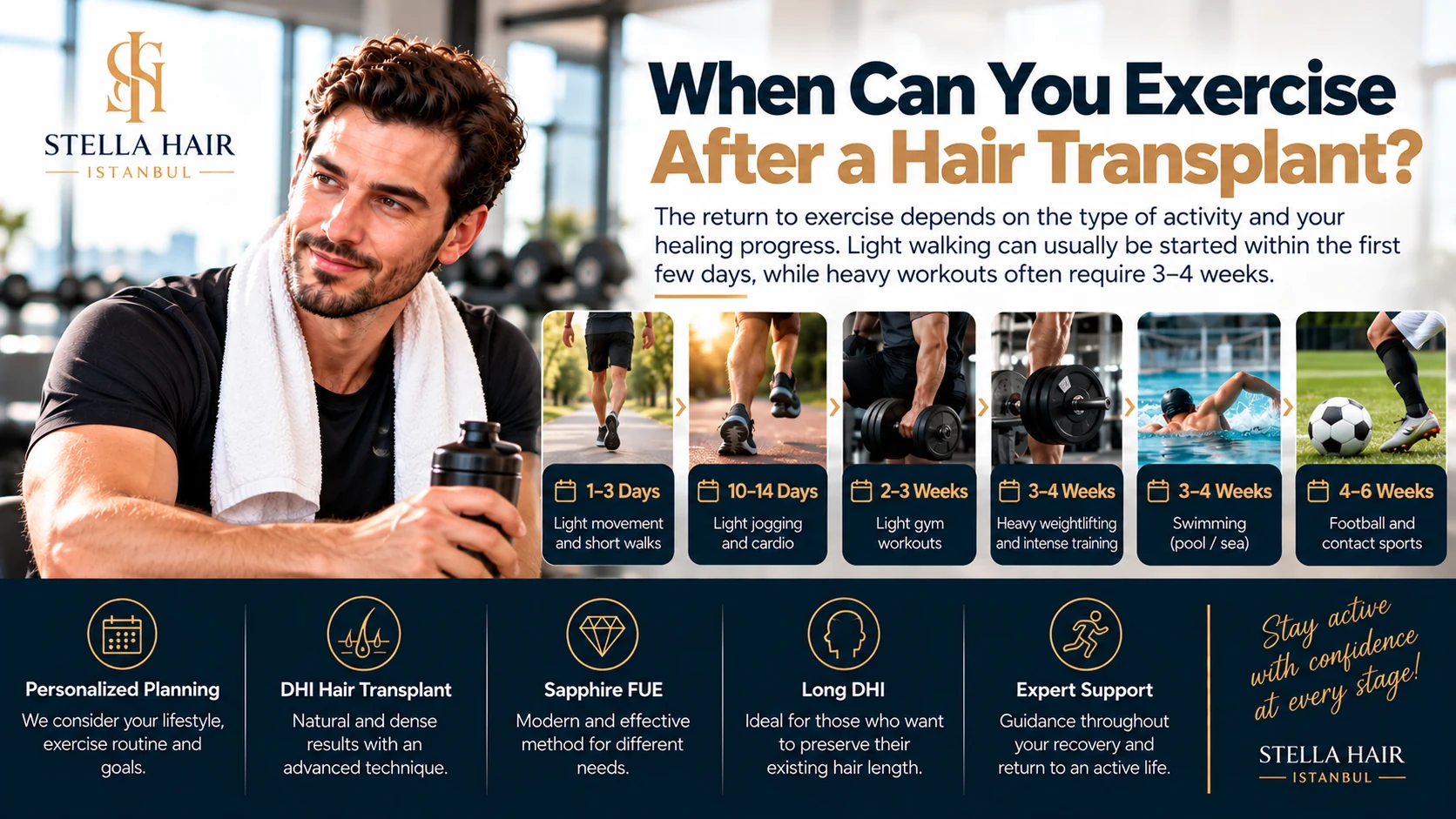
You can usually start taking short, gentle walks within the first few days after a hair transplant. Light running and cardio may be considered after approximately 10–14 days, while heavy weightlifting often requires around 3–4 weeks. Contact sports such as football and boxing generally require a longer break of 4–6 weeks or more. At Istanbul Stella Hair, we understand that staying active is an important part of many patients' lives. That is why we explain how to protect your transplanted follicles during recovery and how to plan your return to exercise without unnecessarily disrupting your routine.
At Istanbul Stella Hair, we offer DHI, Sapphire FUE, and Long DHI hair transplantation, including options for patients who want to preserve their existing hair length. Whether you regularly visit the gym, enjoy running, or participate in competitive sports, your exercise routine is worth discussing before scheduling your procedure. Our Long DHI package also includes postoperative care products and one year of follow-up and consultation support, helping patients understand the recovery process and the precautions involved in returning to their everyday activities.
How Long Should You Avoid Exercise After a Hair Transplant?
A practical approach is to avoid strenuous exercise during the first one to two weeks and then return gradually, depending on the activity and your scalp's healing progress.
Not all exercise places the same demands on your body.
A relaxed walk is different from running five kilometers, lifting heavy weights, or playing a competitive football match.
The risk of physical contact, increased blood pressure, excessive sweating, and accidental injury should all be considered.
The following table provides general planning guidelines.
Exercise or activity
General return-to-exercise timeframe
Gentle movement and short walks
Within the first 1–3 days, if you feel well
Easy outdoor walking
Approximately 3–7 days
Light jogging and low-intensity cardio
Around 10–14 days, with medical clearance
Light gym workouts
Approximately 2–3 weeks
Heavy weightlifting and intense training
Approximately 3–4 weeks
Swimming in a pool or the sea
Usually 3–4 weeks or longer, once the scalp has healed
Sauna, steam rooms, and Turkish baths
Usually at least 4 weeks
Football, basketball, and contact sports
Approximately 4–6 weeks
Boxing, wrestling, and full-contact martial arts
Often at least 6 weeks, with surgeon approval
These are general planning ranges, not universal medical rules. Your surgeon may recommend different restrictions according to your procedure and recovery.
If you are unsure how much time to schedule away from the gym, allowing at least two weeks before resuming structured exercise is a sensible starting point.
Why Should You Avoid Intense Exercise During the First Week?
The first week after hair transplantation is an important part of the healing process.
During the procedure, follicles are collected from a donor area and implanted into small openings in the recipient area.
These areas need time to heal.
Strenuous exercise increases heart rate and blood pressure, which may contribute to bleeding or swelling during early recovery.
There is also a risk of accidentally touching or rubbing the transplanted area.
For example, lifting heavy weights three days after your operation may involve physical strain, sweating, and contact with gym equipment.
You may also instinctively wipe your forehead with a towel, potentially rubbing the newly transplanted region.
By contrast, walking slowly around your home does not involve the same level of physical effort.
During the initial recovery period, the goal is not to maintain your usual training intensity. It is to protect the scalp while it heals.
When Can You Walk After a Hair Transplant?
Gentle walking is usually one of the first activities patients can resume after a hair transplant.
If you feel comfortable, short walks around your home may be possible as early as the following day.
However, if you experience dizziness, discomfort, or unusual fatigue, prioritize rest.
For the first few days, keep walking sessions short and relaxed.
After approximately three or four days, some patients may feel ready for brief outdoor walks if their recovery is progressing normally.
The temperature and intensity of the activity matter.
For example, a relaxed 15-minute walk in cool weather is very different from a one-hour power walk in hot conditions.
Avoid excessive sweating, prolonged sun exposure, and anything that leaves you feeling physically exhausted.
The simple answer: Gentle walking may be possible during the first few days, but wait longer before turning your walks into vigorous cardiovascular exercise.
When Can You Return to the Gym After a Hair Transplant?
If you train regularly, taking time away from the gym may feel frustrating.
However, returning too early is not worth exposing the healing scalp to unnecessary risks.
Light gym activities may be considered after approximately two weeks, while heavier resistance training is usually better postponed until the third or fourth week.
For example, if you normally train four days per week, you could spend the first week resting and taking short walks.
Toward the end of the second week, your surgeon may allow you to begin very light exercise.
When you eventually return, do not immediately attempt your previous workout intensity.
Start with shorter sessions and lighter exercises.
Gym hygiene is another consideration. Avoid contact between the healing scalp and shared surfaces, towels, or equipment.
If you still have significant scabbing, irritation, or tenderness, postponing your first gym session may be appropriate.
When Can You Lift Weights After a Hair Transplant?
Allowing approximately 3–4 weeks before heavy weightlifting is a cautious planning approach.
Weightlifting exercises such as squats, deadlifts, and bench presses can involve significant physical strain.
Holding your breath during a difficult repetition can also increase pressure.
During early recovery, this may contribute to bleeding or swelling.
For example, if your usual squat is 100 kilograms, returning to the same weight after only a week or two would be unnecessarily demanding.
When your surgeon confirms that you can resume resistance training, begin with lighter weights and lower intensity.
Avoid training to failure during your initial sessions.
Increase your workload gradually as your recovery allows.
If you experience scalp throbbing, bleeding, increasing swelling, or unusual discomfort, stop exercising and contact your medical team.
When Can You Start Running After a Hair Transplant?
Running increases heart rate and sweating more than gentle walking.
For that reason, jogging is generally not recommended during the earliest postoperative days.
Light running may be considered after approximately 10–14 days if the initial healing is satisfactory and your surgeon approves.
This does not mean you should immediately return to long-distance running.
For example, if you usually run five kilometers three times a week, consider starting with a shorter, slower session.
Interval training, hill sprints, and high-intensity running may require additional recovery time.
Outdoor conditions are also important.
Hot weather and direct sunlight may cause discomfort or excessive sweating while your scalp is still sensitive.
Choose suitable conditions and stop if the transplanted or donor area becomes uncomfortable.
Does Sweating Damage Transplanted Hair Follicles?
This is one of the most common concerns among active patients.
Sweating alone does not automatically cause transplanted follicles to fall out.
However, excessive sweating during the early recovery period may irritate the healing scalp.
The greater concerns often involve the activity producing the sweat.
Intense exercise may increase blood pressure, while equipment, towels, or headbands may rub against the transplanted area.
For example, wiping your head vigorously with a towel after a workout could disturb the healing skin.
A tight sweatband can also create unwanted pressure or friction.
Mild sweating in warm weather is not necessarily an emergency.
If you sweat, avoid rubbing the recipient area and follow the washing and aftercare instructions provided by your medical team.
The main objective is to protect the healing scalp rather than attempt to eliminate every trace of perspiration.
When Can You Swim After a Hair Transplant?
Swimming requires more caution than walking because the scalp is immersed in water.
Pool chemicals may irritate healing skin, while seawater and natural bodies of water can contain microorganisms.
Immersion may also affect areas that have not fully healed.
A practical approach is to plan around 3–4 weeks or longer before swimming, and only return once the scalp has healed and your surgeon approves.
Some aftercare protocols recommend waiting longer, depending on the procedure and individual recovery.
For example, swimming in a public pool one week after transplantation is not advisable.
If you are planning to swim one month after your procedure, make sure that scabbing has resolved and there are no open or sensitive areas.
Your medical team should confirm that returning to swimming is appropriate.
Once you resume, continue protecting your scalp from excessive sun exposure and follow the recommended washing routine.
When Can You Play Football or Basketball After a Hair Transplant?
Football and basketball involve more than running and sweating.
Both sports include the possibility of collisions, falls, and accidental contact with the head.
In football, heading the ball or colliding with another player can place direct pressure on the transplanted area.
Basketball also involves unexpected physical contact during fast movements.
For contact sports such as football and basketball, allowing approximately 4–6 weeks before returning to full participation is a cautious approach.
For example, if you play a weekly football match with friends, it is better to skip the first few weeks rather than risk a collision during early recovery.
You may be able to resume individual conditioning before returning to competitive matches.
Begin with low-intensity, non-contact training once your surgeon permits it.
Full-contact sports such as boxing, kickboxing, and wrestling often require an even longer break and specific medical clearance.
Can You Ride a Bicycle After a Hair Transplant?
Cycling involves two separate considerations: exercise intensity and helmet use.
A stationary bike at a relaxed pace may be considered a form of low-intensity cardio.
For suitable patients, light stationary cycling may be possible after approximately two weeks with medical approval.
Outdoor cycling is different because a protective helmet is essential.
A helmet that presses against or rubs the recipient area may interfere with early recovery.
Do not remove your helmet simply to return to cycling sooner.
Instead, wait until your medical team confirms that the helmet can be worn safely.
If you cycle as part of your daily commute, discuss this before your procedure so you can arrange alternative transport during recovery.
When Can You Use a Sauna or Steam Room?
Saunas, steam rooms, and Turkish baths expose the scalp to high temperatures and humidity.
These conditions can increase sweating and cause discomfort while the skin is healing.
Waiting at least four weeks before returning to saunas or steam rooms is a reasonable precaution.
If your scalp remains red, irritated, or sensitive, you may need to wait longer.
Patients who regularly use these facilities as part of their training routine should mention this during the consultation.
Your medical team can explain when it is appropriate to resume heat-intensive activities.
Is Exercise Recovery Different After DHI and Sapphire FUE?
DHI and Sapphire FUE use different techniques during the transplantation process.
With DHI, prepared grafts are implanted using specialized implanter pens.
With Sapphire FUE, sapphire-tipped instruments are used to prepare the recipient channels.
However, choosing DHI does not automatically mean you can return to exercise earlier than someone who undergoes Sapphire FUE.
Both procedures involve follicle extraction and implantation.
The scalp still needs time to recover, regardless of the technique used.
The suitable return-to-exercise schedule depends on the size of the procedure, the condition of the donor and recipient areas, and individual healing.
At Istanbul Stella Hair, you can learn more about our DHI Hair Transplant and Sapphire FUE Hair Transplant services.
If you exercise frequently, share your usual training schedule during your consultation.
When Can You Exercise After Long DHI Hair Transplantation?
Long DHI is a hair transplantation approach for patients who want to preserve their existing hair length.
At Istanbul Stella Hair, our Long DHI service focuses on working with longer hair while using the DHI implantation technique.
This can be particularly appealing to people who prefer not to shave their hair for transplantation.
However, preserving hair length does not automatically accelerate scalp healing.
Long DHI patients still need to avoid strenuous exercise during the early recovery period.
If you have longer hair, you should also consider how you manage it during exercise.
Hair that becomes damp with sweat may rest against the recipient area.
Tightly tying or pulling the hair may create unnecessary tension, while certain accessories may press against the healing scalp.
This is why returning to the gym involves more than choosing the right exercise intensity.
Our Long DHI package includes postoperative shampoo and foam, medical care products, a neck pillow, and one year of follow-up and consultation support.
At Istanbul Stella Hair, we explain how to manage your existing hair length, perform the initial washing routine, and care for the transplanted area.
You can also raise questions about returning to exercise during your follow-up and consultation process.
Explore Long DHI Hair Transplantation
How Should You Return to Exercise After a Hair Transplant?
Once you have been cleared to exercise, avoid returning to your previous training intensity immediately.
Even if you have only taken three or four weeks away from the gym, a gradual return is more appropriate.
Start with shorter sessions and reduce the weights or intensity.
Pay particular attention to anything that could cause friction or accidental impact to your scalp.
A few practical precautions can make returning to your routine easier:
- Avoid contact or pressure on the transplanted area.
- Do not rub your scalp vigorously with a towel.
- Discuss tight headbands, protective helmets, and other headwear with your medical team.
- Avoid intense exercise under direct sunlight while the scalp is still healing.
- Wash your hair according to your postoperative instructions.
- Stop exercising if you experience bleeding, increasing swelling, or significant scalp pain.
If unusual symptoms develop after an activity, contact your treating medical team rather than continuing the workout.
Frequently Asked Questions About Exercise After a Hair Transplant
Can I walk three days after a hair transplant?
Yes. If you feel well, short and gentle walks are generally possible by the third day. Avoid fast-paced walking, excessive sweating, and strenuous activity.
Can I exercise seven days after a hair transplant?
Light walking may be possible, but intense exercise is generally discouraged during the first week. Running, gym workouts, and heavy weightlifting usually require more recovery time.
Can I go to the gym 15 days after a hair transplant?
Some patients may be able to resume light gym activities after approximately two weeks with medical clearance. Heavy resistance training often requires a longer break of around three to four weeks.
Can lifting weights damage a hair transplant?
Heavy lifting during early recovery may increase physical strain, bleeding, or swelling. This is why intense weightlifting should be postponed until the scalp has healed sufficiently.
Does sweating make transplanted hair fall out?
Sweating alone does not automatically dislodge grafts. However, excessive sweating and the friction or physical strain associated with intense exercise may irritate the healing scalp.
How long after a hair transplant can I swim?
Swimming is generally postponed for approximately three to four weeks or longer. The scalp should be fully healed, and your surgeon should confirm that it is safe to return.
When can I play football after a hair transplant?
Because football involves collisions and potential head contact, a return to full participation is often planned around four to six weeks after transplantation, depending on medical clearance.
Can I exercise sooner after DHI or Long DHI?
Neither DHI nor Long DHI automatically guarantees a shorter recovery period. The appropriate timing depends on how the scalp heals and how demanding the activity is.
Plan Your Hair Transplant Around Your Fitness Routine With Istanbul Stella Hair
Are you considering a hair transplant but concerned about taking time away from your regular workouts?
Perhaps you visit the gym four times a week, run every morning, or play football on weekends.
At Istanbul Stella Hair, we understand that exercise and physical activity are important parts of everyday life.
When exploring our DHI, Sapphire FUE, and Long DHI hair transplantation services, you can tell us about your training habits, upcoming competitions, and the activities you want to resume after treatment.
If you compete professionally or have an important sporting event approaching, discussing the dates before scheduling your transplant can help you plan more effectively.
Our Long DHI service also provides an option for suitable patients who want to preserve their existing hair length.
The package includes postoperative care products and one year of follow-up and consultation support, allowing patients to receive guidance as they move through recovery.
Contact Istanbul Stella Hair to learn more about your hair transplant options and how to plan the recovery period around your active lifestyle.
Phone and WhatsApp: +90 536 662 94 17
Address: Balmumcu Mahallesi, Bestekar Şevki Bey Sokak No 17, Beşiktaş, Istanbul, Türkiye
Contact: Book a Consultation With Istanbul Stella Hair
This article provides general information about returning to physical activity after hair transplantation. Recovery times vary according to the procedure, individual healing, and exercise intensity. Always follow the instructions of your treating surgeon before resuming strenuous activity or contact sports.
