What Is the Best Age for a Hair Transplant ?
What is the best age for a hair transplant? Discover whether 20, 25, 30, 40, 50 or 60 is the right age and what determines the ideal time for surgery.
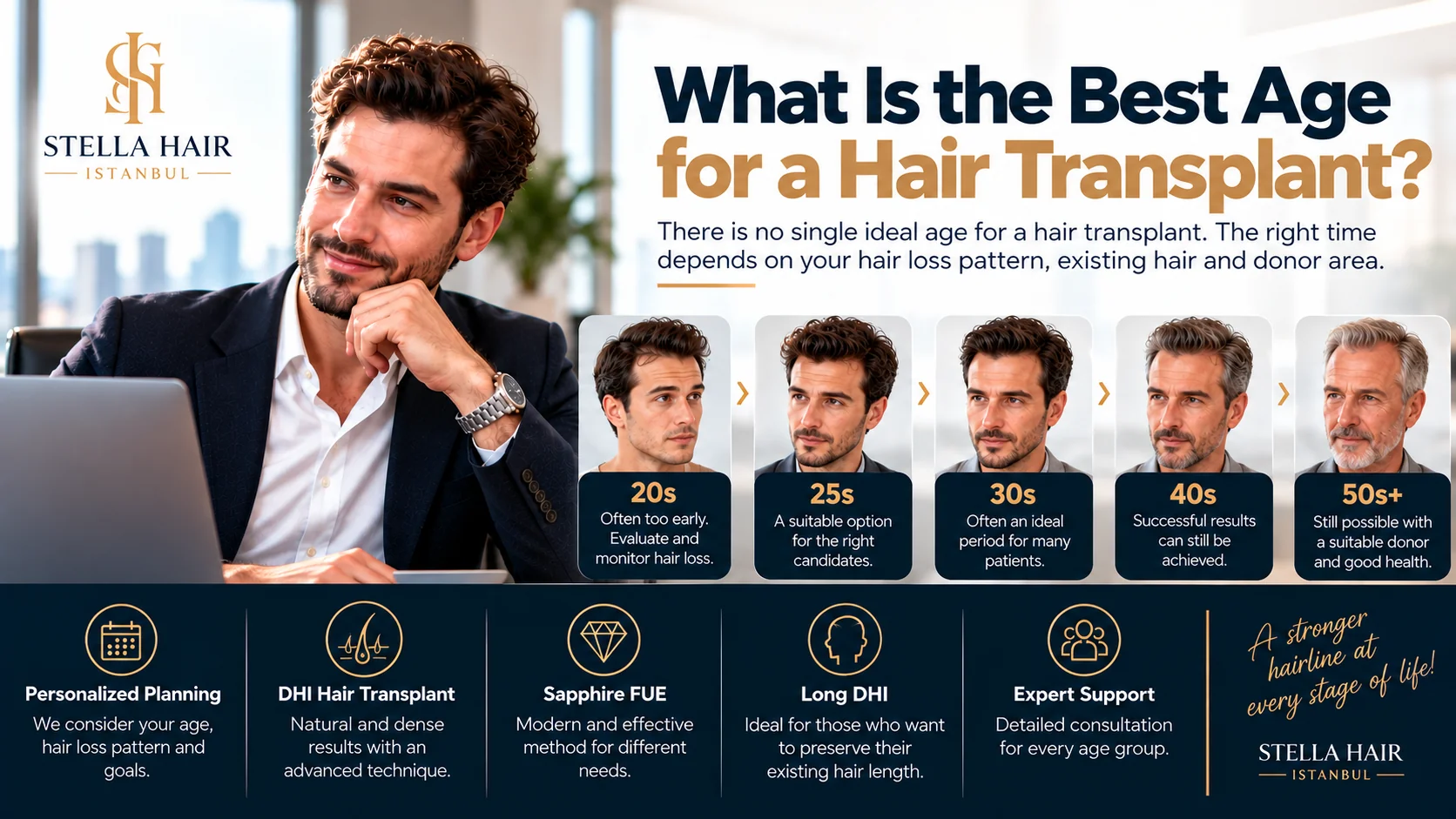
The best age for a hair transplant is often considered to be after 25, but there is no single ideal age that applies to everyone. Your hair loss pattern, the stability of your existing hair, and the quality of your donor area matter more than your date of birth. At Istanbul Stella Hair, we help patients understand when hair transplantation may be appropriate and what should be considered before choosing a procedure. Whether you are experiencing early temple recession or more extensive hair loss, understanding the right timing can make a significant difference to long-term hair restoration planning.
At Istanbul Stella Hair, we offer DHI, Sapphire FUE, and Long DHI hair transplantation for patients with different hair loss patterns and personal preferences. A 25-year-old with a receding hairline may have completely different needs from a 45-year-old experiencing crown thinning. That is why we focus on explaining hairline design, graft planning, donor area preservation, and the characteristics of each technique. For people who want to maintain their existing hairstyle, our Long DHI service also offers a hair-length-preserving approach worth exploring.
At What Age Can You Get a Hair Transplant?
Hair transplantation is generally performed on adults, but turning 18 does not automatically mean that surgery is the right choice.
One of the biggest considerations in younger patients is the future progression of hair loss.
For example, someone who begins losing hair around the temples at 19 may experience additional thinning in the mid-scalp or crown over the following years.
If a new frontal hairline is created too early, the transplanted hair may remain relatively dense while the surrounding natural hair continues to disappear.
This can create an unnatural contrast that may require further treatment.
For this reason, elective hair transplantation is generally discouraged in patients younger than 20.
Even in the early twenties, it may be preferable to monitor hair loss and explore appropriate medical treatment before considering surgery.
The most important question is not simply how old you are.
It is whether your hair loss pattern can be assessed well enough to create a treatment plan that will remain suitable as you get older.
Is 20 Too Young for a Hair Transplant?
For many patients, 20 is relatively young for hair transplantation.
This does not mean that surgery is impossible at that age. However, it does mean that extra care is needed when considering the decision.
Male pattern hair loss often begins during the late teenage years or early adulthood.
At 20, the eventual extent of that hair loss may still be unclear.
For example, a young man experiencing temple recession may want to restore the hairline he had at 16.
However, designing a very low hairline can become problematic if substantial hair loss develops behind it later.
There is also an important difference between a naturally maturing hairline and progressive male pattern baldness.
A dermatologist can help establish whether the changes are part of hereditary hair loss or another condition.
If hereditary hair loss is confirmed, appropriate medical treatment may help slow further thinning in suitable patients.
If you are 20 and losing hair, the first priority should be understanding the cause and progression of the loss rather than rushing into surgery.
Is 25 a Good Age for a Hair Transplant?
Yes. For suitable candidates, 25 can be a reasonable age to consider hair transplantation.
By the mid-twenties, the pattern of hair loss may be clearer than it was during the teenage years.
For example, someone whose temples began receding at 22 may have a more established pattern by age 25.
If the hair loss has progressed slowly and the donor area is healthy, transplantation may be one of the available options.
However, turning 25 does not mean that hereditary hair loss has stopped.
Some people experience only gradual thinning throughout their twenties, while others develop significant hair loss across the front, middle, and crown.
This is why the rate of hair loss matters.
A patient who has experienced substantial thinning over the previous six months may need a different approach from someone whose hairline has remained similar for several years.
Hairline design is particularly important in younger patients.
A hairline that looks attractive at 25 should also remain appropriate for the person's facial features and likely hair loss pattern at 35 or 45.
At Istanbul Stella Hair, patients can discuss the characteristics of DHI and Sapphire FUE transplantation, graft planning, and the importance of preserving healthy donor follicles.
Is 30 the Ideal Age for a Hair Transplant?
Thirty can be an excellent time to consider hair transplantation for suitable patients, and it is certainly not too late.
By this age, the distribution of hereditary hair loss may have become more apparent.
For example, a person who began noticing temple recession at 24 may have a clearer picture of their frontal and mid-scalp thinning by age 30.
This can help when considering the placement of a new hairline and the distribution of donor grafts.
However, hair loss does not automatically become stable at 30.
Some people continue experiencing progressive thinning throughout their thirties and forties.
A long-term treatment plan should therefore account for the possibility of further natural hair loss.
For patients with demanding professional schedules, hairstyle preferences may also influence the choice of technique.
At Istanbul Stella Hair, people who want to preserve their existing hair length can learn more about our Long DHI approach and whether it may be suitable for their hair characteristics.
Can You Get a Hair Transplant at 40?
Yes. Hair transplantation is possible at 40, and many suitable patients can pursue hair restoration at this age.
In some individuals, the overall hair loss pattern has become more established by their forties.
This can make it easier to identify the areas that need attention.
For example, someone may have significant frontal recession, moderate mid-scalp thinning, and an opening around the crown.
In this situation, the treatment plan needs to consider how many grafts are available and where they can contribute most effectively.
Restoring the frontal hairline and increasing coverage in the crown are different objectives.
The size of each area, existing hair density, and donor supply all influence the number of follicles required.
At 40, some patients also have a well-established hairstyle they prefer not to change.
This is one reason hair-length-preserving approaches may be attractive.
Istanbul Stella Hair offers information about DHI, Sapphire FUE, and Long DHI, allowing patients to explore methods according to their preferences and hair restoration needs.
Is 50 Too Old for a Hair Transplant?
No. Being 50 does not make you too old for a hair transplant.
Many people in their fifties can be considered for hair restoration if their general health and donor area are suitable.
For example, a 55-year-old who has experienced frontal hair loss for several years may still have sufficient healthy follicles at the back of the scalp.
Those follicles may be suitable for transplantation if a medical assessment confirms that the procedure is appropriate.
In some people, the hair loss pattern may have remained relatively consistent for years.
This can make the treatment area easier to define.
However, age-related changes in hair thickness, density, and overall health must also be considered.
Medical conditions such as diabetes, cardiovascular disease, and high blood pressure may require additional assessment.
The medications a patient uses can also influence surgical planning.
Having one of these conditions does not automatically rule out transplantation.
The important factor is whether the patient can safely undergo the planned procedure.
For suitable patients, hair transplantation after 50 remains a realistic option.
Can You Have a Hair Transplant After 60?
Yes. Hair transplantation can still be possible at 60 or older.
There is no universally applicable upper age limit based on age alone.
What matters most is the patient's medical condition, donor hair quality, scalp health, and treatment expectations.
For example, a healthy 62-year-old with adequate donor density may be a better surgical candidate than a younger person with extensive donor thinning or uncontrolled medical conditions.
However, the characteristics of the hair may have changed over time.
Some older patients have finer strands, reduced density, or a greater proportion of grey hair.
These factors can influence the visual density achieved by transplantation.
A detailed assessment should also consider medications, existing health conditions, and the planned extent of surgery.
For patients over 60, the decision should be based on individual suitability rather than the assumption that they have passed a particular age limit.
Why Is the Best Hair Transplant Age Different for Everyone?
Two people can be the same age and have completely different hair transplantation requirements.
Imagine two men who are both 30.
One has mild temple recession and thick donor hair.
The other has extensive thinning across the frontal hairline, mid-scalp, and crown.
Although they are the same age, their treatment needs are very different.
Three factors are particularly important.
1. The progression of hair loss
How quickly is the hair thinning? Has the pattern changed significantly over the past year?
2. The quality of the donor area
Are enough suitable follicles available for transplantation without creating noticeable thinning in the donor region?
3. The long-term appearance of the hairline
Will the planned hairline remain balanced and natural if additional hair loss occurs in the future?
These questions have a greater influence on treatment planning than age alone.
What Are the Risks of Getting a Hair Transplant Too Young?
The main concern with early transplantation is that natural hair may continue to fall out afterward.
Consider someone who undergoes a hairline transplant at 23.
The follicles collected from a suitable donor region may be relatively resistant to hereditary thinning.
However, the existing natural hair behind the transplanted hairline can continue to become thinner.
By age 28 or 32, new areas of hair loss may develop.
This can leave a relatively dense frontal hairline with noticeable thinning immediately behind it.
A second transplant may then be considered.
However, the number of donor follicles available for future procedures is limited.
Using an unnecessarily large number of grafts in the first operation may reduce future treatment options.
For younger patients, a conservative hairline design and careful donor management are therefore especially important.
The biggest issue with early transplantation is not simply being young. It is the uncertainty surrounding future hair loss.
Should You Wait if Your Hair Is Still Falling Out?
If your hair loss is progressing rapidly, it may be sensible to investigate the cause and discuss treatment options before scheduling a transplant.
This applies whether you are 25, 30, or 40.
For example, someone who has experienced substantial thinning over the past six months may have different needs from a person whose hair loss pattern has remained similar for several years.
Rapid or unexplained hair loss may also have causes other than hereditary pattern baldness.
A dermatologist can help identify the underlying condition.
For suitable patients with androgenetic alopecia, medical treatments may help slow progressive thinning and preserve existing hair.
Monitoring the response to treatment may also provide useful information before surgical planning.
A hair transplant should be timed around the condition and likely future progression of your hair loss, not simply around your next birthday.
What Is the Best Age for a Hair Transplant in Women?
There is no single ideal age for female hair transplantation either.
Women may experience hair loss due to hereditary factors, hormonal changes, thyroid conditions, iron deficiency, or other medical causes.
The pattern of thinning is particularly important.
For example, a 35-year-old woman with a localized area of permanent hair loss may have different treatment options from a 50-year-old experiencing diffuse thinning across the entire scalp.
In cases of widespread thinning, the donor region may also be affected.
This can make transplantation less suitable for some patients.
Before considering surgery, the cause of hair loss and the condition of the donor area should be assessed.
Women who want to maintain their existing long hairstyle may also be interested in Long DHI.
At Istanbul Stella Hair, patients can learn about hair-length-preserving options and the preparation involved.
The suitability of any method depends on the patient's hair characteristics and medical assessment, rather than age or gender alone.
Does Age Determine Whether DHI, Sapphire FUE, or Long DHI Is Better?
No. The choice between DHI, Sapphire FUE, and Long DHI should not be based on age alone.
There is no rule stating that patients in their twenties should undergo DHI while patients in their forties should choose Sapphire FUE.
The appropriate method depends on the hair loss pattern, existing hair density, donor capacity, and personal preferences.
With DHI, prepared follicles are implanted using a specialized implanter pen.
With Sapphire FUE, sapphire-tipped instruments are used to create the recipient channels.
Long DHI focuses on preserving existing hair length while using a DHI implantation approach.
For example, a 28-year-old who prefers to keep longer hair may be interested in Long DHI.
A 48-year-old with a similar hairstyle preference may also explore the same method.
Age alone does not determine suitability.
At Istanbul Stella Hair, you can learn about our DHI Hair Transplant, Sapphire FUE Hair Transplant, and Long DHI Hair Transplant services.
What Can You Discuss During a Consultation at Istanbul Stella Hair?
Choosing the right time for hair transplantation starts with understanding your current hair condition and expectations.
At Istanbul Stella Hair, our initial consultation process provides an opportunity to discuss your hair loss history, previous treatments, donor area, and preferred transplantation method.
If you are 25 and concerned about your receding hairline, you can ask about hairline planning and the importance of considering future hair loss.
If you are 40 and have a large crown opening, you can learn why donor capacity and graft distribution matter.
If you want to preserve your hairstyle, you can discuss Long DHI and its preparation requirements.
Our Long DHI package includes preoperative blood tests, PRP, postoperative shampoo and foam, a neck pillow, care products, and one year of follow-up and consultation support.
These services help patients understand not only the transplantation procedure but also the support available throughout the recovery and hair growth process.
Frequently Asked Questions About Hair Transplant Age
What is the ideal age for a hair transplant?
There is no single ideal age. For many patients, considering transplantation from the mid-twenties onward may allow a clearer assessment of their hair loss pattern. However, the progression of hair loss, donor density, and general health are more important than age alone.
Can you get a hair transplant at 18?
Being 18 does not automatically make someone a suitable candidate. Elective transplantation is generally discouraged at such a young age because future hair loss may still be difficult to predict.
Is 20 too young for a hair transplant?
For many patients, 20 is relatively young. It is often better to investigate the cause of hair loss, monitor its progression, and consider appropriate medical treatment before surgery.
Is 25 a good age for a hair transplant?
Yes, 25 can be a suitable age for selected patients. However, hereditary hair loss may still progress, so long-term hairline planning remains important.
Can I get a hair transplant at 35?
Yes. Suitable patients can undergo transplantation at 35. The decision depends on their hair loss pattern, donor area, medical condition, and treatment goals.
Is 50 too old for a hair transplant?
No. Many patients over 50 can be considered for hair transplantation if they have sufficient donor hair and are medically suitable for the procedure.
Can a 60-year-old have a hair transplant?
Yes. Patients in their sixties may still be suitable candidates. Their general health, medications, donor hair quality, and scalp condition should be assessed before surgery.
Will I need another hair transplant if I have surgery at a young age?
Not necessarily. However, natural hair may continue thinning after transplantation. If new bald areas develop, a second procedure may be considered when sufficient donor follicles remain.
Find the Right Time for Your Hair Transplant With Istanbul Stella Hair
Are you wondering whether you should have a hair transplant at 25, wait until 30, or explore your options after 40?
Perhaps you have been concerned about your receding hairline for years.
Maybe you are experiencing crown thinning and want to understand whether transplantation is appropriate at your current age.
At Istanbul Stella Hair, we help patients explore their hair transplantation options with attention to their hair loss patterns, donor area characteristics, and personal expectations.
Our DHI, Sapphire FUE, and Long DHI services provide different approaches to hair transplantation.
We explain how the methods work, what preparation may be required, and what patients should know about postoperative care.
If you prefer to maintain your current hairstyle, you can also ask about Long DHI and the circumstances in which a hair-length-preserving procedure may be suitable.
The right time for transplantation is not determined by age alone.
It is the time when your hair loss, donor supply, medical condition, and expectations can be brought together in a sensible treatment plan.
Contact Istanbul Stella Hair to discuss your hair loss history and explore the options available to you.
Phone and WhatsApp: +90 536 662 94 17
Address: Balmumcu Mahallesi, Bestekar Şevki Bey Sokak No 17, Beşiktaş, Istanbul, Türkiye
Contact: Book a Consultation With Istanbul Stella Hair
This article is intended for general information. Hair transplant suitability depends on the cause and progression of hair loss, donor area characteristics, and overall health. An appropriate medical assessment is required before deciding on a surgical procedure.
