What If You Don’t Have Enough Donor Hair for a Hair Transplant?
Not enough donor hair for a transplant? Explore beard and body hair options, limited graft planning, donor area assessment and hair restoration at Stella Hair.
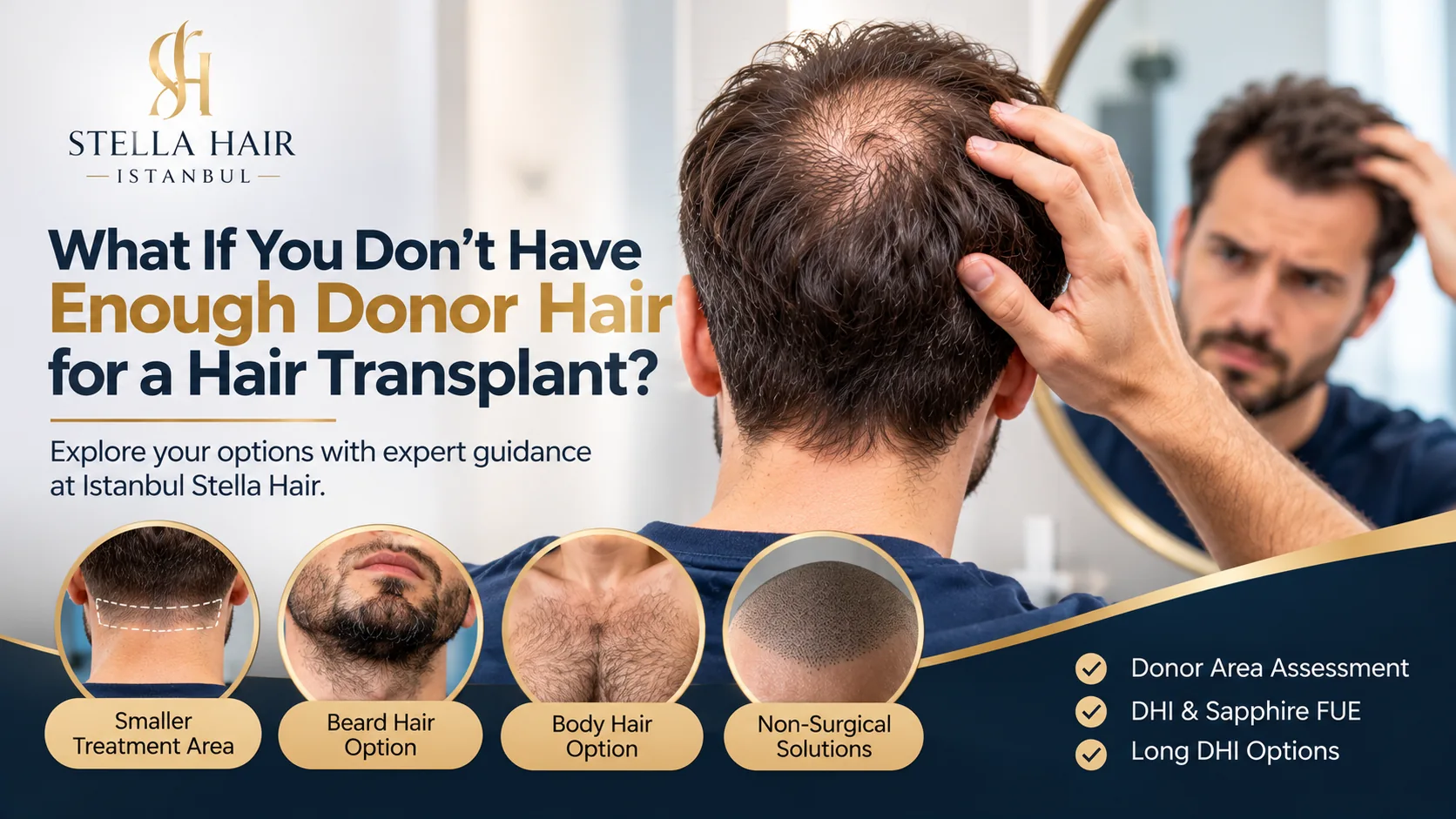
Are you considering a hair transplant but worried that you do not have enough hair at the back of your head? Perhaps you have experienced extensive hair loss, or a previous transplant has already used some of your donor follicles. Having a limited donor area does not necessarily mean that hair restoration is out of reach. At Istanbul Stella Hair, we help people understand why donor hair matters and what should be considered when the available supply is limited. Our consultation approach focuses on explaining the available techniques, understanding individual hair characteristics, and helping patients explore realistic options.
At Istanbul Stella Hair, we provide information about DHI, Sapphire FUE, Long DHI, and unshaven hair transplantation. We believe that good hair transplant planning starts with understanding the hair you already have. Alongside the thinning areas, the density and condition of your donor region are particularly important. For patients concerned about insufficient donor hair, we explain how graft availability affects treatment planning, why donor preservation matters, and which questions should be discussed during a medical assessment.
Can You Get a Hair Transplant With Insufficient Donor Hair?
Yes, some people with limited donor hair can still undergo a hair transplant. The available grafts may be used to restore a smaller, carefully selected area instead of attempting to cover the entire scalp.
For example, a person with significant hair loss at both the front and crown may not have enough donor follicles to achieve the desired density across both regions.
In this situation, treatment may focus on the frontal hairline or another area that the patient considers a priority.
For selected patients, beard or body hair follicles may also be considered as supplementary donor sources.
If the available follicles are extremely limited or the donor area is affected by ongoing hair loss, non-surgical solutions may offer a more suitable approach.
The important question is whether enough healthy, usable follicles remain for a carefully planned procedure.
What Is the Donor Area in Hair Transplantation?
The donor area is the part of the scalp from which follicles are collected for transplantation.
Most hair transplants use suitable follicles from the back and sides of the head.
These areas are commonly selected because many of the follicles are relatively resistant to the effects of hereditary hair loss.
During transplantation, the follicles are extracted and moved to areas where hair has become thin or disappeared.
For example, follicles taken from the back of the scalp may be implanted along a receding frontal hairline or into a thinning crown.
An important point is that hair transplantation redistributes existing follicles rather than creating new ones.
Once a follicle has been removed from the donor region, that exact follicle does not grow back in its original location.
This is why protecting the appearance of the donor area is essential.
Taking too many follicles can leave visible thinning at the back of the head, particularly when the person wears their hair short.
Why Might Someone Have Insufficient Donor Hair?
There are several reasons why a person may have fewer usable donor follicles than required for their desired transplant.
Extensive Hair Loss
Someone with advanced hair loss may have large bald areas across the front, middle, and crown.
The area requiring transplantation can be much larger than the available donor supply.
In this situation, it becomes important to establish which regions should receive priority.
Naturally Thin Donor Hair
Some people naturally have fine or relatively sparse hair at the back and sides of their heads.
Even if hair is present throughout these areas, the number of follicles that can be safely extracted may be limited.
Previous Hair Transplant Procedures
Every transplant uses some of the available donor follicles.
A person who has undergone one or more previous procedures may have a smaller supply remaining for future surgery.
Scarring or Donor Area Damage
Previous surgery, injuries, or certain scalp conditions can affect the donor region.
Scarring and changes in follicle distribution may reduce the areas suitable for extraction.
These factors help explain why two people with similar hair loss patterns can have very different transplantation options.
What Can Be Done If There Is Not Enough Hair at the Back of the Head?
There are four main approaches worth understanding.
1. Use the Available Grafts in a Smaller Area
When the donor supply is limited, focusing on a smaller treatment area may offer a practical solution.
For example, someone with both frontal and crown hair loss may be most concerned about the appearance of their hairline.
In that case, the available grafts may be allocated primarily to the front rather than distributed thinly across the entire scalp.
The aim is to use the available follicles where they may contribute most meaningfully to the overall appearance.
This approach does not require every bald area to be treated during the same operation.
2. Consider Beard Hair as an Additional Donor Source
In selected cases, suitable beard follicles may be used as an alternative donor source for scalp transplantation.
Hair from beneath the chin is sometimes considered when the scalp donor supply is insufficient.
Beard hair is often thicker than scalp hair and can have different growth characteristics.
For this reason, it is commonly considered for adding coverage or density in selected mid-scalp or posterior areas rather than creating the delicate leading edge of a frontal hairline.
The suitability of beard follicles depends on the individual's beard density, hair characteristics, and medical assessment.
Beard-to-scalp transplantation is a specialized procedure. It should not be assumed to be available at every clinic.
Istanbul Stella Hair does not currently present beard-to-scalp transplantation as a verified service on its website. Patients interested in this option should confirm the availability and expertise of a suitably qualified medical provider.
3. Explore Suitable Body Hair Donor Areas
In selected cases, follicles from parts of the body, such as the chest, may be considered for hair restoration.
However, body hair differs from scalp hair in thickness, maximum length, growth cycle, and appearance.
Chest hair may provide a supplementary source of follicles in particular circumstances, while hair from other body areas may have different characteristics.
Body hair does not offer an unlimited substitute for scalp donor follicles.
Its usefulness depends on the individual's hair characteristics and the proposed recipient area.
4. Consider Non-Surgical Hair Restoration
When the supply of suitable donor follicles is extremely limited, non-surgical approaches may be useful.
Scalp micropigmentation, for example, creates the visual impression of closely cropped hair or greater density using pigment placed in the skin.
Hair systems are another option for people who want the appearance of fuller coverage without surgery.
Medical treatments may also be considered when the aim is to preserve existing natural hair or manage the underlying cause of hair loss.
These options work in different ways, so the most appropriate choice depends on the patient's goals and scalp condition.
Can Beard Hair Really Be Transplanted to the Scalp?
Yes. Suitable beard follicles can be transplanted to the scalp in selected patients.
This approach is sometimes used when the number of available scalp donor follicles is limited.
Beard hair can contribute to coverage because many beard follicles produce relatively thick strands.
However, beard hair and scalp hair are not identical.
Beard hair may feel coarser, grow differently, and create a different visual effect.
This makes graft distribution important.
For example, the very front of the hairline generally benefits from carefully selected, finer scalp follicles that create a softer transition.
Beard follicles may be more useful in areas where adding coverage is the main objective.
The beard donor area must also be protected. Extracting too many follicles can change beard density or create visible marks.
A qualified physician with experience in alternative donor transplantation should assess whether this approach is suitable.
Can Chest or Body Hair Be Used for a Hair Transplant?
Yes, body hair transplantation is possible in selected circumstances.
Chest hair is among the alternative donor sources that may be considered when scalp follicles are limited.
However, body hair usually differs from scalp hair in how long it grows and how it behaves over time.
Some body hairs are shorter or finer, while others have a different texture.
These characteristics affect how well the transplanted hair may blend with the patient's existing scalp hair.
For this reason, body hair is generally considered a supplementary option rather than a direct replacement for a healthy scalp donor area.
A medical assessment is needed to determine which follicles are suitable and where they may be used.
Can More Grafts Be Extracted From a Weak Donor Area?
A weak donor area should not be overharvested simply to increase the graft count.
If the back of the head is already thin, taking additional follicles may create a new cosmetic problem.
For example, a patient may want extensive coverage at the front and crown, but the donor region may only support a smaller number of grafts.
Extracting more than the area can reasonably provide may leave visible patches or uneven density.
Not every follicle at the back of the head is equally suitable for transplantation.
The extraction zone must be selected carefully, particularly when hereditary thinning extends toward the edges of the donor region.
The objective is to improve the recipient area while maintaining an acceptable appearance in the donor area.
How Do You Know If Your Donor Area Is Strong Enough?
A donor area assessment examines the density, thickness, and distribution of hair follicles at the back and sides of the scalp.
A physician may use magnified scalp examination, including trichoscopy, to obtain a clearer picture of the available follicles.
The assessment aims to establish three important points.
First, how many suitable follicles may be available for transplantation?
Second, which areas can provide these grafts?
Third, how will the donor region look after extraction?
A person may have visible hair across the back of the head but still have a limited number of follicles suitable for removal.
That is because enough hair must remain to maintain the natural appearance of the donor area.
If you have undergone a previous hair transplant, information about the original graft count and extraction area may also help.
What If the Donor Area Is Insufficient for a Second Hair Transplant?
Patients considering a second hair transplant may have fewer donor follicles available than they did before their first operation.
This is especially relevant when a large number of grafts were collected previously.
The first step is to examine the current donor area and review the appearance of the original transplant.
If only a small area needs additional coverage, the remaining follicles may still offer options.
If the patient wants extensive new coverage but the available donor supply is low, the approach may need to change.
In specialized cases, alternative donor follicles may be considered.
If sufficient donor hair is not available, non-surgical options can also be discussed.
The most useful assessment considers what was done during the first operation and what can reasonably be achieved with the remaining follicles.
Can DHI or Sapphire FUE Help When Donor Hair Is Limited?
DHI and Sapphire FUE are hair transplantation techniques. They do not increase the number of available donor follicles.
This distinction matters.
With DHI, prepared grafts are implanted using a specialized implanter pen.
With Sapphire FUE, sapphire-tipped instruments are used to prepare recipient channels before the grafts are placed.
Both approaches still require suitable donor follicles.
If the available supply is limited, choosing DHI instead of Sapphire FUE does not create additional hair.
However, when enough healthy grafts are available for a carefully selected treatment area, these methods may be considered according to the patient's hair characteristics and surgical plan.
At Istanbul Stella Hair, we provide clear explanations of the different techniques so patients can understand how the procedures work.
Explore our DHI Hair Transplant and Sapphire FUE Hair Transplant services.
Is an Unshaven Hair Transplant Possible With Limited Donor Hair?
Unshaven hair transplantation is an attractive option for people who want to preserve their existing hairstyle.
However, shaving requirements and donor hair availability are two separate issues.
An unshaven procedure does not increase the number of follicles in the donor area.
If suitable donor hair is available, an approach that preserves existing hair length may be discussed.
At Istanbul Stella Hair, Long DHI is one of the methods offered to people who prefer to maintain their current hairstyle.
The procedure focuses on working with longer hair and preserving hair length where the treatment plan allows.
The exact preparation of the donor and recipient areas is discussed during consultation.
For people interested in maintaining their hairstyle, our Long DHI Hair Transplant page explains the technique and the associated treatment package.
When Might a Hair Transplant Not Be the Best Option?
If there are too few suitable follicles for extraction, a hair transplant may not provide the coverage the patient wants.
The same applies when the donor region is affected by significant ongoing thinning or certain scalp conditions.
In these circumstances, taking more follicles can create further problems without providing enough hair to improve the intended area meaningfully.
This is where treatment planning becomes especially important.
Medical management of existing hair loss, scalp micropigmentation, or hair systems may be more appropriate for some individuals.
Choosing a suitable alternative is not a failure of hair restoration. It is a way to match the available options to the person's actual hair condition.
Frequently Asked Questions About Insufficient Donor Hair
Can I get a hair transplant if I have very little hair at the back of my head?
Yes, if enough suitable follicles remain for a smaller treatment area. The available donor supply and the extent of hair loss determine which areas may be treated.
What happens if the scalp donor area is completely exhausted?
Suitable beard or body hair may be considered by specialists in selected cases. If no suitable donor follicles remain, non-surgical hair restoration options can be explored.
Can beard hair be used to create a frontal hairline?
Beard hair is often thicker than scalp hair. It is therefore more commonly considered for adding coverage behind the leading hairline rather than creating its finest front edge.
Can chest hair be transplanted to the scalp?
Yes, in selected cases. Chest hair has different growth characteristics from scalp hair, so its usefulness depends on the individual's hair type and treatment plan.
Does donor hair grow back after extraction?
The follicles transferred during transplantation do not regenerate in their original donor locations. This is why careful extraction planning is important.
Can DHI achieve the same density with fewer donor grafts?
DHI changes how follicles are implanted; it does not multiply them. The appearance of density depends on the available grafts, hair thickness, placement, and treatment area.
Does unshaven hair transplantation increase donor hair availability?
No. Unshaven techniques focus on preserving existing hair length. They do not increase the number of follicles available for extraction.
Can I have a second transplant if my donor area is weak?
A second procedure may be considered if enough suitable donor follicles remain. Previous extraction, existing thinning, and the size of the area requiring treatment all influence the available options.
Discuss Your Donor Hair Concerns With Istanbul Stella Hair
Are you considering hair transplantation but uncertain whether your donor region contains enough suitable hair?
Perhaps you have already undergone a transplant, or you are experiencing extensive thinning and want to understand your options.
At Istanbul Stella Hair, we provide information about DHI, Sapphire FUE, and Long DHI hair transplantation, including the importance of donor area assessment and responsible graft planning.
We welcome questions about previous procedures, existing hair density, preparation, and the consultation process.
If preserving your current hairstyle is particularly important, you can also ask about our Long DHI approach and the treatment package associated with this service.
Phone and WhatsApp
+90 536 662 94 17
Address
Balmumcu Mahallesi, Bestekar Şevki Bey Sokak No 17, Beşiktaş, Istanbul, Türkiye
Contact and Consultation
Contact Istanbul Stella Hair
This article provides general information about donor hair availability and hair restoration options. The suitability of a procedure, the number of usable grafts, and the choice of donor area depend on an individual medical assessment.
