How Soon Can You Return to Work After a Hair Transplant?
When can you return to work after a hair transplant? Discover recovery timelines for office workers, physical jobs, DHI, Sapphire FUE, and Long DHI.
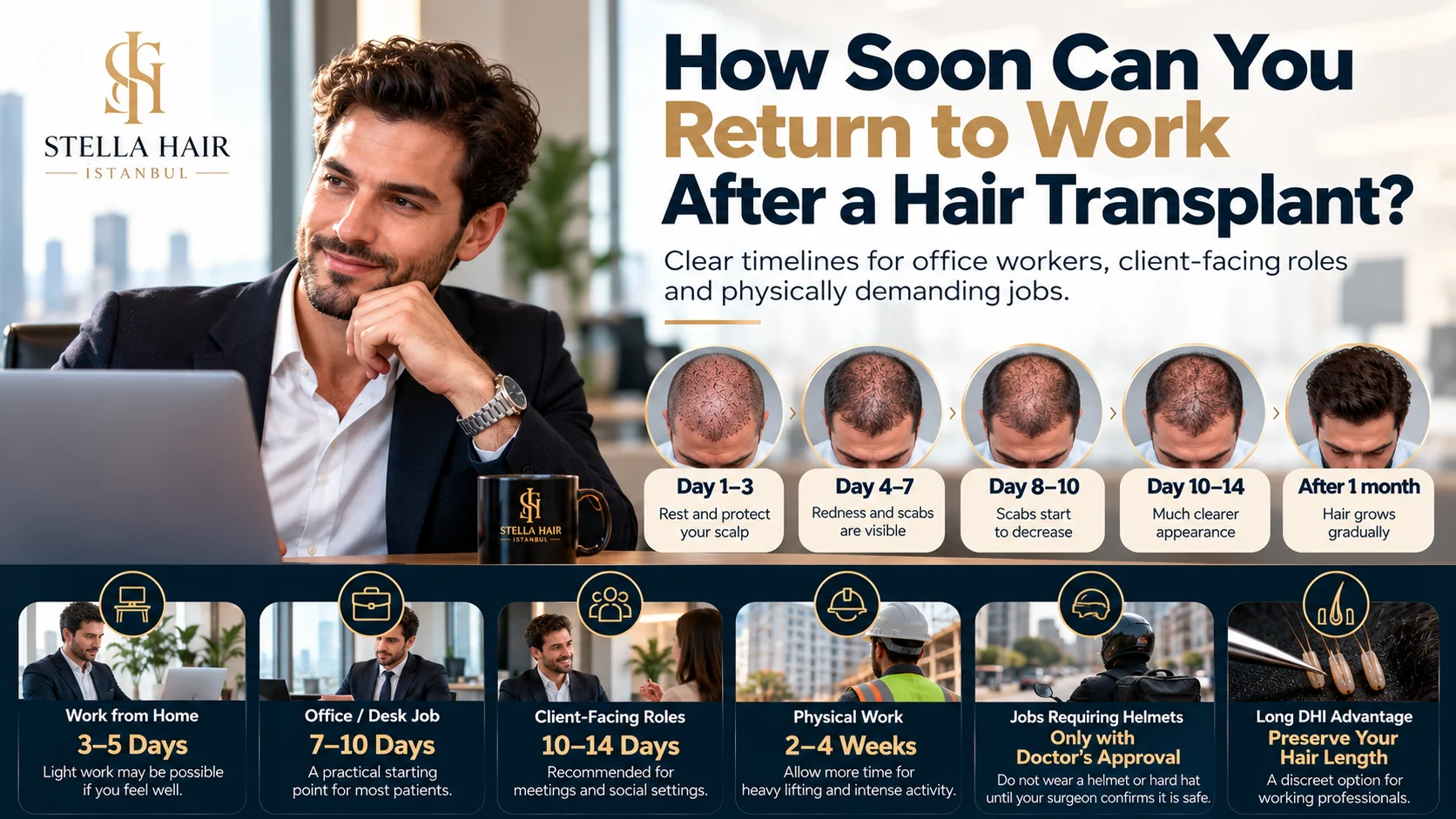
Are you considering a hair transplant but worried about taking too much time away from work? For most desk-based professionals, planning around 7 days off is a practical starting point. People who regularly meet clients may prefer 10–14 days, while physically demanding jobs can require a longer recovery period. At Istanbul Stella Hair, we understand that choosing a hair transplant involves more than selecting a procedure. You also need to know when you can return to your normal routine, how your scalp may look during recovery, and what precautions to take once you are back at work.
At Istanbul Stella Hair, we offer DHI, Sapphire FUE, and Long DHI hair transplantation for patients with different needs and preferences. Our Long DHI service is particularly appealing to professionals who want to preserve their existing hair length and avoid a dramatic change to their hairstyle. Our Long DHI package also includes postoperative care products, a neck pillow, and one year of follow-up and consultation support. We explain the treatment process, recovery precautions, and aftercare arrangements before your procedure so you can organize your time away from work with greater confidence.
How Many Days Should You Take Off Work After a Hair Transplant?
A practical starting point is 7–10 days for office work, 10–14 days for client-facing roles, and approximately 2–4 weeks before returning to heavy physical activities.
These are general planning ranges rather than fixed medical requirements. The appropriate return date depends on your recovery, the extent of your transplant, and the demands of your job.
Type of work
Suggested planning period
Working from home on a computer
Light work may be possible after 3–5 days if you feel well.
Desk-based office work
Around 7–10 days
Sales, consulting, teaching, and client meetings
Around 10–14 days
Light physical work
Approximately 10–14 days
Construction, warehouse work, and heavy lifting
Approximately 2–4 weeks, depending on medical advice
Jobs requiring helmets or hard hats
Return only when your surgeon confirms that the equipment can be worn safely.
For example, an accountant working at a desk may be comfortable returning after one week. A construction worker who regularly wears a hard hat may need a longer break or temporary adjustments to their duties.
The simplest recommendation: If you work in an office, plan for at least a week. If appearance is important for your job, consider allowing up to two weeks.
What Happens During the First 14 Days After a Hair Transplant?
Understanding the first two weeks makes it easier to choose suitable dates for your procedure.
Days 1–3: Rest and Protect Your Scalp
During the first few days, the transplanted area may appear red and feel sensitive. Small scabs usually begin to form around the implanted grafts.
Some patients also experience temporary swelling around the forehead or eyes.
Your priority during this period should be rest and following your postoperative instructions.
You may feel well enough to check emails or use your computer, but it is sensible to avoid demanding schedules, long journeys, and physically strenuous activities.
Our advice: Whenever possible, keep the first two or three days free from work commitments.
Days 4–7: Gradually Return to Light Activities
By the second half of the first week, many patients begin to feel more comfortable.
If you work remotely, you may be able to resume light computer-based tasks, provided they do not interfere with your aftercare.
However, the transplanted area may still have visible scabs and redness.
If your job involves in-person meetings, you may prefer to allow a few more days before returning.
Days 8–10: A More Comfortable Time for Office Work
For many patients, scabbing begins to decrease noticeably during this period.
This is one reason why taking 7–10 days off is often a useful plan for office workers.
You may feel physically ready to work before your scalp has returned to its usual appearance.
Redness can also last longer in some patients, particularly those with sensitive or lighter skin.
Our advice: If you have an important presentation or client meeting, consider scheduling your transplant at least 10 days beforehand.
Days 10–14: Returning to Your Social and Professional Routine
By the end of the second week, much of the initial scabbing has usually cleared.
For patients with physically light jobs, this is often a more comfortable time to return to a normal professional routine.
However, the hair transplant result itself will not be visible yet.
The transplanted follicles need months to produce new hair growth, and the final appearance develops gradually.
During the first two weeks, the goal is to allow the scalp to complete its initial healing phase while protecting the transplanted grafts.
How Soon Can Office Workers Return After a Hair Transplant?
If you work as a software developer, accountant, administrator, designer, or another desk-based professional, planning approximately 7 days away from work is a sensible starting point.
Desk work generally does not involve heavy lifting, excessive sweating, or activities that put direct pressure on the scalp.
For example, if you schedule your transplant on a Friday and take the following working week off, you may have approximately 10 days before returning to the office.
This gives you time to rest, complete the early stages of aftercare, and allow visible scabbing to decrease.
If you have the flexibility to work from home, you may be able to resume certain responsibilities earlier.
However, you should still avoid putting pressure on the transplanted area and continue following your surgeon's washing and care instructions.
Returning to your desk does not mean postoperative care is complete.
When Can Teachers, Managers, and Sales Professionals Return to Work?
If your profession involves meeting people throughout the day, your decision may depend as much on appearance as on physical comfort.
During the early recovery period, you may experience temporary redness, swelling, or scabbing.
For teachers, managers, consultants, and sales representatives, these changes may be noticeable during face-to-face interactions.
For client-facing professions, allowing 10–14 days is often more comfortable than taking only three or four days off.
Some patients also prefer not to shave their existing hair because they want to maintain their usual appearance at work.
This is where an unshaven hair transplant approach becomes particularly interesting.
At Istanbul Stella Hair, our Long DHI service is designed with hair-length preservation in mind.
Why Is Long DHI an Attractive Option for Working Professionals?
Many patients want to improve their hair density without changing their hairstyle dramatically.
They may have spent years growing their hair or simply prefer to keep their appearance consistent at work.
At Istanbul Stella Hair, Long DHI hair transplantation focuses on preserving existing hair length wherever the individual treatment plan allows.
Conventional transplantation may require shaving substantial sections of the scalp. Long DHI uses an approach designed for patients who prefer to maintain longer hair.
For example, someone experiencing recession around the temples may want treatment without having their entire hairstyle cut short.
For suitable patients, Long DHI can offer an alternative worth exploring.
What Is the Main Professional Advantage of Long DHI?
Its main advantage is preserving your existing hair length, rather than promising faster healing.
Keeping longer hair may make the change in your overall hairstyle less noticeable compared with a procedure that requires extensive shaving.
Existing hair may also partially conceal certain treatment areas, depending on its length and the location of the transplant.
This can be particularly valuable for professionals who regularly appear in meetings, meet customers, or work in public-facing roles.
However, it is important to understand the distinction between preserving hair length and avoiding the visible signs of surgery.
Long DHI does not eliminate postoperative redness, swelling, or scabbing. It also does not automatically allow patients to return to work earlier.
The preparation of the donor area may vary between patients, and some trimming may still be required depending on the procedure.
At Istanbul Stella Hair, we explain these details during the consultation so you know what to expect before arranging your time off.
Explore Long DHI Hair Transplantation at Istanbul Stella Hair
What Is Included in the Istanbul Stella Hair Long DHI Package?
Choosing a hair transplant clinic is not just about what happens during the operation.
It is also important to understand what support is available afterward.
Our Long DHI package includes services and products intended to support patients throughout their treatment experience.
The package includes:
- Preoperative blood tests: Part of the health assessment before the procedure.
- PRP treatment: An additional treatment included in the package.
- Ice Cell Therapy: A named treatment included in the package, with its purpose and procedure explained during consultation.
- Postoperative shampoo and foam: Products supplied for the early hair-care routine.
- A neck pillow: Designed to help patients maintain a suitable sleeping position during the initial recovery period.
- Postoperative care products: Products provided with instructions for use.
- One year of follow-up and consultation support: Assistance with questions about aftercare, hair growth, and the recovery process.
- A guarantee certificate: Provided with terms and conditions explained before treatment.
- A meal on the procedure day: Included as part of the treatment package.
For busy professionals, knowing that aftercare products and follow-up support are included can make the overall process easier to organize.
You can ask how and when to wash your hair, how to use the supplied products, and how to care for longer hair after the procedure.
Our one-year follow-up and consultation service means you can continue receiving guidance beyond the operation day.
We explain the package details during your initial consultation, including which services are included in your proposed treatment.
Is Recovery Faster With DHI or Sapphire FUE?
DHI and Sapphire FUE are different hair transplantation approaches.
With DHI, prepared grafts are implanted using specialized implanter pens.
With Sapphire FUE, sapphire-tipped instruments are used to create the recipient channels before implantation.
These technical differences do not mean that every DHI patient can return to work in three days while every Sapphire FUE patient needs seven days.
Neither method guarantees a specific return-to-work date.
Both involve donor follicle extraction and implantation, and both require the scalp to heal.
For desk-based work, a 7–10-day plan may be suitable for many patients undergoing either method.
For face-to-face professional roles, 10–14 days may provide more flexibility.
The best technique depends on your hair-loss pattern, donor area, hair characteristics, and personal treatment requirements.
Learn more about our DHI Hair Transplant and Sapphire FUE Hair Transplant services.
How Long Should Construction and Warehouse Workers Wait?
If your job involves lifting heavy objects, frequent bending, or intense physical activity, returning after only a few days is generally not advisable.
Strenuous activity during the initial healing period can increase the risk of bleeding or swelling.
There may also be a greater risk of accidentally hitting or rubbing the transplanted area.
For example, a warehouse employee who regularly lifts boxes has different recovery requirements from someone who works at a desk.
For physically demanding work, planning approximately 2–4 weeks before returning to full duties may be more appropriate.
Your surgeon may recommend a different timeframe depending on the procedure and your recovery.
If your employer can temporarily assign you lighter duties, this may provide additional flexibility.
What If Your Job Requires a Helmet or Hard Hat?
Construction workers, motorcycle couriers, industrial employees, and other professionals may need protective headgear throughout the day.
After a hair transplant, pressure and friction from tight headgear can interfere with the healing area.
You should therefore discuss helmet or hard-hat requirements before scheduling your procedure.
Do not return to duties requiring protective headgear until your surgeon confirms that wearing it is safe.
Removing mandatory safety equipment is not an appropriate alternative.
The better approach is to arrange sufficient leave or temporary duties that do not require the equipment.
What Should You Avoid When Returning to Work?
Even after you return to your normal working schedule, your scalp may still require care.
Small everyday habits can make a difference during the recovery period.
For example, tight hats, certain headphones, or equipment that rubs against the transplanted area may cause unwanted friction.
You should also avoid scratching the scalp or removing scabs manually.
When returning to work:
- Protect your scalp from accidental knocks and friction.
- Follow the washing instructions provided after your procedure.
- Avoid heavy exercise and activities that cause intense sweating until cleared by your surgeon.
- Ask before using helmets, hard hats, or other tight-fitting headgear.
- Continue using your prescribed or supplied aftercare products as instructed.
- Contact your medical team if you experience increasing pain, spreading redness, discharge, fever, or other unusual symptoms.
The return to work is an important milestone, but it is only one part of the overall recovery process.
How Should You Schedule Your Hair Transplant Around Work?
One of the most common planning mistakes is arranging only one or two days off after a transplant.
Although some people feel relatively well after a few days, visible healing changes and aftercare responsibilities usually continue beyond that point.
If you have an office job, booking your procedure before a week of annual leave can be convenient.
For example, a Friday procedure followed by a full week away from work may provide around 10 days before your first day back.
If you meet clients regularly, planning two weeks between your procedure and an important public appearance may be more comfortable.
For physically demanding jobs, you should discuss the specific activities involved before confirming your leave dates.
At Istanbul Stella Hair, you can tell us about your profession, available time off, and preferences regarding shaving.
We can then explain the relevant transplant options and the recovery precautions you should discuss with your treating medical team.
Frequently Asked Questions About Returning to Work After a Hair Transplant
Can I return to work 3 days after a hair transplant?
Some patients who work remotely may feel comfortable performing light computer-based tasks after three days. However, swelling, sensitivity, and scabbing may still be present. Returning to physically demanding work this early is generally inappropriate.
Can I go back to the office after 5 days?
It may be possible for some patients whose recovery is progressing well. However, visible redness and scabbing can still be present. Taking approximately one week off is often a more comfortable option.
Can I return to work 7 days after a hair transplant?
Yes. Many patients with desk-based jobs may be able to return after about seven days, provided healing is progressing normally and their surgeon agrees.
Is 10 days enough time off after a hair transplant?
For many desk-based and physically light jobs, 10 days may be sufficient. Heavy physical work and jobs requiring protective headgear may require a longer recovery period.
Will people at work notice that I have had a hair transplant?
They may notice temporary redness, scabbing, swelling, or a change in hairstyle. Long DHI and other hair-length-preserving approaches may reduce the need for a dramatic haircut, but they cannot make the procedure completely invisible.
Can Long DHI patients return to work sooner?
Long DHI focuses on preserving existing hair length. It does not automatically shorten the medical recovery period. The appropriate return date still depends on healing and the physical requirements of your job.
How much annual leave should I book for a hair transplant?
As a practical starting point, consider 7–10 days for office work, 10–14 days for client-facing professions, and approximately 2–4 weeks before returning to physically strenuous duties. Confirm your individual requirements with your surgeon.
When can I wear a helmet or hard hat after a hair transplant?
Protective headgear can place pressure on the transplanted area. You should not resume wearing a helmet or hard hat until your surgeon confirms that it is safe for your stage of recovery.
Plan Your Hair Transplant Around Your Professional Life With Istanbul Stella Hair
You do not need to put your professional life on hold indefinitely to consider hair transplantation.
However, allowing enough time for the initial recovery period and arranging suitable aftercare can make the experience more comfortable.
At Istanbul Stella Hair, we offer DHI, Sapphire FUE, and Long DHI hair transplantation to meet different hair restoration needs.
For professionals who prefer to preserve their hairstyle, Long DHI is a particularly interesting option.
You can ask how much of your existing hair length may be preserved, what preparation is involved, and how the recovery process could affect your work schedule.
Our Long DHI treatment package includes postoperative hair-care products, a neck pillow, and one year of follow-up and consultation support.
If your main concern is taking time away from work, tell us about your schedule during your consultation.
Share your occupation, how many days you can take off, and whether you want to preserve your current hairstyle.
We will explain the relevant transplantation techniques, package options, and recovery considerations so you can make an informed decision.
Istanbul Stella Hair
Phone and WhatsApp: +90 536 662 94 17
Address: Balmumcu Mahallesi, Bestekar Şevki Bey Sokak No 17, Beşiktaş, Istanbul, Türkiye
Contact Istanbul Stella Hair for a Consultation
The recovery periods described in this article are general planning estimates. Return-to-work timing varies according to the procedure, individual healing, and occupational requirements. Always follow the instructions of your treating surgeon before resuming work or strenuous physical activity.
