How Many Grafts Do You Need for a Hair Transplant and How Is the Number Calculated?
How many grafts do you need for a hair transplant? Learn what 1,000 to 4,000 grafts can cover, how graft counts are calculated, and what affects hair density.
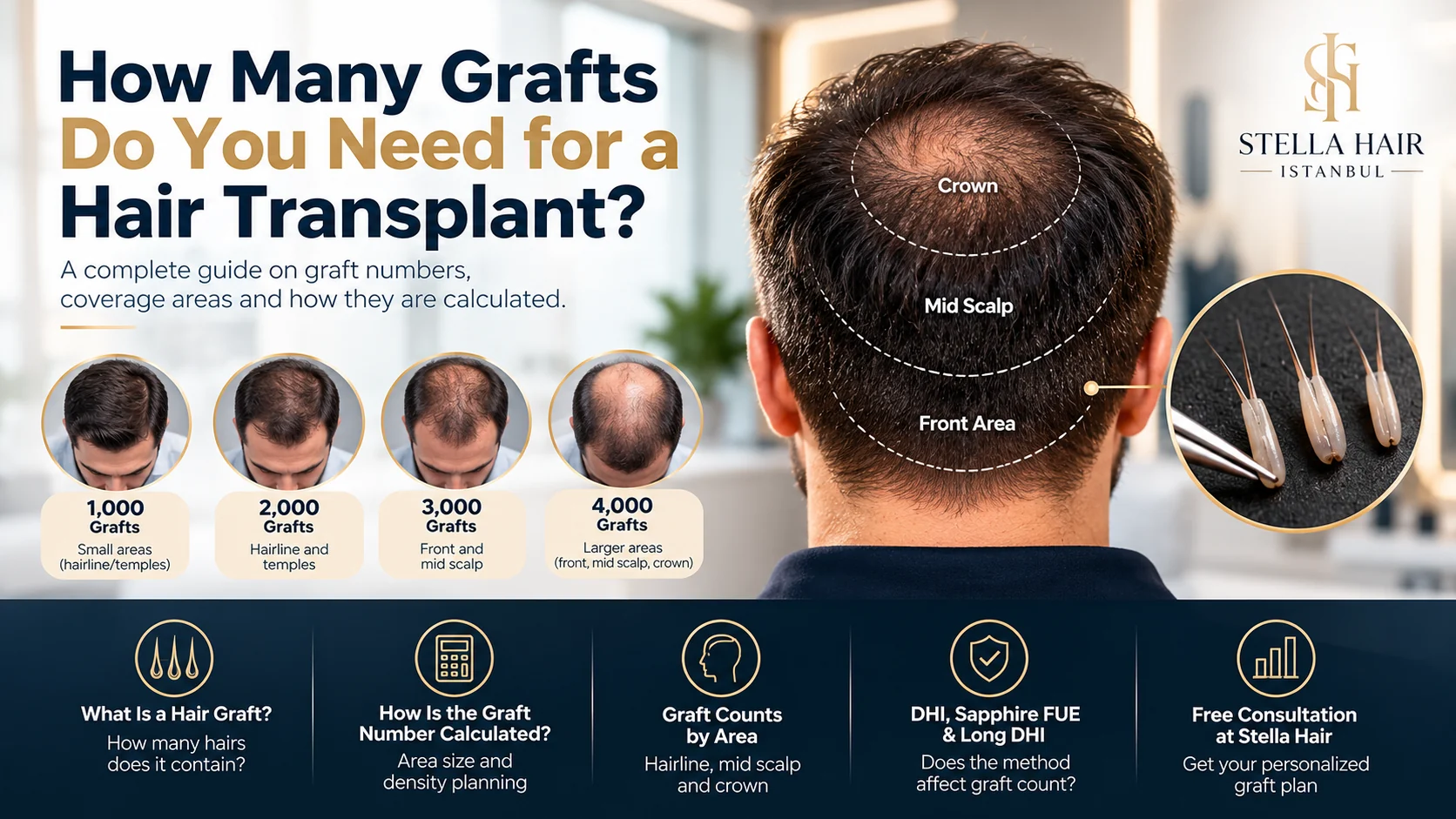
If you are considering hair transplantation, one of your first questions is probably “How many grafts do I need for a hair transplant?” You may have seen people receiving 2,000, 3,000, or even 4,000 grafts and wondered which number would be right for you. However, the same graft count does not produce the same appearance for everyone. At Istanbul Stella Hair, we help patients understand how graft requirements are calculated, why certain areas need more follicles than others, and how hair characteristics influence the final appearance.
At Istanbul Stella Hair, we provide information about DHI, Sapphire FUE, and unshaven Long DHI hair transplantation. Our approach emphasizes more than the total number of grafts. The natural appearance of the frontal hairline, the extent of crown thinning, existing hair density, and preservation of the donor area are equally important. We want patients to understand not only how many grafts may be required, but also where those grafts will be placed and how they contribute to a balanced, natural-looking result.
How Many Grafts Are Needed for a Hair Transplant?
The number of grafts needed for a hair transplant depends primarily on the size of the area affected by hair loss and the desired hair density.
A person with minor temple recession will usually have different requirements from someone experiencing extensive hair loss across the front, middle, and crown.
For example, approximately 1,000–1,500 grafts may be considered for a relatively small frontal area, while larger areas may require treatment plans involving 3,000 or 4,000 grafts.
These numbers are examples, not fixed medical standards.
Hair thickness, existing density, scalp characteristics, and the number of suitable donor follicles all influence the calculation.
The presence of existing hair is particularly important. Adding density between thinning hairs is different from transplanting into an entirely bald area.
This is why a graft count should be based on the individual's hair loss pattern rather than a number chosen in advance.
What Is a Hair Graft and How Many Hairs Does It Contain?
A hair graft is a follicular unit containing one or more hair follicles and their associated tissue.
Human scalp hair does not always grow as individual strands.
Some follicular units contain a single hair, while others contain two, three, or occasionally more hairs.
This means that 1,000 grafts do not necessarily equal 1,000 hair strands.
For example, if 2,000 grafts contain an average of two hairs each, they would represent approximately 4,000 individual hairs.
The actual number depends on the composition of the harvested grafts.
Single-hair grafts are often preferred at the leading edge of the frontal hairline because they help create a softer, more natural transition.
Multi-hair grafts may be useful farther behind the hairline, where additional visual density is desirable.
Therefore, graft quality, hair count, and placement can be just as important as the total number of grafts.
What Can a 1,000-Graft Hair Transplant Cover?
A 1,000-graft hair transplant may be suitable for relatively small treatment areas.
For example, someone with minor temple recession or a limited section of thinning along the frontal hairline may be considered for a treatment of this size.
However, even a small area can require different graft counts depending on hair characteristics.
Thicker strands can provide greater visual coverage, while fine hair may require a different distribution to create a comparable appearance.
There is also a difference between reinforcing an existing hairline and creating a new one.
A patient who still has a substantial amount of natural hair may have different needs from someone with a completely bare section of scalp.
Consequently, 1,000 grafts may be useful in certain cases, but the number alone cannot determine the area that can be successfully treated.
Is a 2,000-Graft Hair Transplant Enough?
A 2,000-graft hair transplant may be considered for selected patients with frontal hairline recession, temple hair loss, or moderate thinning in a particular area.
For example, a person with receding temples and a thinning frontal hairline may have a treatment plan involving approximately 2,000 grafts.
A similar number might be considered for certain crown areas, depending on the size of the thinning region.
However, 2,000 grafts cannot be expected to cover the same amount of scalp in every patient.
Hair thickness, existing coverage, desired density, and the shape of the treatment area influence how those grafts are distributed.
This is why photographs of another person's 2,000-graft transplant should not be used as a direct prediction of your own requirements.
Two people can have similar hair loss patterns but require different treatment plans.
Who Might Need a 3,000-Graft Hair Transplant?
A 3,000-graft hair transplant is commonly discussed when a larger area requires restoration.
For example, someone with significant frontal hairline recession and additional thinning through the mid-scalp may need a more extensive treatment plan.
In some cases, most of the grafts may be allocated to the front, with the remaining follicles distributed through the middle area.
The distribution can make a substantial difference to the overall appearance.
Placing 3,000 grafts into a single region is different from spreading the same number across both the front and crown.
When multiple regions are affected by hair loss, it may be preferable to prioritize specific areas rather than attempting to achieve the same density everywhere.
At Istanbul Stella Hair, we emphasize the importance of understanding how graft distribution affects the appearance of the hairline and surrounding areas.
The objective is to use the available follicles effectively, not simply to reach a particular number.
Is a 4,000-Graft Hair Transplant Enough for a Full Head of Hair?
A 4,000-graft transplant does not automatically provide full coverage for every person with extensive hair loss.
Some patients have thinning primarily across the frontal and mid-scalp regions.
Others have substantial hair loss affecting the front, middle, and crown.
These situations require different planning.
For some individuals, 4,000 grafts may provide meaningful coverage across a relatively large area.
For others, the same graft count may be insufficient to achieve the desired density across every affected region.
The donor area must also contain enough suitable follicles to support the planned extraction.
Not everyone can safely provide 4,000 grafts from the back and sides of the scalp.
If the donor supply is limited, a smaller treatment area or a different approach may be more suitable.
A higher graft count is not necessarily a better plan. What matters is how effectively the available follicles are used.
How Is the Number of Hair Transplant Grafts Calculated?
A basic graft calculation considers the size of the treatment area and the intended density of follicular units.
The simplified formula is:
Required grafts = Treatment area (cm²) × Planned graft density (grafts/cm²)
For example, suppose a completely bald treatment area measures 40 cm².
If a hypothetical treatment plan uses 35 grafts per square centimeter, the calculation would be:
40 × 35 = 1,400 grafts
This example illustrates how graft calculations work.
It does not mean that every patient should receive 35 grafts per square centimeter.
The planned density depends on several factors, including existing hair, hair shaft thickness, scalp condition, and donor availability.
When natural hair is already present in the treatment area, additional grafts may be distributed differently.
Likewise, a person with thicker hair may achieve a fuller visual effect with a different follicular unit density than someone with fine hair.
Online graft calculators can provide a rough estimate, but they cannot replace an examination of the hair and scalp.
How Many Grafts Are Needed for the Hairline?
The graft count required for the frontal hairline depends on how far the hairline has receded and how much reconstruction is needed.
Correcting minor temple recession is different from rebuilding a significantly receded frontal hairline.
The hairline also plays a major role in framing the face.
Because of this, the direction, angle, and distribution of the implanted follicles are particularly important.
Suitable single-hair grafts are commonly used along the front edge to help create a softer transition.
Behind that leading edge, other follicular units may be used to support greater visual density.
A natural-looking hairline requires more than placing as many grafts as possible into the front of the scalp.
Its position, shape, and relationship to the person's existing hair must all be considered.
How Many Grafts Are Needed for the Crown?
The number of grafts needed for the crown depends on the size of the thinning area and the density of the surrounding hair.
A small crown opening requires a different approach from an extensive bald area.
The crown also has a distinctive growth pattern.
Hair in this region typically follows a spiral or whorl, which influences how grafts are positioned.
Following this pattern helps transplanted hairs blend with surrounding natural hair.
Some patients may have both frontal and crown hair loss.
In those situations, the available grafts must be distributed according to the treatment priorities and donor capacity.
If you would like to learn more about treating this area, visit our Crown Hair Transplant page.
Does a Higher Graft Count Mean a Better Hair Transplant?
No. More grafts do not automatically mean a better hair transplant.
The number of grafts is only one part of the procedure.
The condition of the follicles, their placement, the direction of hair growth, and the preservation of the donor region all matter.
For example, trying to place an unnecessarily high number of grafts into a small area may create avoidable risks to the scalp or existing follicles.
On the other hand, spreading too few grafts across a large bald area may produce a thinner appearance than the patient expected.
The goal is to achieve a suitable distribution that takes both existing hair and donor availability into account.
Hair thickness also affects how dense the transplanted area appears.
A person with relatively thick strands may experience a different visual result from someone with fine hair, even when the graft counts are identical.
This is why effective planning focuses on the relationship between graft quantity, distribution, and hair characteristics.
How Does the Donor Area Affect Graft Count?
Most hair transplant procedures use suitable follicles from the back and sides of the head.
The number of follicles available in these regions helps determine the scope of the procedure.
For example, a patient may have an area of hair loss that could theoretically require 4,000 grafts.
However, if the donor region cannot safely provide that number, the treatment plan may need to be adjusted.
The available grafts might be concentrated in a smaller area rather than used across the entire scalp.
In some situations, treatment may be approached in stages, although multiple procedures do not increase the underlying donor supply.
Excessive extraction can leave visible thinning in the donor region.
Since transplanted follicles do not regenerate at their original extraction sites, the remaining donor hair must be protected.
If you are concerned about a limited donor supply, our article “What If You Don’t Have Enough Donor Hair for a Hair Transplant?” explains the available options in greater detail.
Does Graft Count Change With DHI or Sapphire FUE?
DHI and Sapphire FUE are different approaches to placing transplanted follicles.
With DHI, prepared grafts are implanted using specialized implanter pens.
With Sapphire FUE, sapphire-tipped instruments are used to create recipient channels for graft placement.
However, choosing one technique does not automatically reduce the number of follicles needed to cover a particular area.
For example, if a patient has a substantial bald area, selecting DHI does not eliminate the need for enough grafts to provide appropriate coverage.
The suitable method depends on the patient's hair characteristics, treatment area, donor capacity, and surgical plan.
At Istanbul Stella Hair, we explain these differences so patients can better understand their options.
Explore our DHI Hair Transplant and Sapphire FUE Hair Transplant services for additional information.
How Many Grafts Can Be Transplanted With Long DHI?
Long DHI is an option for patients who want to preserve their existing hair length during transplantation.
At Istanbul Stella Hair, Long DHI is one of our distinctive hair transplant services.
The technique is particularly interesting for individuals who prefer not to have their hair completely shaved.
However, the number of grafts that can be used depends on the person's donor region, hair characteristics, and the practical requirements of the procedure.
Working with longer hair can require a different approach to preparation and implantation.
A graft count that may be feasible with a conventional shaved procedure should not automatically be assumed to be suitable for every Long DHI case.
For this reason, hair length preferences and graft requirements need to be considered together.
You can learn more about the technique and treatment package on our Long DHI Hair Transplant page.
Can the Number of Required Grafts Be Estimated From Photos?
Photographs can provide an initial idea of the extent and location of hair loss.
For example, images may show recession along the frontal hairline or the approximate size of a thinning crown.
However, photographs do not always reveal the true density of the donor region, the thickness of individual hair strands, or the condition of the scalp.
Lighting, camera angles, and hair length can also change how thinning areas appear.
This means that a graft estimate based on photographs should be treated as preliminary.
A more detailed assessment of the scalp and donor area is needed to establish an appropriate treatment plan.
Frequently Asked Questions About Hair Transplant Grafts
What is the minimum number of grafts needed for a hair transplant?
There is no universal minimum. Small procedures may involve a few hundred grafts, while extensive hair restoration can require several thousand. The number depends on the treatment area and the patient's hair characteristics.
How many hairs are in 2,000 grafts?
Each graft may contain one or more hairs. If the average is two hairs per graft, 2,000 grafts would contain approximately 4,000 hairs. The actual total depends on the follicular units collected.
Can 3,000 grafts cover an entire head?
It depends on the extent of hair loss. A 3,000-graft procedure may provide substantial coverage in selected areas, but it may not be enough to achieve the desired density across a scalp with extensive baldness.
Can 4,000 grafts be transplanted in one session?
A 4,000-graft procedure may be possible for selected patients with sufficient donor capacity and appropriate medical conditions. The feasibility of a single session depends on the technique and individual surgical assessment.
Is one graft the same as one hair follicle?
Not necessarily. A graft typically contains a follicular unit, which may include one, two, three, or more hairs. That is why graft count and individual hair count are different measurements.
Can 3,000 grafts be divided between the hairline and crown?
Yes, in suitable cases. However, the available grafts must be distributed according to the size of the affected areas, existing hair density, and donor capacity.
Does DHI require fewer grafts than FUE?
DHI does not automatically reduce the number of grafts required. The graft count depends mainly on the treatment area, desired coverage, and individual hair characteristics.
Is there a graft limit for unshaven hair transplantation?
The number of grafts that can be transplanted depends on donor availability, hair characteristics, and the specific unshaven technique. There is no single number that applies to every patient.
Find Out How Many Hair Grafts You May Need at Istanbul Stella Hair
Are you considering a hair transplant but unsure whether you need 1,000, 2,000, 3,000, or 4,000 grafts?
You may be experiencing frontal hairline recession, thinning in the middle of your scalp, or hair loss around the crown.
Perhaps you want to increase density in a smaller area or explore transplantation while preserving your current hairstyle.
At Istanbul Stella Hair, we provide information about DHI, Sapphire FUE, and Long DHI hair transplantation, including graft planning, donor area preservation, and the steps involved in treatment.
During your initial consultation, you can ask questions about the transplantation process, shaving preferences, hairline planning, and recovery.
The most important factor is not simply reaching a high graft count. It is understanding how the available follicles can be used to complement your existing hair and achieve a balanced appearance.
Phone and WhatsApp:
+90 536 662 94 17
Address:
Balmumcu Mahallesi, Bestekar Şevki Bey Sokak No 17, Beşiktaş, Istanbul, Türkiye
Contact:
Contact Istanbul Stella Hair
This article is intended for general informational purposes. Graft numbers are illustrative examples, not individual treatment recommendations. Personal graft requirements and hair transplant planning must be established through an appropriate medical assessment.
