Can You Have a Hair Transplant on the Hairline and Crown at the Same Time?
Can you have a hairline and crown hair transplant in one session? Explore graft planning, DHI, Sapphire FUE and unshaven Long DHI options at Istanbul Stella Hair.
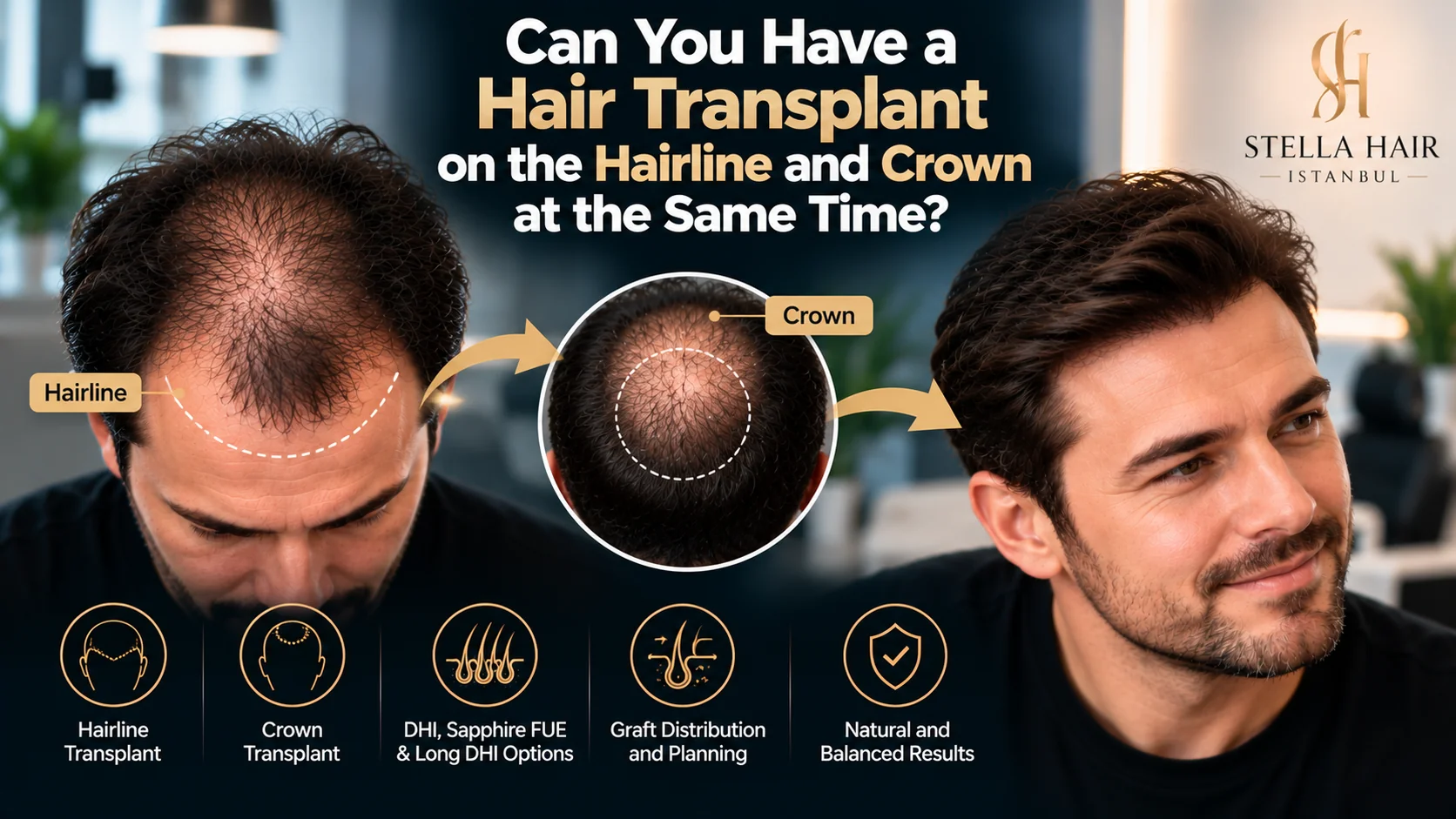
Hair loss does not always affect just one part of the scalp. For many people, the frontal hairline gradually recedes while the crown becomes thinner at the same time. This can make choosing a hair restoration approach feel more complicated, especially when both areas need attention. One of the most common questions is “Can you have a hair transplant on the hairline and crown at the same time?” At Istanbul Stella Hair, we understand that patients want to improve their overall appearance rather than focus on a single thinning area. We provide clear information about hair transplantation, available techniques, and the factors involved in planning treatment across different parts of the scalp.
At Istanbul Stella Hair, we introduce patients to DHI, Sapphire FUE, Long DHI, and completely unshaven hair transplant options. We pay particular attention to natural hairline design, the direction of hair growth at the crown, and the responsible use of donor follicles. When someone has hair loss in both the front and crown, our goal is to help them understand how these areas can be assessed together. Depending on the individual's hair characteristics and donor capacity, transplanting both areas during one procedure may be an option worth exploring.
Can You Have a Hair Transplant on the Hairline and Crown in One Session?
Yes. In suitable patients, hair transplantation can be performed on the frontal hairline and crown during the same session.
This approach may be considered when hair loss affects more than one area of the scalp and the donor region contains enough suitable follicles for the proposed treatment.
The frontal hairline and crown have different characteristics, so each area requires its own placement plan.
The hairline frames the face and has a major influence on overall appearance. The crown, on the other hand, contains hair that usually grows around a natural spiral or whorl.
When both areas are treated together, the medical team must consider how many grafts are available, where they will be placed, and how the transplanted hair will blend with existing follicles.
The main objective is to create a balanced appearance while considering the patient's current hair loss and longer-term needs.
What Is the Difference Between Hairline and Crown Hair Transplantation?
Although the general hair transplantation process is similar, the front and crown require different approaches to hair placement.
Frontal Hairline Transplantation
The frontal hairline is one of the first areas people notice when looking at someone's face.
A receding hairline can change the appearance of the forehead and make the hair look thinner even when other areas remain relatively dense.
When restoring the frontal hairline, factors such as facial proportions, age, existing hair direction, and hair thickness should be considered.
Creating a natural transition between the forehead and the surrounding hair is particularly important.
The aim is to establish a hairline that complements the person's features and existing hairstyle.
Crown Hair Transplantation
The crown is located toward the upper back of the scalp.
Hair in this region often grows around a central point, creating a spiral pattern known as the hair whorl.
Because the direction changes across the crown, transplanted follicles need to be positioned with the surrounding hair pattern in mind.
The crown may also contain thinning natural hair, and the affected area can become larger as hair loss progresses.
At Istanbul Stella Hair, we highlight these differences when explaining why the front and crown should not automatically receive identical graft placement plans.
For more information about this specific area, visit our Crown Hair Transplant page.
How Is a Hairline and Crown Hair Transplant Planned?
When both the front and crown require attention, the process begins with understanding the overall pattern of hair loss.
The hairline, mid-scalp, and crown are examined together to see how much natural hair remains and where coverage could be improved.
A typical planning process includes several stages.
1. Assessing Both Areas of Hair Loss
The first step is to review the recession of the frontal hairline and the extent of thinning at the crown.
The medical team also considers whether hair loss is continuing in the middle of the scalp.
This matters because the appearance of the front and crown is influenced by the natural hair connecting the two regions.
2. Examining the Donor Area
Hair follicles are usually collected from suitable areas at the back and sides of the head.
The density, thickness, and condition of donor hair help determine the number of grafts that may be available.
When two regions are involved, preserving a healthy donor area becomes especially important.
3. Planning Graft Distribution
The next step is deciding how available grafts may be distributed between the frontal hairline and crown.
The aim is not necessarily to place the same number of follicles in each area.
Instead, the plan considers the size of each thinning region, the natural hair that remains, and the appearance the patient hopes to achieve.
4. Implanting the Hair Follicles
Once the treatment plan has been established, the collected follicles are prepared and implanted using the selected technique.
The frontal hairline and crown are approached according to their individual hair growth patterns.
5. Explaining Recovery and Aftercare
After the procedure, patients receive information about washing, protecting the scalp, and attending follow-up appointments.
Because both the front and crown may have been treated, aftercare instructions cover both recipient areas.
How Many Grafts Are Needed for the Hairline and Crown?
The number of grafts required for a combined hair transplant varies from person to person.
Someone with mild hairline recession and a small thinning area at the crown may have very different needs from someone experiencing extensive hair loss across both regions.
The size of the affected areas is important, but it is not the only consideration.
Hair thickness, texture, color, remaining natural density, and donor hair availability all influence the planning process.
A person with thicker hair may achieve a different visual impression of coverage from someone with very fine hair, even when graft numbers are similar.
When transplanting two areas, graft distribution becomes particularly important.
Some patients may benefit from giving greater attention to the frontal hairline. Others may have a relatively well-preserved hairline but a more noticeable crown problem.
The most useful graft plan is one that considers the entire scalp rather than simply trying to maximize the number of transplanted follicles.
At Istanbul Stella Hair, we emphasize the importance of understanding donor capacity and the individual characteristics of each treatment area.
Should the Hairline or Crown Be Treated First?
Patients with hair loss in both areas often wonder which region should receive priority.
The answer depends on the pattern of thinning and the amount of donor hair available.
For some people, the frontal hairline is the main concern because it directly influences facial appearance.
A well-planned frontal restoration may create a noticeable change in how the hair frames the face.
For others, crown thinning is more pronounced, while the frontal hairline remains relatively strong.
In these cases, crown coverage may be an important part of the treatment discussion.
The medical team should also consider future hair loss.
If the available donor supply needs to be used carefully, treating both areas to the same density may not be the most appropriate strategy.
A balanced plan takes the patient's priorities into account while considering the long-term appearance of the scalp.
Who May Be Suitable for a Combined Hairline and Crown Transplant?
A combined procedure may be considered for people who have visible hair loss at the front and crown and sufficient suitable donor hair.
However, hair loss patterns vary.
Some people have relatively stable thinning, while others continue to experience noticeable changes over a short period.
The underlying cause of hair loss, the condition of the scalp, age, medical history, and previous procedures can all influence suitability.
Patients who have already undergone a hair transplant may also need an assessment of their remaining donor capacity.
In some circumstances, treating both regions in one session may be appropriate. In others, a staged approach or additional treatment planning may be preferable.
An individual medical assessment helps establish which option best fits the patient's needs.
Can DHI Be Used for the Hairline and Crown?
DHI is one of the techniques that may be considered when transplanting hair into the frontal and crown regions.
With Direct Hair Implantation, prepared grafts are placed using specialized implanter pens.
The direction and positioning of the implanted follicles are important in both areas.
Along the frontal hairline, the plan focuses on creating a natural transition that complements existing hair.
At the crown, attention is given to the changing growth direction around the hair whorl.
DHI may also be considered when existing natural hair remains within the recipient area.
At Istanbul Stella Hair, we explain how DHI works and what patients can expect during preparation, transplantation, and recovery.
Explore our DHI Hair Transplant service for more information.
Can Sapphire FUE Be Used for Both Areas?
Sapphire FUE is another technique that may be considered for a combined hairline and crown transplant.
In Sapphire FUE procedures, suitable donor follicles are collected using the FUE extraction approach.
Sapphire-tipped instruments may then be used to prepare recipient channels before the grafts are implanted.
The angle and direction of these channels influence how the transplanted hair will grow.
This is relevant for the frontal hairline, where a natural-looking transition is important, and for the crown, where the hair follows a spiral pattern.
The choice between DHI and Sapphire FUE depends on the patient's hair characteristics, the treatment areas, and the individual medical plan.
You can learn more through our Sapphire FUE Hair Transplant page.
Can You Have an Unshaven Hair Transplant on the Hairline and Crown?
Many people considering hair transplantation would prefer to keep their existing hairstyle.
This is especially common among individuals who still have a considerable amount of natural hair but are experiencing thinning in multiple areas.
Unshaven hair transplantation focuses on preserving existing hair length during the procedure.
Depending on the technique and individual needs, the preparation may involve different approaches to the donor and recipient regions.
When the hairline and crown are treated together, the number of grafts and overall scope of the procedure become important considerations.
For suitable patients, techniques designed to maintain hair length may offer an attractive option.
This approach may be particularly interesting to people who want to explore hair restoration without significantly changing the hairstyle they are accustomed to.
Long DHI and Completely Unshaven Hair Transplantation at Istanbul Stella Hair
At Istanbul Stella Hair, Long DHI hair transplantation is one of the distinctive options we introduce to patients who want to preserve their hair length.
Our Long DHI approach focuses on completely unshaven hair transplantation, making it particularly appealing to individuals who prefer to maintain their existing hairstyle.
Unlike conventional approaches that involve closely trimming the hair, Long DHI is designed around working with longer hair during transplantation.
For patients who have thinning at both the front and crown, the suitability of Long DHI depends on the treatment areas, donor capacity, and the number of grafts involved.
At Istanbul Stella Hair, we provide clear information about the Long DHI procedure, preparation, and the aftercare process.
Our Long DHI package also includes preoperative blood tests, PRP, hair care products, and one year of follow-up and consultation support.
Patients can ask about the full package details and the individual stages of the treatment process during their consultation.
If maintaining your hair length is important to you, explore our Long DHI Hair Transplant page.
What Is Recovery Like After a Hairline and Crown Transplant?
When hair transplantation is performed in both the frontal and crown regions, recovery involves caring for both treated areas.
During the first days, temporary redness, sensitivity, and small crusts may appear on the scalp.
Patients receive aftercare instructions covering washing, sleeping positions, and protecting the newly treated areas.
The crown may require particular attention when resting or sleeping because pressure on this region is common.
Some transplanted hair shafts may shed during the early weeks before new growth begins.
New hair generally starts to become noticeable over the following months.
The frontal hairline and crown may not develop at exactly the same visible pace.
For example, growth at the crown can appear slower because of the natural whorl pattern and the way light reaches the scalp.
The overall appearance continues to develop as the transplanted hair grows and matures.
Following the treating medical team's aftercare instructions is an important part of the recovery process.
What Should You Discuss Before a Combined Hair Transplant?
If you are considering transplantation in both the front and crown, preparing a few details can make your consultation more useful.
Think about when your hairline began to recede and when you first noticed thinning around the crown.
It can also help to explain whether the middle of your scalp has become thinner over time.
If you have previously undergone hair transplantation, information about the procedure and approximate graft count may be relevant.
Your medical history, medications, and any scalp-related concerns should also be discussed with the appropriate healthcare professional.
It is equally important to explain your personal preferences.
Would you like to restore the appearance of your frontal hairline, improve crown coverage, or address both areas?
Are you interested in preserving your current hair length through an unshaven approach?
At Istanbul Stella Hair, we encourage patients to share these questions during the consultation process so the available options can be explained clearly.
Frequently Asked Questions About Hairline and Crown Hair Transplants
Can the hairline and crown be transplanted in one session?
Yes. In suitable patients, both areas may be treated during the same procedure. Donor hair availability, the size of the thinning regions, and medical assessment help determine the treatment plan.
How many grafts are needed for the hairline and crown?
The required number varies according to the extent of hair loss, existing hair density, hair characteristics, and donor supply. An individual assessment helps establish the appropriate distribution.
Can DHI be used for both the front and crown?
DHI may be considered for transplantation in both areas. The plan takes into account natural hair direction, existing follicles, and the characteristics of each region.
Can the hairline and crown be treated without shaving the head?
Unshaven hair transplant options may be considered for suitable individuals. Istanbul Stella Hair provides information about Long DHI, which focuses on preserving existing hair length.
Is one session always enough for both areas?
The required number of sessions depends on the extent of hair loss and available donor follicles. Some individuals may be suitable for a combined procedure, while others may benefit from a staged plan.
How long does a combined hair transplant take?
The duration depends on the number of grafts, the selected technique, and the overall scope of the procedure. The estimated treatment schedule can be discussed during consultation.
Will hair grow at the same rate in both areas?
Hair growth can develop differently across the scalp. The frontal hairline and crown may show visible changes at different stages of recovery.
Explore Hairline and Crown Hair Transplant Options at Istanbul Stella Hair
Are you experiencing both a receding hairline and thinning around the crown?
At Istanbul Stella Hair, we understand that restoring multiple areas of the scalp requires attention to the overall appearance of your hair.
We provide information about DHI, Sapphire FUE, Long DHI, and completely unshaven hair transplant approaches, helping patients understand the differences between the available methods.
Whether your main concern is your frontal hairline, the crown, or both areas together, our team can answer your questions about the consultation process, graft planning, and hair transplant preparation.
If preserving your existing hairstyle is a priority, you can also learn more about our Long DHI approach and its focus on maintaining hair length.
Phone and WhatsApp
+90 536 662 94 17
Address
Balmumcu Mahallesi, Bestekar Şevki Bey Sokak No 17, Beşiktaş, Istanbul, Türkiye
Contact and Consultation
Contact Istanbul Stella Hair
This article is intended for general informational purposes. Hair transplant suitability, graft distribution, technique selection, and treatment planning depend on an individual assessment by a qualified medical professional.
