Can a Failed Hair Transplant Be Fixed?
Can a failed hair transplant be corrected? Learn about hair transplant repair, unnatural hairlines, poor density, donor area problems and treatment options.
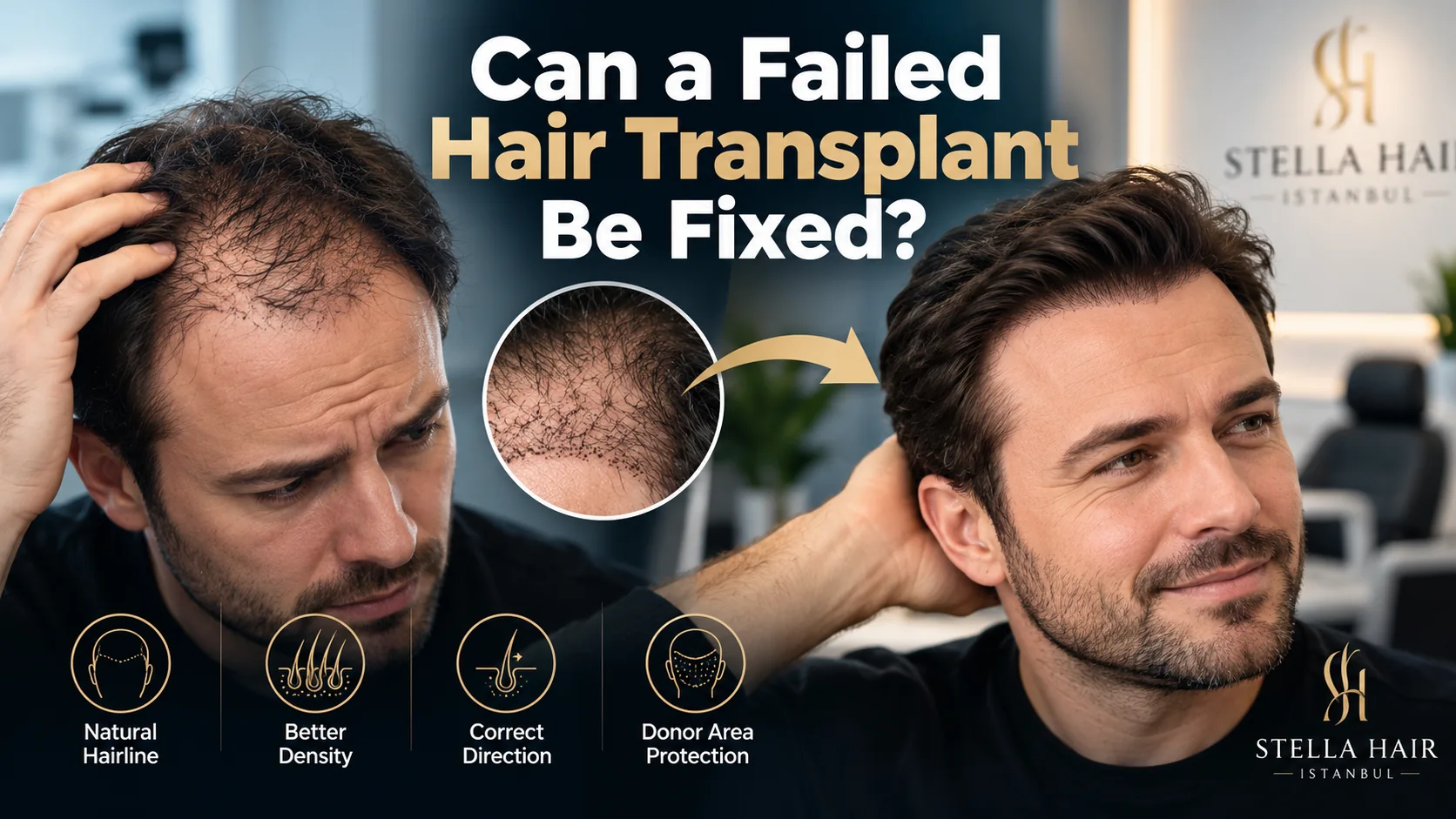
A hair transplant is an important decision, and it is natural to expect a noticeable improvement in your appearance. However, not everyone is satisfied with the outcome of their first procedure. Some people experience poor hair density, while others are concerned about an unnatural hairline, uneven growth, or visible thinning in the donor area. If you are experiencing these problems, you may be wondering, can a failed hair transplant be fixed? At Istanbul Stella Hair, we believe that clear information, realistic expectations, and careful attention to individual hair characteristics are essential parts of the hair transplant journey.
At Istanbul Stella Hair, we provide information about DHI, Long DHI, and Sapphire FUE hair transplant techniques, with particular attention to natural-looking hairlines, responsible donor area planning, and understanding what happens after surgery. We also recognize that people who are unhappy with a previous hair transplant may have different concerns from first-time patients. Our team takes these questions seriously and explains the factors that should be reviewed before considering another procedure. Understanding what went wrong is an important first step toward exploring possible improvements.
What Is Considered a Failed Hair Transplant?
A failed hair transplant generally refers to a procedure that does not produce the expected aesthetic or medical outcome.
However, dissatisfaction does not always mean that the operation has failed.
For example, someone who is concerned about low density four months after surgery may still be experiencing normal hair growth and recovery. Transplanted hair can take many months to develop, and early results should not be treated as final.
On the other hand, persistent gaps after sufficient recovery time, an unnatural hairline, incorrectly directed hair, or significant donor area thinning may require a different assessment.
Common concerns associated with a failed or poorly performed hair transplant include:
- Transplanted hair growing with insufficient density
- An unnatural or excessively straight frontal hairline
- Hair follicles implanted at incorrect angles
- Visible gaps between transplanted and existing hair
- Excessive thinning or scarring in the donor area
- Uneven hair distribution across the recipient area
- A noticeable difference between transplanted and surrounding hair
Not every problem requires another operation. The most appropriate approach depends on the cause, severity, and individual circumstances.
Why Do Hair Transplants Sometimes Fail?
Several factors can influence hair transplant outcomes. Some are related to surgical planning and technique, while others involve the patient's scalp condition, underlying hair loss, recovery, or overall health.
Understanding these factors is important before considering hair transplant repair.
Poor Hairline Design
The frontal hairline plays a major role in the overall appearance of a hair transplant.
A hairline positioned too low, designed as a completely straight line, or created without considering facial proportions may look artificial.
Natural hairlines vary between individuals. Age, facial features, forehead shape, and the distribution of existing hair should all influence the design.
A well-considered hairline should complement the person's appearance rather than simply cover as much of the forehead as possible.
Incorrect Hair Growth Direction
Hair does not grow in the same direction across every part of the scalp.
At the front, hair follicles follow particular angles and patterns. At the crown, hairs often grow around a circular whorl.
When transplanted follicles are placed at angles that do not match the surrounding hair, the results may appear unnatural.
The hair can also become difficult to style.
This is especially noticeable around the frontal hairline, where incorrectly positioned follicles can make the transplant more obvious.
Poor Graft Development
Not every transplanted follicle is guaranteed to develop successfully.
The extraction, handling, storage, and implantation of grafts can influence their survival and subsequent growth.
Individual healing, scalp conditions, and other medical factors may also affect the result.
When sufficient recovery time has passed but the transplanted area remains noticeably thin, the underlying reasons should be investigated.
Excessive Donor Hair Extraction
Hair transplantation relies on follicles collected from suitable donor areas, usually at the back and sides of the scalp.
This supply is limited.
Removing too many follicles can cause visible thinning, uneven density, and sometimes permanent changes in the donor region.
Excessive extraction may also reduce the number of healthy follicles available for future procedures.
Protecting the donor area is therefore just as important as planning the recipient area.
Can a Failed Hair Transplant Be Corrected?
In some cases, yes. Certain problems following an unsuccessful hair transplant can be improved through corrective procedures.
However, the available options depend on the type of problem and the condition of the scalp.
For example, a person with inadequate density may be considered for additional graft placement if sufficient donor hair remains.
Someone with an unnatural hairline may require a different approach, potentially involving the repositioning, removal, or selective addition of follicles.
Hair transplant correction is not a single procedure that works for everyone.
The treatment plan should reflect the individual's existing hair, previous surgical work, donor availability, and expectations.
Some concerns may be improved surgically, while others may be better managed through non-surgical options.
It is also important to recognize that not every failed hair transplant can be completely repaired.
Scarring, donor area damage, and tissue changes caused by the original procedure may limit the improvements that are realistically possible.
Can Poor Hair Density After a Transplant Be Improved?
One of the most common complaints after hair transplantation is insufficient hair density.
Some patients notice that the transplanted area remains thinner than expected, particularly along the frontal hairline, mid-scalp, or crown.
The first consideration is timing.
Transplanted hair does not reach its final appearance immediately. Growth continues over several months, and an area that initially looks sparse may become fuller as the hair develops.
If sufficient time has passed and significant gaps remain, an additional transplant may be considered after medical assessment.
However, simply adding more grafts does not guarantee a better appearance.
Hair thickness, the direction of existing follicles, scalp condition, and remaining donor capacity all influence the options.
At Istanbul Stella Hair, we emphasize that natural hair appearance depends on more than the number of grafts used.
You can learn more about our available methods on our Hair Transplant Treatments page.
Can an Unnatural Hairline Be Fixed?
An unnatural hairline is one of the most noticeable problems following a poorly planned hair transplant.
A hairline that is too straight, excessively symmetrical, or positioned too low may make the transplanted area appear artificial.
In suitable cases, additional fine hairs may be placed around the existing hairline to create a softer transition.
Other correction techniques may involve selectively removing or redistributing previously transplanted follicles.
However, these approaches require careful medical assessment. Removing or adjusting existing grafts can cause additional scarring or tissue damage.
The goal should not simply be to create a lower or denser hairline.
A more natural result requires attention to facial proportions, age, individual hair characteristics, and the direction of surrounding hair.
Patients considering a hairline correction should understand both the possible benefits and the limitations of another surgical procedure.
What If the Donor Area Was Damaged During the First Transplant?
The donor area is a particularly important consideration when assessing the possibility of hair transplant repair.
If excessive numbers of grafts were extracted during the original procedure, visible thinning or scarring may remain.
This can make a second operation more difficult.
Before considering further transplantation, the remaining donor hair must be examined to determine whether additional extraction would be appropriate.
If donor capacity is insufficient, another transplant may not be possible or may fail to achieve the desired coverage.
Depending on the individual circumstances, other medical or cosmetic approaches may be considered to improve the appearance of the affected area.
However, donor hair that has been permanently removed cannot simply be restored to its original supply.
This is why responsible donor management during the first operation is so important.
Can DHI or Sapphire FUE Be Used for Hair Transplant Repair?
People considering a corrective hair transplant often ask whether DHI or Sapphire FUE is the better technique.
Both approaches have different procedural characteristics.
DHI Hair Transplant
DHI uses specialized implanter pens to place hair follicles into the recipient area.
When planning work around existing hair, attention to follicle direction and the surrounding hair distribution is important.
Depending on the patient's condition, DHI may be among the techniques considered for an additional procedure.
Learn more about DHI Hair Transplant.
Sapphire FUE Hair Transplant
In Sapphire FUE procedures, sapphire-tipped instruments may be used to prepare recipient channels before the grafts are implanted.
The size of the area, existing hair density, and previous surgical changes must be considered during planning.
Learn more about Sapphire FUE Hair Transplant.
Neither DHI nor Sapphire FUE should automatically be considered the best solution for every failed transplant.
The appropriate technique depends on the specific problem being addressed, the available donor hair, and an individual medical assessment.
Is Corrective Hair Transplant Surgery More Complicated?
A corrective hair transplant can be more complex than a first procedure.
The recipient area may already contain transplanted follicles, scar tissue, or changes resulting from previous surgical work.
The donor area may also have a reduced supply of usable follicles.
These factors can influence surgical planning and limit the available options.
For some patients, the main challenge is improving density without damaging existing hair. For others, it may involve addressing incorrectly placed follicles or an unnatural hairline.
A previous complication, such as infection or problematic wound healing, must also be considered.
For this reason, corrective surgery should be approached carefully, with a clear understanding of the possible benefits, risks, and limitations.
A second operation is not automatically the right answer to every unsatisfactory result.
How Long Should You Wait Before Correcting a Failed Hair Transplant?
It is understandable to feel disappointed when a hair transplant does not look the way you expected.
However, deciding that the procedure has failed too early can lead to unnecessary concern.
During the first few months, some transplanted hair shafts may shed before new growth becomes visible.
Hair development continues gradually, and the final appearance may take a year or longer to become clear.
In some individuals, particularly when the crown is involved, visible changes may continue for approximately 12–18 months.
Therefore, the timing of any corrective procedure should depend on the stage of recovery and the condition of the scalp.
If the first transplant is still developing, further observation may be appropriate.
If significant concerns remain after sufficient time has passed, a qualified medical professional can assess whether another intervention should be considered.
The waiting period is not identical for every patient.
What Should You Check Before Considering Hair Transplant Repair?
Before seeking another procedure, gathering information about your first transplant can make the assessment more useful.
If available, prepare the date of the original operation, the technique used, the approximate graft count, and details of any complications.
Photographs taken before the procedure and at different stages of recovery may also help show how the hair developed.
There are several important questions to discuss during a medical consultation.
What caused the unsatisfactory result?
Understanding whether the problem involves low density, continued natural hair loss, hairline design, or another factor is essential.
Is there enough donor hair for another procedure?
The remaining donor capacity can influence whether additional transplantation is possible.
Can the existing hairline or density be improved?
Possible improvements should be discussed realistically, without assuming that complete correction is achievable.
Could previous scarring affect another operation?
Scar tissue and changes to the scalp may influence treatment planning.
Would a non-surgical approach be more appropriate?
In some situations, another surgical procedure may not be the best option.
Clear answers to these questions can help patients make informed decisions and establish realistic expectations.
Why Does a Natural Appearance Matter in Hair Transplant Correction?
Hair transplant correction is not only about increasing density.
Natural appearance is equally important.
A person whose previous transplant resulted in an unnatural hairline or incorrectly directed follicles may require a different plan from someone who simply needs more coverage.
Hair thickness, texture, distribution, and growth direction should be considered together.
The frontal hairline generally requires particular attention because it is highly visible.
The crown also presents specific challenges because hair often grows around a whorl, changing direction across the area.
Age and future hair loss should also be considered.
A hairline that looks dense today may appear different if surrounding natural hair continues to thin over the following years.
For this reason, correction planning should consider both the current appearance and the possible progression of hair loss.
Frequently Asked Questions About Failed Hair Transplants
Can a failed hair transplant be completely repaired?
Some unsuccessful results can be improved through corrective procedures. However, complete correction is not always possible. The outcome depends on donor availability, scalp condition, previous surgical changes, and the specific problem.
Can I have another transplant if the first one did not work?
An additional procedure may be considered if the initial results remain unsatisfactory after an appropriate recovery period. A medical assessment is needed to determine the cause of the problem and whether sufficient donor hair remains.
Can incorrectly implanted hair follicles be corrected?
In some situations, incorrectly positioned or angled follicles may be addressed through corrective techniques. However, these interventions can carry additional risks, including scarring, and require specialist medical evaluation.
How many grafts are needed for hair transplant repair?
There is no standard graft number for corrective procedures. The amount depends on the area requiring improvement, existing hair density, available donor supply, and individual treatment goals.
Does thin hair after transplantation always mean the procedure failed?
No. Hair can look thin during the early stages of recovery. New growth may take several months to become visible, and the final appearance develops gradually.
Can a second hair transplant provide better results?
An additional transplant may improve the appearance in suitable cases. However, better density or a specific cosmetic outcome cannot be guaranteed. Results depend on multiple individual and medical factors.
Contact Istanbul Stella Hair About Your Hair Transplant Concerns
Have you previously undergone a hair transplant but feel dissatisfied with the results?
Perhaps your hairline looks unnatural, the transplanted area remains thin, or you are concerned about the appearance of your donor area.
At Istanbul Stella Hair, we understand that people researching hair transplant correction often have detailed questions about their previous procedure and the options that may be available.
We provide information about DHI, Long DHI, Sapphire FUE, and the general hair transplant process, with an emphasis on clear explanations and realistic expectations.
You can contact our team to discuss your concerns and learn more about the consultation process.
Whether a corrective procedure is medically appropriate, and what improvements may be possible, must be determined by a qualified physician following an individual assessment.
Phone and WhatsApp
+90 536 662 94 17
Address
Balmumcu Mahallesi, Bestekar Şevki Bey Sokak No 17, Beşiktaş, Istanbul, Türkiye
Contact and Consultation
Contact Istanbul Stella Hair
This article is intended for general informational purposes only. Decisions about corrective hair transplantation require an individual medical assessment by a qualified physician. No surgical correction can guarantee a specific aesthetic or medical outcome.
