When Does Hair Grow After a Hair Transplant? 1, 3, 6 & 12 Months
When does transplanted hair start growing? Discover the hair transplant growth timeline at 1, 3, 6 and 12 months, including shedding and final results.
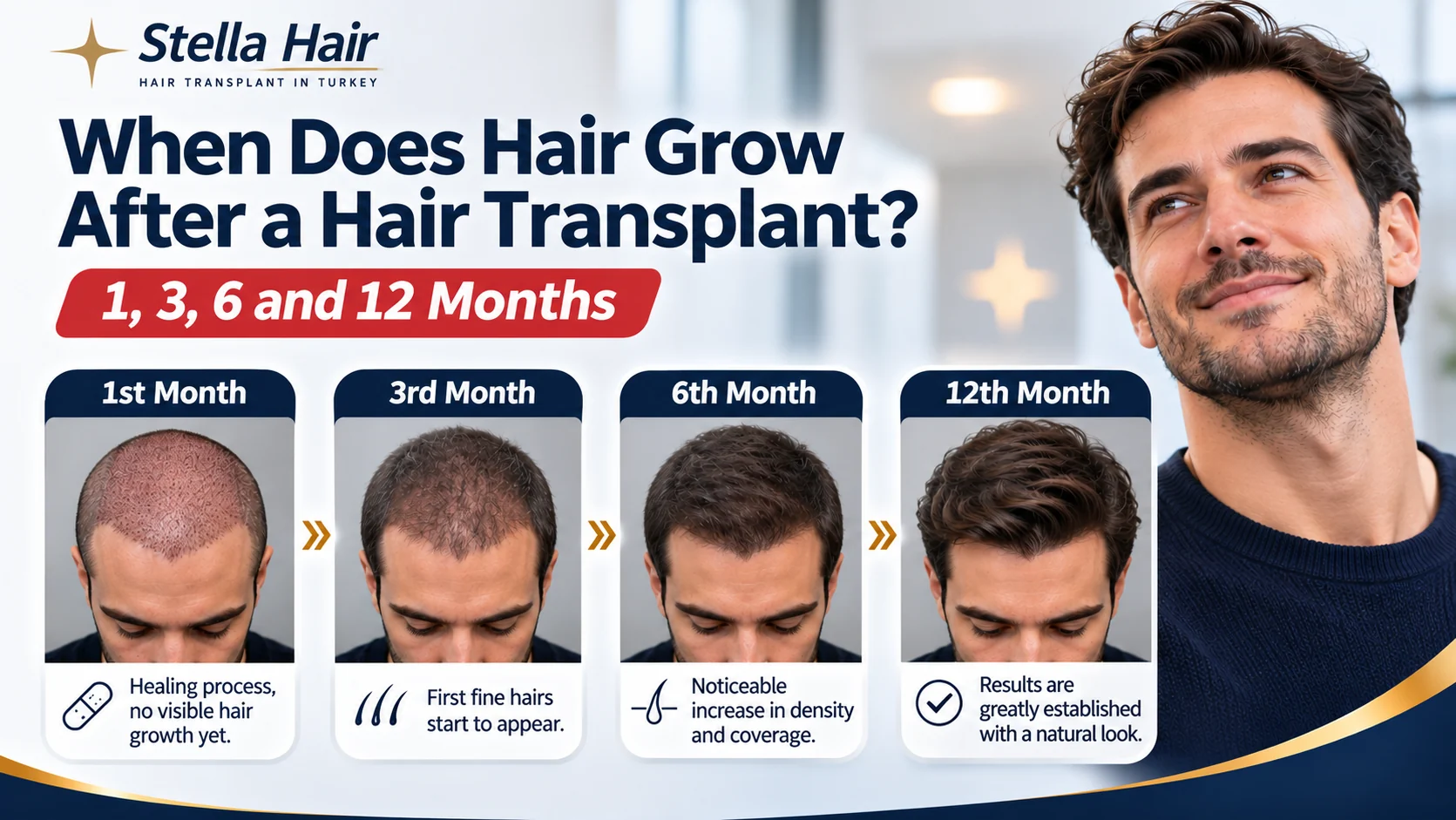
When Does Hair Grow After a Hair Transplant? 1, 3, 6 and 12 Months
One of the most common questions patients ask after undergoing hair transplantation is when their transplanted hair will begin to grow and how long it will take to achieve visible results. Hair restoration is a gradual biological process, and new hair growth does not happen immediately after surgery. At Istanbul Stella Hair, we explain that transplanted follicles need time to settle into their new location, enter their natural growth cycle, and produce visible hair. Understanding the hair transplant growth timeline helps patients develop realistic expectations throughout recovery.
At Istanbul Stella Hair, we believe that successful hair restoration involves more than the transplantation procedure itself. Understanding how transplanted hair develops, monitoring progress, and recognizing normal changes are important parts of the overall experience. So, when does transplanted hair start growing? Is it normal to see very little growth after three months? How much improvement can patients expect after six months, and are hair transplant results final after one year? In this guide, we explain the typical hair transplant growth stages from the first month through the twelfth month and beyond.
When Does Transplanted Hair Start Growing?
New transplanted hair generally begins to become visible around three to four months after surgery. However, noticeable improvements in density usually develop later.
Many patients observe significant changes between six and nine months, while results are often largely established around twelve months.
For some individuals, particularly those who have undergone transplantation in the crown area, further thickening and maturation may continue for up to eighteen months.
The following table provides a general overview of the hair transplant growth timeline.
Time After Surgery
Typical Hair Growth Development
Month 1
Initial healing and temporary shedding
Month 2
Resting phase with little visible growth
Month 3
Early fine hairs may begin to appear
Month 4
New hair growth becomes more noticeable
Months 5–6
Visible improvements in coverage and density
Months 7–9
Hair continues growing, thickening, and gaining volume
Months 10–12
Results become substantially more established
Months 12–18
Additional maturation and thickening in some patients
These are general timeframes rather than guaranteed milestones. Individual results depend on several biological and medical factors.
Hair Transplant After 1 Month: Why Is There Little New Growth?
The first month after a hair transplant is primarily associated with healing rather than new hair growth.
During the initial days and weeks, patients may experience temporary redness, sensitivity, and small scabs around the transplanted follicles.
These symptoms generally improve as the scalp heals.
Although transplanted hair shafts may initially remain visible, many begin to shed during the first few weeks.
This temporary shedding is a common part of the recovery process.
Losing transplanted hair shafts does not necessarily mean that the follicles have been lost.
The hair shaft and the follicle are different structures. A successfully established follicle can remain beneath the scalp even when its visible hair shaft sheds.
During this period, some patients notice that the transplanted area appears thinner than it did immediately after surgery.
This can be concerning, especially for individuals expecting continuous hair growth.
However, the appearance of the scalp during the first month is not a reliable indication of the final outcome.
Patients should focus on following their medical team's postoperative instructions rather than judging hair density at this early stage.
Hair Transplant After 2 Months: Is No Growth Normal?
The second month can be one of the most frustrating stages of hair transplant recovery.
By this point, the initial healing process has usually progressed considerably, but the transplanted area may still show very little visible hair growth.
This happens because many follicles have not yet entered the visible growth phase.
Some patients may notice very short or fine hairs beginning to emerge, while others see almost no change.
Both situations can fall within the normal recovery timeline.
The appearance of new hair during the second month varies considerably between individuals.
At Istanbul Stella Hair, we encourage patients to evaluate progress over several months rather than comparing their appearance from one day to the next.
A lack of visible hair growth after two months does not automatically indicate an unsuccessful transplant.
Hair Transplant After 3 Months: Does New Hair Start Growing?
The third month represents an important transition in the hair transplant growth timeline.
For many patients, this is when the first signs of new hair growth may become noticeable.
However, the emerging hairs are often different from the thicker, mature strands patients expect.
During the third month, new hair may:
- Appear thin and short.
- Grow at different rates across the transplanted area.
- Have a lighter or softer appearance.
- Provide only limited coverage.
- Create an uneven or patchy appearance.
For example, patients may notice several new hairs around the frontal hairline while other transplanted areas remain relatively sparse.
This does not necessarily indicate a problem.
Hair follicles do not all begin producing visible hair at the same time.
Some may enter their growth phase earlier, while others require additional time.
It is also possible for patients to see little noticeable development until the fourth month.
Hair transplant results at three months are still considered an early stage and should not be mistaken for the final outcome.
Hair Transplant After 4 Months: Growth Becomes More Noticeable
Around the fourth month, new hair growth often becomes easier to recognize.
Areas that previously appeared almost empty may begin showing additional fine hairs.
However, the density and length of the newly emerging strands can still vary considerably.
Some hairs may grow faster, while others are only beginning to emerge.
This can create an uneven appearance during the early growth stages.
The frontal hairline may start looking more defined, although the overall density is usually still developing.
Patients should remember that visible improvement at four months is encouraging, but the transplantation result has not yet reached its mature stage.
Hair Transplant After 5 and 6 Months: How Much Hair Should Have Grown?
The fifth and sixth months are often associated with increasingly visible improvements in hair coverage.
During this stage, more transplanted follicles may produce visible hair, while strands that appeared earlier can gradually become thicker.
This combination can make the transplanted area look noticeably fuller.
Common developments during months five and six include:
- Increasing numbers of visible hair strands.
- Gradual thickening of previously fine hairs.
- Better coverage in areas that appeared sparse.
- A more defined frontal hairline.
- Longer hair that may become easier to style.
However, six-month hair transplant results are generally not considered final.
Some patients experience substantial improvement by this stage, while others develop visible density more slowly.
It is important not to assume that everyone will achieve the same percentage of their final density after six months.
Hair growth varies according to individual biological factors, follicle characteristics, and the area being treated.
At Istanbul Stella Hair, we emphasize evaluating the overall progression of growth rather than relying on a fixed percentage for every patient.
Hair Transplant After 7, 8 and 9 Months: Does Hair Density Increase?
Between the seventh and ninth months, many patients begin noticing a more substantial change in their appearance.
During this stage, the improvements are not limited to new hairs emerging.
Previously grown strands may continue to lengthen and become thicker, contributing to greater visual density.
As the transplanted hair develops, the scalp may become less visible.
Patients may also find it easier to style their hair.
However, different parts of the scalp can progress at different rates.
For instance, the frontal hairline may appear relatively mature while the crown continues to develop more slowly.
Hair thickness, texture, and overall coverage may continue changing throughout this period.
By the ninth month, many patients have a much clearer understanding of their developing results, although further improvement remains possible.
Hair Transplant After 10, 11 and 12 Months: Are the Results Final?
Twelve months after a hair transplant is an important milestone for evaluating the overall outcome.
By this stage, many patients have experienced substantial growth, and the transplanted hair often looks more established.
Several aspects of the result can now be assessed more meaningfully:
- The appearance and shape of the hairline.
- Overall coverage of the transplanted area.
- Hair growth direction.
- Hair shaft thickness.
- Distribution of density.
- Integration with existing natural hair.
However, twelve months should not be considered an absolute deadline for every patient.
Some individuals, particularly those receiving crown transplantation, may continue experiencing improvements in hair thickness and visual density.
In these cases, the final appearance may continue developing beyond the first year.
Hair Transplant After 12 to 18 Months: Can Hair Still Improve?
Yes. Some patients continue noticing improvements after twelve months.
This later stage is generally associated with hair maturation rather than the beginning of the entire growth process.
Previously emerged hairs may continue becoming thicker and contributing to greater coverage.
The crown area can sometimes require additional time before the final appearance becomes clear.
However, continued improvement is not guaranteed for every individual.
If the results remain significantly below expectations, patients should discuss their progress with the healthcare professionals responsible for their treatment.
What Factors Affect Hair Transplant Growth Speed?
Not everyone experiences the same hair transplant growth timeline.
Several factors can influence how quickly transplanted hair becomes visible and how dense it eventually appears.
1. The Natural Hair Growth Cycle
Hair follicles move through different biological stages, including growth, transition, and resting phases.
Because follicles do not all follow identical schedules, transplanted hairs may emerge at different times.
2. Hair Thickness and Characteristics
Hair shaft thickness plays an important role in visual coverage.
Thicker hair strands may provide greater apparent density than finer strands, even when the number of transplanted follicles is similar.
Hair color, curl pattern, and the contrast between hair and scalp can also affect the appearance of fullness.
3. The Transplanted Area
Hair growth and maturation can differ between the frontal region and the crown.
Some patients notice earlier visual improvement in the frontal hairline, while crown results may take longer to mature.
4. Overall Health
General health and certain medical conditions can influence the normal hair growth cycle.
Nutritional deficiencies, hormonal disorders, or scalp diseases may also affect hair health.
Patients experiencing unusual hair changes should seek appropriate medical evaluation.
5. Postoperative Care
Following the recommended aftercare instructions is important for protecting the transplanted area and reducing preventable complications during recovery.
However, no shampoo, supplement, or cosmetic product can guarantee that transplanted hair will grow by a particular month.
How Should Hair Transplant Progress Be Monitored?
Checking hair density every day is rarely useful because hair growth occurs gradually.
Small daily changes are difficult to recognize.
A more practical approach is to compare photographs taken at regular intervals.
For example, patients can document their appearance at:
- One month
- Three months
- Six months
- Nine months
- Twelve months
For accurate comparisons, photographs should be taken under similar conditions.
Try to maintain consistent lighting, camera angles, hair length, and styling.
Comparing wet hair with dry hair can be misleading because moisture changes how much of the scalp remains visible.
Photographs of the frontal, side, and crown regions can help patients and healthcare professionals assess progression over time.
What If Transplanted Hair Is Not Growing?
Limited visible growth during the first three months does not automatically indicate a failed hair transplant.
However, patients should contact their treatment team if they experience unusual symptoms or remain concerned about their progress.
Signs such as increasing pain, persistent swelling, spreading redness, or discharge require medical attention rather than waiting for the next growth milestone.
If there is very little visible development around the sixth month, an individual assessment may be appropriate.
Similarly, unexpected density concerns at nine or twelve months should be discussed with the responsible healthcare professionals.
Patients should avoid starting medications, supplements, or scalp treatments solely to accelerate growth without appropriate medical advice.
The most suitable postoperative approach depends on the individual's medical history and recovery.
Frequently Asked Questions
When does hair start growing after a hair transplant?
New transplanted hair generally begins becoming visible around the third or fourth month. Noticeable improvements in density often develop over the following months.
Is it normal to have no hair growth after three months?
Yes. Some patients experience very limited visible growth at three months. Hair emergence varies between individuals, and development may become more noticeable during the fourth month.
How much hair should grow after six months?
Many patients experience visible improvements in coverage and thickness by six months. However, the amount of growth differs, and six months is generally too early to evaluate the final result.
Can transplanted hair still be thin after eight months?
Yes. Hair thickness and density may continue improving beyond eight months. Some areas can develop more slowly than others.
Are hair transplant results complete after twelve months?
For many patients, results are largely established around twelve months. However, additional maturation may continue up to eighteen months in some cases, particularly in the crown area.
Does all transplanted hair grow at the same time?
No. Individual follicles may enter their growth phases at different times, resulting in gradual and sometimes uneven hair emergence.
Does DHI hair transplantation grow faster than FUE?
There is no reliable guarantee that DHI will produce faster hair growth than FUE in every patient. Both procedures involve transplanted follicles following their biological growth cycles.
Can anything make transplanted hair grow faster?
Maintaining general health and following professional aftercare instructions supports recovery. However, no single treatment or product guarantees faster transplanted hair growth for every patient.
Conclusion: Hair Transplant Growth Takes Time
When does hair grow after a hair transplant? In general, the first visible hairs may begin emerging around three to four months after surgery. Improvements in density often become more noticeable after six months, while results are commonly evaluated around twelve months.
Some patients may continue experiencing hair maturation for up to eighteen months.
The exact growth pattern depends on individual biological factors, the transplanted area, and the patient's overall health.
At Istanbul Stella Hair, we believe that understanding the hair transplant growth timeline is an important part of establishing realistic expectations and monitoring recovery.
For more information about available hair restoration methods, explore our hair transplantation services and learn how the treatment process is planned.
Medical Disclaimer: This article is provided for general educational purposes. Individual recovery and hair growth timelines may vary. Patients should consult the healthcare professionals responsible for their treatment for personalized assessment and medical advice.
