When Can You Wear a Hat After a Hair Transplant?
When can you wear a hat after a hair transplant? Learn when to use caps, helmets, beanies and hard hats safely without putting transplanted grafts at risk.
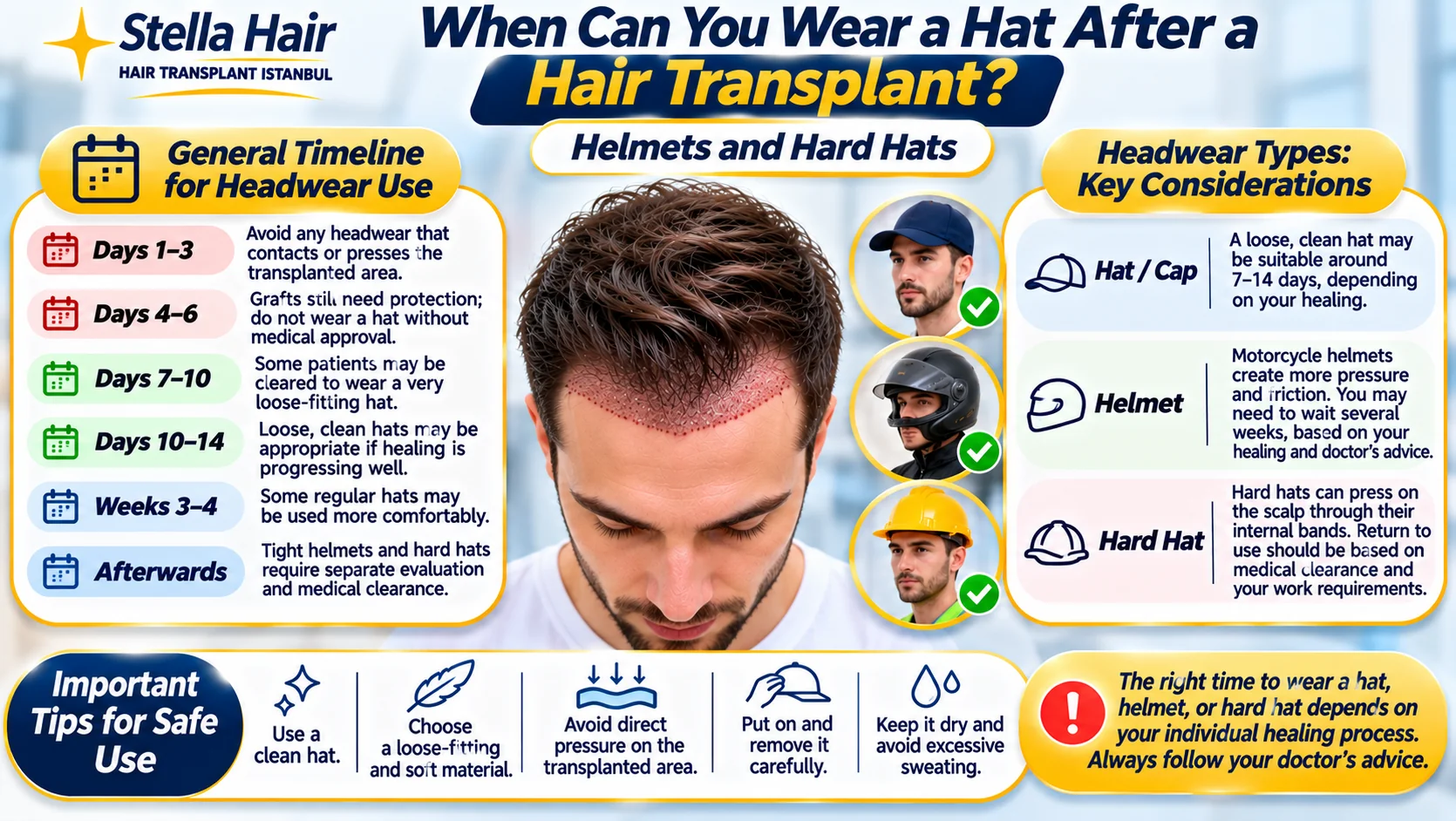
When Can You Wear a Hat After a Hair Transplant? Helmets and Hard Hats
When can you wear a hat after a hair transplant? This is one of the most common questions patients ask during the recovery period. Whether you regularly wear a baseball cap, ride a motorcycle, or work in an environment that requires a safety helmet, understanding when headwear can be used is important. Newly transplanted hair follicles need time to become securely established in the recipient area, and unnecessary pressure or friction during the early healing period should be avoided. At Istanbul Stella Hair, we emphasize the importance of protecting transplanted grafts and following appropriate postoperative care instructions.
At Istanbul Stella Hair, we believe that returning to everyday activities safely is an important part of the hair transplant experience. Many patients want to know when they can wear their usual hats, protective helmets, or workplace hard hats without interfering with recovery. However, not all headwear creates the same amount of pressure on the scalp. So, how many days after a hair transplant can you wear a hat? When is it appropriate to use a motorcycle helmet? Can construction workers return to wearing hard hats? In this guide, we explain the general recovery timeline, different types of headwear, and the precautions patients should consider.
Can You Wear a Hat After a Hair Transplant?
Yes, wearing a hat after a hair transplant is generally possible, but timing and the type of hat are important.
During hair transplantation, follicles extracted from the donor region are implanted into areas affected by hair loss.
The newly implanted grafts need time to become established within the surrounding scalp tissue.
During the first days after surgery, pressure, rubbing, or pulling against the recipient area may increase the risk of disturbing these grafts.
For this reason, patients are generally advised to avoid tight hats and headwear that directly touches the transplanted area during early recovery.
However, a loose-fitting cap and a motorcycle helmet should not be treated as equivalent.
The following factors should be considered before wearing headwear:
- Whether the material touches the transplanted area
- How much pressure it applies to the scalp
- Whether friction occurs when putting it on or removing it
- The stiffness and cleanliness of the material
- The patient's individual healing progress
- How long the headwear will be used
The safest approach is to follow the postoperative instructions provided by the medical team responsible for the transplantation.
How Many Days After a Hair Transplant Can You Wear a Hat?
The first several days after hair transplant surgery are particularly important for protecting newly implanted follicles.
In some postoperative care protocols, wearing a clean, loose-fitting hat may be considered around 7–14 days after surgery, provided healing is progressing normally.
However, this timeframe is not a universal medical clearance.
Some patients may require additional time, particularly when scabbing, sensitivity, or delayed wound healing remains present.
General Timeline for Wearing Hats After Hair Transplantation
Time After Surgery
General Headwear Considerations
Days 1–3
Avoid headwear that contacts or presses against the transplanted area.
Days 4–6
The grafts still require protection; do not wear hats without medical approval.
Days 7–10
Certain patients may be cleared to wear very loose-fitting hats.
Days 10–14
Loose, clean hats may become appropriate if healing is satisfactory.
Weeks 3–4
Some patients may be able to return to additional types of ordinary headwear.
Later recovery
Tight helmets and hard hats require separate consideration and medical clearance.
These are approximate stages rather than guaranteed dates.
Permission to wear a loose cap does not automatically mean that a motorcycle helmet or construction hard hat is safe to use.
Why Should You Avoid Hats During the First Three Days?
Immediately after transplantation, the implanted follicles are in the early stages of becoming established within the recipient area.
The scalp also contains many small surgical openings that require time to heal.
During this period, a hat can potentially cause mechanical irritation.
For example, pulling a tight hat over the head may create friction against the implanted follicles.
Removing it can also disturb scabs or produce unwanted pulling forces.
During early recovery, patients should generally avoid:
- Applying direct pressure to the transplanted area
- Rubbing or scratching the recipient region
- Forcibly removing scabs
- Wearing tight hats or elastic headbands
- Allowing clothing or accessories to scrape against the grafts
These precautions are relevant not only when wearing hats but also while changing clothes, sleeping, and performing daily activities.
When Do Hair Transplant Grafts Become Secure?
Transplanted follicles become more firmly established within the surrounding tissues as healing progresses.
However, graft security is not an immediate process.
During the first days, newly implanted follicles can be vulnerable to mechanical pulling.
A clinical study investigating graft anchoring found that the risk of dislodgement following pulling decreased substantially during the first postoperative days, with grafts becoming more secure by approximately day nine.
Nevertheless, this does not mean that all pressure and friction become harmless after nine days.
The surrounding scalp may still have scabs, redness, tenderness, or other signs of healing.
Graft anchoring and complete scalp recovery are not the same thing.
This distinction is particularly important when considering tight hats, helmets, and workplace safety equipment.
What Type of Hat Can You Wear After a Hair Transplant?
Once the medical team confirms that wearing a hat is appropriate, the characteristics of the headwear become important.
Generally, a clean, lightweight, loose-fitting design is preferable to one that tightly compresses the scalp.
Loose-Fitting Baseball Caps
An adjustable baseball cap may be suitable for some patients after the initial healing period.
However, the front section should not press against the transplanted hairline.
The cap should be positioned carefully and should not rub against the recipient area when being put on or removed.
An adjustable strap does not automatically make a cap safe if its structure still creates pressure.
Soft, Breathable Hats
Soft materials may be more comfortable than stiff or abrasive fabrics.
Breathable materials can also reduce discomfort associated with heat.
However, soft fabric does not guarantee safe use.
The hat must still fit appropriately and avoid unnecessary contact with healing areas.
Hats to Avoid During Early Recovery
Tight-fitting caps, restrictive headbands, and hats with strong elastic edges may place pressure on the recipient area.
These should generally be avoided until the scalp has healed sufficiently and their use has been approved.
The important consideration is not simply whether a hat feels comfortable but whether it can be worn without disturbing the treated scalp.
When Can You Wear a Beanie After a Hair Transplant?
Beanies are commonly worn during colder months, particularly in winter.
However, many beanies fit closely around the scalp.
Their elastic structure can create pressure across the frontal hairline and other transplanted areas.
Pulling a beanie over the head may also cause friction.
For this reason, tight beanies require more caution than certain loose-fitting hats.
During approximately the first 10–14 days, avoiding tight beanies is generally a sensible precaution.
Even after that period, patients should obtain medical clearance if the treated scalp remains sensitive.
Winter patients should consider their need for warm headwear when scheduling surgery.
Planning time away from activities that require tight head coverings may make recovery easier.
When Can You Wear a Motorcycle Helmet After a Hair Transplant?
Motorcycle helmets require special consideration because they are designed to fit securely around the head.
Unlike a loose cap, a motorcycle helmet contains internal padding that contacts multiple areas of the scalp.
A properly fitted helmet must remain secure during riding.
However, this protective design may create problems during the early stages of hair transplant recovery.
Potential concerns include:
- Pressure from the helmet's internal padding
- Friction when putting on or removing the helmet
- Contact with the newly transplanted hairline
- Increased sweating and scalp irritation
- Prolonged compression during use
- Accidental pulling against healing tissue
Some patients may need to wait several weeks before returning to motorcycle helmet use.
However, there is no universally established postoperative day when every motorcycle helmet becomes safe.
The appropriate timing depends on the location of the transplanted area, scalp healing, helmet fit, and the assessment of the treating healthcare professional.
Can You Ride a Motorcycle Without a Helmet After Hair Transplantation?
No. Riding without a required protective helmet is not a safe alternative.
If the scalp has not healed sufficiently to tolerate a motorcycle helmet, the appropriate solution is to postpone riding or arrange alternative transportation.
Protecting transplanted hair should never involve compromising essential road safety measures.
When Can You Wear a Hard Hat After a Hair Transplant?
Construction workers, industrial employees, engineers, and other professionals may be required to wear hard hats throughout the working day.
Unlike ordinary caps, hard hats are personal protective equipment designed to reduce the risk of head injuries.
Their internal suspension systems, headbands, and adjustment mechanisms can place pressure on specific regions of the scalp.
These contact points may overlap with recently transplanted areas.
For this reason, hard hat use should be considered separately from ordinary hat use.
Why Can Hard Hats Be Problematic During Recovery?
A hard hat may create several challenges:
- Internal straps can press against the transplanted hairline.
- Headbands may rub against healing areas.
- Extended use can cause discomfort.
- Heat and sweating may increase irritation.
- Adjusting or removing the helmet can disturb sensitive scalp tissue.
Even if the outer shell does not directly touch the scalp, the internal suspension system may still create pressure.
Therefore, simply selecting a larger hard hat does not necessarily eliminate the problem.
How Should Workers Plan Their Return?
Employees required to wear hard hats should ideally discuss their recovery needs with their employer before undergoing transplantation.
Possible arrangements may include temporary administrative duties, approved medical leave, or work in an area where protective headwear is not required.
However, workers should never enter hazardous work environments without the required protective equipment.
The appropriate approach is to coordinate medical clearance and workplace safety requirements rather than removing essential safety equipment.
Some patients may be able to resume hard hat use after several weeks, while others may require more time.
The exact decision must be based on individual healing and the pressure points created by the equipment.
Can Wearing a Hat Damage Transplanted Hair Follicles?
Wearing a hat does not always damage transplanted follicles.
The potential risk depends on when it is worn, how it fits, and whether it creates mechanical pressure or friction.
During early recovery, rubbing or pulling against newly implanted grafts may interfere with healing.
However, once the follicles are securely established and the scalp has recovered sufficiently, appropriately fitted headwear can generally be used again.
This means patients do not need to avoid hats permanently after hair transplantation.
The restriction is primarily associated with the early postoperative period.
At Istanbul Stella Hair, we emphasize the importance of protecting transplanted follicles during this temporary phase rather than unnecessarily restricting normal activities in the long term.
Can Sweating Under a Hat Affect Hair Transplant Results?
Sweating can occur when wearing hats, particularly during hot weather or physical activity.
Sweating alone does not automatically cause transplanted follicles to fail.
However, excessive sweating may increase discomfort, itching, and irritation while the scalp is healing.
Patients may also be tempted to scratch or wipe the area.
These actions can create additional friction.
For this reason, once headwear has been approved, patients should choose clean and appropriate materials.
Hats should not remain excessively damp or dirty.
The scalp should be cleaned according to the postoperative washing instructions provided by the treating medical team.
Can You Wear a Hat After Completely Unshaven Long DHI?
Yes. Patients undergoing completely unshaven Long DHI transplantation may also return to wearing hats when their scalp has healed sufficiently.
At Istanbul Stella Hair, we offer Long DHI as a completely unshaven hair transplantation procedure.
Our approach is designed to preserve the existing hair length in both the donor and recipient areas.
However, preserving hair length does not mean that the scalp avoids surgical intervention.
Follicles are still extracted from the donor region and implanted into the recipient area.
Therefore, transplanted grafts still require protection during early recovery.
The existing hair length does not eliminate the need to avoid pressure and friction.
Patients undergoing Long DHI should follow the same individualized principles regarding hats, motorcycle helmets, and workplace hard hats.
Important Precautions When Wearing a Hat After Hair Transplantation
Once the medical team confirms that hat use is appropriate, patients should continue taking reasonable precautions.
- Choose clean headwear.
- Avoid hats that place pressure on the transplanted area.
- Put on and remove hats carefully.
- Avoid stiff or excessively tight internal bands.
- Stop using headwear if it causes pain or unusual discomfort.
- Avoid prolonged use if the scalp remains sensitive.
- Do not assume helmet or hard hat clearance simply because ordinary hats are permitted.
If bleeding, increasing pain, or unusual irritation occurs after wearing headwear, patients should contact the healthcare professionals responsible for their procedure.
Frequently Asked Questions
Can I wear a hat seven days after a hair transplant?
Some patients may be cleared to wear a very loose-fitting hat around day seven. However, the condition of the grafts, remaining scabs, and scalp sensitivity must be considered. Medical approval is necessary.
Can I wear a cap ten days after a hair transplant?
A clean and loose-fitting cap may be appropriate for certain patients if healing is progressing normally. However, tight hats, motorcycle helmets, and hard hats should be assessed separately.
Is it safe to wear a hat 15 days after a hair transplant?
Many patients experience substantial scalp healing within the first two weeks. Nevertheless, the suitability of ordinary hats depends on individual recovery and the instructions of the treating healthcare professional.
How long should I wait before wearing a motorcycle helmet?
Motorcycle helmets create greater pressure and friction than ordinary caps. Some patients may need several weeks before returning to helmet use. The exact timing depends on healing and medical clearance.
Can wearing a hard hat damage transplanted hair?
During early recovery, the internal headband or suspension system of a hard hat may press against sensitive transplanted areas. Patients should arrange appropriate work accommodations until protective equipment can be used safely.
When can I wear a beanie after a hair transplant?
Tight beanies should generally be avoided during the early postoperative period. Patients should wait until the scalp has healed sufficiently and the treating medical team confirms that use is appropriate.
Does wearing a hat cause transplanted hair to fall out?
Pressure or friction during early recovery may disturb grafts. However, once healing is complete, normal use of suitable headwear does not automatically cause transplanted follicles to fall out.
Can I wear a hat after an unshaven hair transplant?
Yes, but the existing hair length does not eliminate postoperative restrictions. Even completely unshaven procedures require graft protection while the scalp heals.
Conclusion: When Can You Safely Wear a Hat After a Hair Transplant?
When can you wear a hat after a hair transplant? The answer depends on the type of headwear, the location of the transplanted grafts, and the patient's individual healing process.
For some patients, loose-fitting hats may become appropriate around 7–14 days after surgery.
However, tight beanies, motorcycle helmets, and workplace hard hats require additional consideration because they can place more pressure on the scalp.
The early recovery period is particularly important for protecting newly transplanted follicles.
At Istanbul Stella Hair, we emphasize postoperative care that supports safe healing and a gradual return to everyday activities.
Patients should follow their medical team's individualized recommendations before returning to hats, helmets, or other protective headwear.
For more information about hair transplantation methods and the recovery process, explore our hair transplant services.
Medical Disclaimer: This article is intended for general educational purposes only. The appropriate timing for wearing hats, helmets, or hard hats after hair transplantation depends on individual healing and should be determined by qualified healthcare professionals.
