When Can You Cut Your Hair After a Hair Transplant?
When can you cut your hair after a hair transplant? Learn when to use scissors, clippers or razors, and how to protect your transplanted grafts.
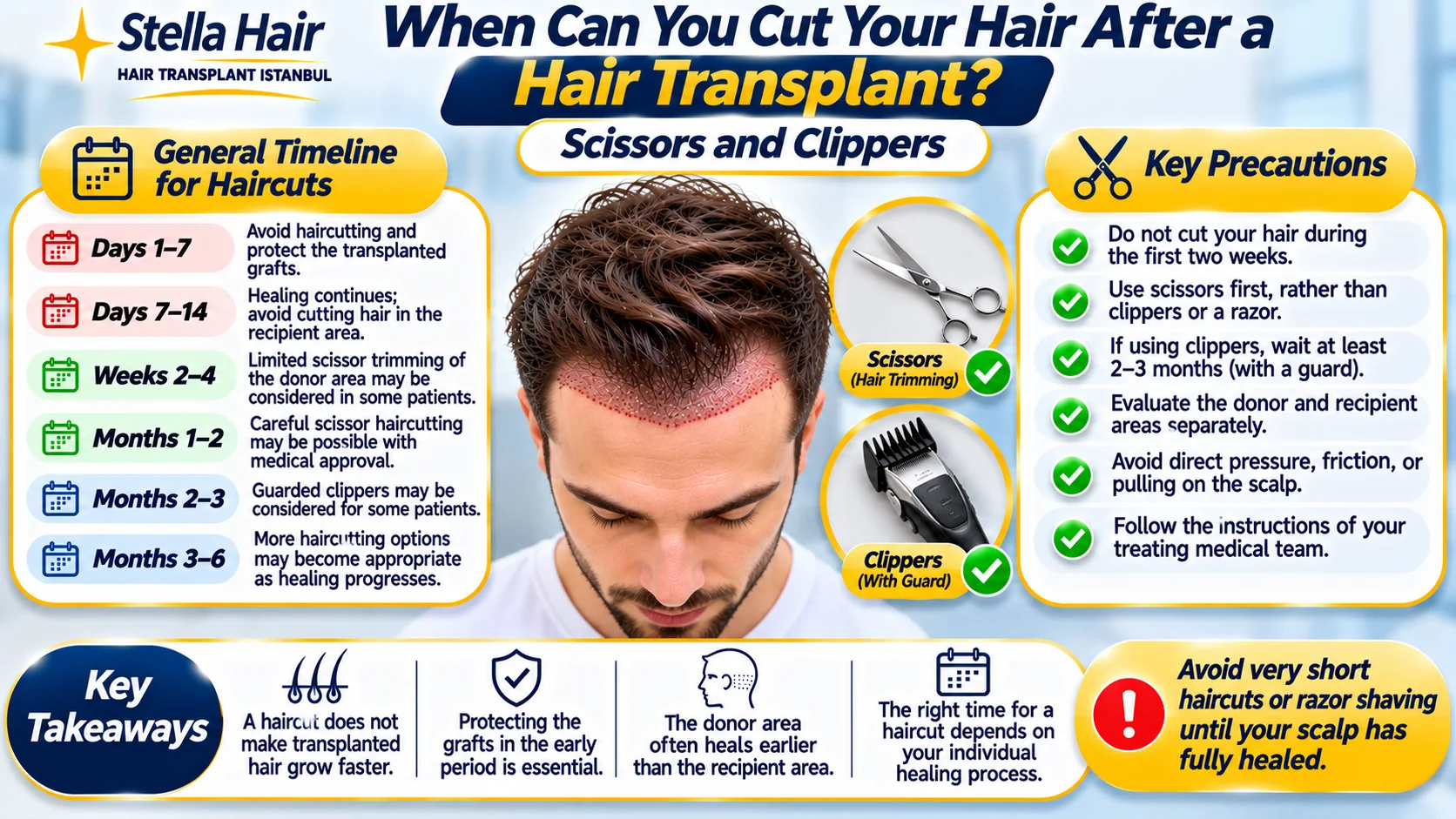
When Can You Cut Your Hair After a Hair Transplant? Scissors and Clippers
When can you cut your hair after a hair transplant? This is one of the most common questions patients ask following hair restoration surgery. As the remaining hair begins growing, differences in length between the donor and recipient areas may become more noticeable. Some patients want to visit their barber to restore a more balanced hairstyle, while others wonder whether they can use scissors, electric clippers, or a razor. However, newly transplanted follicles and the surrounding scalp tissues require time to heal. At Istanbul Stella Hair, we emphasize the importance of protecting implanted grafts and choosing an appropriate time for the first postoperative haircut.
At Istanbul Stella Hair, we believe that returning to normal grooming habits should be part of a carefully planned recovery process. Cutting hair with scissors, using electric clippers, and shaving the scalp closely are not equivalent procedures. They involve different levels of contact, pressure, and friction. The donor area may also heal differently from the recipient area. So, how long should you wait before getting a haircut after a hair transplant? Is it safer to use scissors first? Can electric clippers damage transplanted follicles? In this guide, we explain the general timing, precautions, and differences between haircutting methods after hair transplantation.
When Can You Get Your First Haircut After a Hair Transplant?
The first haircut is generally considered only after the initial healing period has progressed sufficiently. In many postoperative care protocols, a careful scissor haircut may be considered around one month after surgery.
However, this is not a universal rule.
Hair transplant recovery varies between patients, and the donor and recipient areas may heal at different rates.
During the first two weeks, protecting the transplanted grafts from pressure, pulling, and friction is especially important.
The timing of a haircut depends on several factors:
- The condition of the recipient area
- The healing progress of the donor area
- Whether scabs or redness remain
- The haircutting instrument being used
- The amount of contact with the scalp
- Individual postoperative instructions
General Haircut Timeline After Hair Transplantation
Time After Surgery
General Haircut Considerations
Days 1–7
Avoid haircuts and protect the transplanted grafts.
Days 7–14
Early healing continues; avoid cutting hair in the recipient area.
Weeks 2–4
Limited scissor trimming of the healed donor area may be considered in selected patients.
Months 1–2
Careful scissor trimming may be possible with medical approval.
Months 2–3
Guarded electric clippers may be considered for some patients.
Months 3–6
More haircutting options may become appropriate as healing progresses.
Later recovery
Normal grooming can gradually resume according to individual healing.
These are general estimates rather than guaranteed dates.
Very close clipper cuts or razor shaving may require a longer waiting period.
Why Should You Avoid Haircuts During the First Two Weeks?
The first days after hair transplantation are important for graft anchoring and wound healing.
During the procedure, extracted follicles are implanted into small recipient sites in the scalp.
These newly placed grafts gradually become established within the surrounding tissues.
During early recovery, mechanical pressure, rubbing, or pulling may disturb the transplanted area.
Haircutting tools can create some of these mechanical effects.
For example, a comb may scrape the recipient area, or electric clippers may press against healing skin.
During the first two weeks, patients should generally avoid:
- Applying unnecessary pressure to transplanted areas
- Brushing or combing the scalp aggressively
- Scratching the recipient area
- Forcibly removing scabs
- Using electric clippers directly over the grafts
- Pulling hair during styling or trimming
Although grafts generally become more secure as healing progresses, this does not mean that the scalp has completely recovered.
Graft anchoring and complete skin healing are different stages of recovery.
This distinction is important when deciding when to resume haircutting.
Can You Cut Your Hair With Scissors After a Hair Transplant?
Yes. Scissor trimming may be possible once the scalp has healed sufficiently and the treating healthcare professionals approve it.
Scissors can shorten hair strands without requiring the same degree of scalp contact as very close electric clipper cuts.
However, using scissors is not automatically risk-free.
Pulling hair tightly, pressing a comb against the scalp, or allowing the scissors to touch healing tissue may cause irritation.
Some patients may be cleared for careful scissor trimming around one month after surgery.
Others may need additional time, especially when redness, scabbing, or sensitivity persists.
Precautions for the First Scissor Haircut
During the first approved haircut:
- Avoid pulling the hair tightly.
- Keep scissors away from the scalp.
- Trim the ends rather than cutting extremely close.
- Do not cut areas that remain tender or scabbed.
- Use clean scissors and combs.
- Avoid aggressive brushing or styling.
- Follow the instructions of the treating medical team.
The first haircut should prioritize gentle handling rather than achieving a very short hairstyle.
When Can You Use Electric Clippers After a Hair Transplant?
Using electric clippers requires additional consideration because the device may come into direct contact with the scalp.
Depending on the guard length, clippers can create pressure and friction against the skin.
This is especially important around the recipient area.
Some postoperative protocols recommend waiting approximately two to three months or longer before using electric clippers directly over transplanted areas.
However, the appropriate timing varies between patients and clinics.
The donor area may sometimes tolerate haircutting earlier than the recipient area.
It is therefore important not to treat the entire scalp as one uniform healing region.
Precautions When Using Hair Clippers
Once medical clearance has been given:
- Use clean and properly maintained clippers.
- Avoid very short settings during the first clipper haircut.
- Consider using an appropriate protective guard.
- Do not press the device firmly against the scalp.
- Avoid areas with ongoing redness, tenderness, or irritation.
- Do not stretch or pull the skin aggressively.
- Stop if discomfort or unusual irritation develops.
A guarded clipper haircut may be different from a zero-guard or skin-close shave.
The type of haircut should be discussed with the medical team before proceeding.
When Can You Cut the Donor Area After a Hair Transplant?
The donor area is usually located at the back and sides of the scalp.
During FUE transplantation, individual follicular units are extracted from this region.
Each extraction creates a small surgical wound.
After surgery, the donor area may experience temporary redness, sensitivity, and small scabs.
However, healing in the donor region may differ from healing in the recipient area.
In some patients, the donor area may become suitable for limited scissor trimming earlier.
For example, careful trimming may be considered within approximately two to four weeks if superficial healing has progressed satisfactorily.
Nevertheless, the absence of visible scabs does not automatically mean that every type of haircut is appropriate.
A donor area that is suitable for gentle scissor trimming may not yet be ready for a zero-guard clipper haircut or razor shaving.
Extremely short haircuts may also make the small scars associated with FUE extraction more visible.
When Can You Cut the Transplanted Hair?
The recipient area requires particular attention because the follicles have been placed into new locations.
During the first weeks, the area may experience redness, scabbing, and temporary sensitivity.
Some transplanted hair shafts may also shed during the early recovery period.
As a result, there may be relatively little newly transplanted hair to trim at first.
However, patients who receive transplantation between existing hair strands may still have longer hair in the recipient area.
These strands may eventually need trimming to maintain a balanced hairstyle.
A careful scissor haircut that avoids direct scalp contact may be considered after sufficient healing and medical approval.
Electric clippers and razors require greater caution because they may touch or irritate the recipient area.
The timing should be based on individual healing rather than hair length alone.
Can You Shave Your Head After a Hair Transplant?
Shaving the head very closely requires more caution than an ordinary scissor haircut.
With a zero-guard clipper or razor, the cutting instrument may come into direct contact with the scalp.
During early recovery, this contact can cause friction, irritation, or minor injuries.
Additionally, the small extraction scars in the donor region may become more noticeable when hair is cut extremely short.
For these reasons, very close shaving may require several months of healing before it is considered.
However, there is no universally established month when razor shaving becomes safe for every patient.
The appropriate timing depends on:
- Complete healing of the treated scalp
- Absence of ongoing tenderness or irritation
- Condition of the donor and recipient areas
- Type of shaving instrument
- Individual medical guidance
Patients should obtain approval from their treating healthcare professionals before using a razor or zero-guard clippers on the transplanted area.
Can Cutting Hair Damage Transplanted Follicles?
Cutting the visible part of a hair strand does not normally damage the follicle beneath the scalp.
This is because the hair shaft and the hair follicle are different structures.
The hair shaft is the visible portion above the skin.
The follicle is the biological structure within the skin responsible for producing hair.
A normal haircut shortens the hair shaft without removing the follicle.
However, this distinction is particularly important during early postoperative recovery.
Even if cutting the shaft itself is harmless, the pressure and friction created during the haircut may disturb healing tissue.
For example, pulling hair aggressively with a comb or pressing a clipper against the recipient area may cause irritation.
Therefore, the concern is not simply whether hair is being shortened.
The main consideration is how the haircut is performed and whether the scalp has healed sufficiently.
Does Cutting Transplanted Hair Make It Grow Faster?
No. Cutting transplanted hair does not make the follicles grow faster.
Hair growth is controlled by biological processes within the follicle.
Trimming the visible hair shaft does not directly accelerate these processes.
Some people believe that regularly cutting their hair encourages thicker or faster growth.
However, cutting hair does not change the number of follicles or increase the biological growth rate.
A haircut may create a more uniform appearance, but it does not accelerate transplanted hair development.
Following transplantation, new hair generally begins becoming visible around the third or fourth month.
Hair density and thickness may improve over subsequent months.
Many patients experience substantial development around twelve months, although some require longer.
The growth timeline should not be confused with the appropriate timing for the first haircut.
Is Haircut Timing Different After DHI and Sapphire FUE?
DHI and Sapphire FUE use different instruments during the implantation process.
However, both approaches involve surgical intervention in the scalp.
Consequently, the general precautions regarding graft protection and early healing are similar.
There is no reliable basis for claiming that every DHI patient can safely get a haircut earlier than every Sapphire FUE patient.
Similarly, Sapphire FUE does not automatically require a longer waiting period.
Haircut timing depends on the extent of surgery, healing progress, scalp sensitivity, and individual postoperative recommendations.
The method's name alone should not determine when haircutting resumes.
When Can You Cut Your Hair After Completely Unshaven Long DHI?
Patients undergoing completely unshaven hair transplantation may have different grooming concerns because their existing hair remains long.
At Istanbul Stella Hair, we offer Long DHI as a completely unshaven hair transplantation procedure.
Our approach is designed to preserve existing hair length in both the donor and recipient areas.
However, maintaining hair length does not eliminate the need for postoperative healing.
Follicles are still extracted from the donor area and implanted into the recipient region.
Therefore, the transplanted grafts must be protected during the early postoperative period.
Longer existing hair may also require extra care when combing or styling to avoid pulling or tangling near healing areas.
The timing of the first haircut after Long DHI should be assessed according to scalp healing, existing hair length, and the location of transplanted follicles.
When Can You Visit a Barber After a Hair Transplant?
Many patients want to visit their barber once the hair begins looking uneven.
However, the first appointment should be scheduled according to the medical team's recommendations rather than simply waiting for the hair to grow longer.
Before the haircut begins, patients should inform their barber that they have undergone hair transplantation.
It is particularly important to explain which areas were treated and whether clippers are permitted.
Precautions for the First Barber Visit
- Tell the barber when the procedure was performed.
- Explain which areas received transplanted follicles.
- Distinguish between the donor and recipient regions.
- Avoid clippers in areas where their use has not been approved.
- Do not request extremely short haircuts during early recovery.
- Avoid aggressive combing and scalp manipulation.
- Make sure all tools are clean.
- Stop the haircut if discomfort occurs.
The first postoperative haircut should be gentle and carefully controlled.
When Can You Dye or Style Hair After a Hair Transplant?
Haircutting and chemical hair treatments should not be treated as equivalent activities.
Even if scissors are permitted, this does not necessarily mean that hair dye, bleaching products, gels, waxes, or other styling products are appropriate.
Hair dye and chemical treatments can irritate healing skin.
Patients should avoid applying these products to areas that remain red, tender, or covered in scabs.
Similarly, high-temperature styling tools should not be placed directly against healing scalp tissue.
The timing of coloring and styling treatments should be discussed separately with the healthcare professionals responsible for postoperative care.
Frequently Asked Questions
Can I cut my hair 15 days after a hair transplant?
Some patients may be suitable for limited scissor trimming in the donor area after approximately two weeks. However, cutting hair in the transplanted region may still be premature. Individual medical approval is important.
Can I use scissors one month after a hair transplant?
In many patients, careful scissor trimming may be considered around one month after surgery if healing is progressing normally. However, the recipient and donor areas should be assessed separately.
Can I use electric clippers one month after a hair transplant?
One month may be too early for direct clipper use over the transplanted area. Some patients may need to wait several months. The appropriate timing depends on healing and the type of clipper haircut.
Can I use clippers three months after a hair transplant?
Guarded clippers may be appropriate for certain patients around three months after surgery. However, scalp healing, guard length, and direct contact with the recipient area should be considered.
When can I trim the donor area after FUE?
The donor area may become suitable for limited scissor trimming earlier than the recipient area. Some patients may be assessed for this within a few weeks, provided the extraction sites have healed sufficiently.
Can I shave my head with a zero guard after a hair transplant?
Very close clipper cuts may be possible after sufficient healing, but they require more caution than scissor trimming. The appropriate timing should be confirmed by the treating healthcare professionals.
Does cutting transplanted hair damage the roots?
Trimming the hair shafts does not normally damage the follicles beneath the scalp. However, during early recovery, pulling, pressure, or friction from haircutting tools may disturb the treated area.
Does cutting transplanted hair make it grow faster?
No. Haircuts do not increase follicle growth rates. Transplanted hair follows its natural biological growth cycle, regardless of whether the visible hair shafts are trimmed.
Can I get a haircut after Long DHI?
Yes, once healing is sufficiently advanced. Completely unshaven Long DHI preserves existing hair length but still involves follicle extraction and implantation. Haircut timing should follow individualized medical instructions.
Conclusion: Do Not Rush Your First Haircut After a Hair Transplant
When can you cut your hair after a hair transplant? The answer depends on the area being trimmed, the instrument being used, and the progress of scalp healing.
The first few weeks are particularly important for protecting newly transplanted follicles.
For some patients, gentle scissor trimming may become appropriate around one month after surgery.
However, electric clippers, very short haircuts, and razor shaving may require additional healing time.
The donor and recipient areas should not automatically be treated in the same way.
At Istanbul Stella Hair, we emphasize protecting transplanted follicles and helping patients return to their normal grooming habits at an appropriate stage of recovery.
The safest approach is to follow the personalized instructions provided by the healthcare professionals responsible for the procedure.
For more information about transplantation techniques and postoperative care, explore our hair transplant services.
Medical Disclaimer: This article is intended for general educational purposes only. Haircut timing, clipper use, shaving, and postoperative care should be determined according to individual recovery and the recommendations of qualified healthcare professionals.
