What Is the Norwood Scale? 7 Stages of Male Hair Loss
Discover the Norwood Scale and the seven stages of male pattern hair loss, from a receding hairline to advanced baldness and hair transplant suitability.
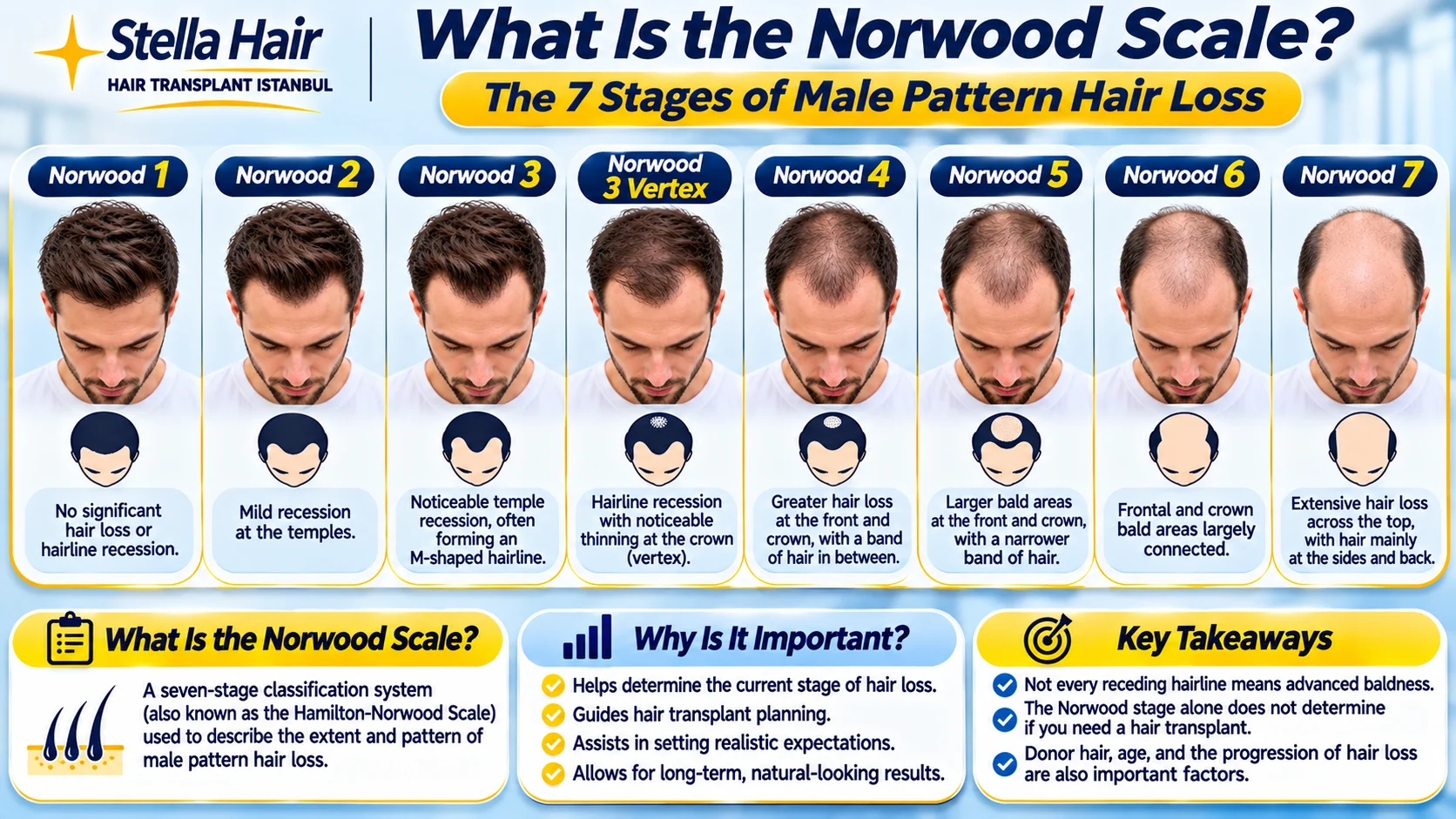
What is the Norwood Scale? The Norwood Scale is one of the most widely used classification systems for evaluating the progression and patterns of male hair loss. It helps describe changes such as a receding hairline, thinning temples, and hair loss around the crown. At Istanbul Stella Hair, we consider not only the visible extent of hair loss but also its distribution, potential progression, and the characteristics of the donor area when discussing hair restoration. Understanding the Norwood classification can therefore be a useful starting point for evaluating male pattern hair loss.
At Istanbul Stella Hair, we believe that understanding the different stages of hair loss helps patients make more informed decisions about their hair restoration options. Not every receding hairline indicates advanced baldness, and two individuals with the same Norwood classification may have very different treatment requirements. Donor hair density, hair shaft thickness, age, and the progression of hair loss all influence treatment planning. So, what do Norwood stages 1, 2, 3, 4, 5, 6, and 7 mean? What is Norwood 3 Vertex? At which stage may hair transplantation be considered? In this guide, we explain the Hamilton-Norwood Scale and its role in evaluating male pattern hair loss.
What Is the Norwood Scale?
The Norwood Scale is a seven-stage classification system used to describe the extent and distribution of male pattern hair loss.
Also known as the Hamilton-Norwood Scale, it is based on earlier work by James Hamilton in the 1950s.
The classification was later refined by Dr. O'Tar Norwood in 1975, producing the system widely used today.
The scale primarily describes androgenetic alopecia, commonly called male pattern baldness.
This condition is associated with genetic predisposition and the sensitivity of certain hair follicles to androgen hormones, particularly dihydrotestosterone (DHT).
Male pattern hair loss commonly involves:
- Gradual recession of the frontal hairline
- Thinning around the temples
- Reduced hair density at the crown
- Progressive thinning across the mid-scalp
- The development of larger bald areas in advanced stages
However, hair loss does not progress identically in every individual.
Some men first notice recession around the temples, while others experience more pronounced thinning at the crown.
The Norwood Scale helps describe these patterns, but it does not independently diagnose the underlying cause or predict how quickly hair loss will progress.
What Are the Seven Stages of the Norwood Scale?
The Norwood classification describes patterns of male hair loss from Stage 1 to Stage 7.
In general, Norwood 1 represents little or no visible male pattern hair loss, while Norwood 7 describes the most extensive pattern.
Norwood Scale Comparison Table
Stage
Typical Hair Loss Pattern
Norwood 1
No significant hairline recession or visible male pattern hair loss
Norwood 2
Mild recession around the temples
Norwood 3
Noticeable temporal recession, often forming an M-shaped hairline
Norwood 3 Vertex
Visible thinning or hair loss at the crown
Norwood 4
Greater frontal and crown hair loss, separated by a band of hair
Norwood 5
Larger bald areas with a narrower, thinner separating band
Norwood 6
Frontal and crown bald areas become largely connected
Norwood 7
Extensive loss across the top, with hair mainly remaining at the sides and back
These descriptions are general classifications. Individual hair loss patterns may vary, and not everyone progresses through every stage.
Norwood 1: No Significant Male Pattern Hair Loss
Norwood 1 represents a hairline with no significant signs of male pattern baldness.
At this stage, the frontal hairline is generally preserved.
There is no pronounced recession at the temples, and the crown typically retains its natural density.
However, a person classified as Norwood 1 may still experience hair shedding.
Hair shedding and male pattern baldness are not necessarily the same condition.
Temporary shedding may occur because of stress, illness, nutritional deficiencies, certain medications, or other medical factors.
Consequently, visible shedding does not automatically mean that someone is progressing toward a higher Norwood stage.
Hair transplantation is generally not indicated simply because a patient reports shedding without significant permanent hair loss.
An appropriate medical evaluation may be more useful when the underlying cause remains unclear.
Norwood 2: Mild Hairline Recession
Norwood 2 is characterized by mild recession, particularly around the temples.
For some men, this appearance may represent the development of a mature adult hairline rather than progressive baldness.
Changes can occur as the hairline transitions from its adolescent position.
Typical characteristics include:
- Slight recession at the temples
- A more defined frontal hairline
- Relatively preserved crown density
- Limited overall visible hair loss
Not every person with Norwood 2 will experience advanced male pattern baldness.
However, continued recession over time may indicate progression.
Monitoring changes in the frontal hairline and crown can help identify whether additional evaluation is necessary.
Norwood 3: When Does Male Pattern Baldness Become Noticeable?
Norwood 3 is generally considered the first stage of clinically significant male pattern baldness in the traditional Norwood classification.
At this stage, recession around the temples becomes more pronounced.
The frontal hairline may appear M-shaped or U-shaped.
The temple regions become visibly deeper than in Norwood 2.
However, hair density at the crown may still be relatively well preserved.
Some individuals at Norwood 3 may be considered for hair transplantation.
Nevertheless, the classification alone is insufficient to determine surgical suitability.
Important considerations include:
- The patient's age
- Whether hair loss is stable or progressing
- The available donor hair supply
- Future hair loss expectations
- The condition of the existing hair
- Realistic long-term hairline design
For example, a young patient with rapidly progressing hair loss may require a different treatment strategy from an older patient whose hairline has remained stable for many years.
The objective is not simply to restore the lowest possible hairline but to consider how it may look as natural hair loss continues.
Norwood 3 Vertex: Hair Loss at the Crown
Norwood 3 Vertex describes a pattern in which noticeable hair loss is present at the crown.
The term vertex refers to the crown or top-back region of the scalp.
At this stage, the patient may have thinning around the crown alongside a relatively limited or more noticeable frontal hairline recession.
Typical features include:
- Reduced density around the crown
- Greater scalp visibility in the vertex region
- Possible recession at the temples
- Different rates of hair loss across the scalp
The crown has a natural spiral or whorl-shaped hair growth pattern.
For this reason, lighting conditions, hair length, and styling can influence how thin the area appears.
An accurate evaluation may require more than a single photograph.
Norwood 4: Frontal and Crown Hair Loss
Norwood 4 represents more extensive hair loss than Norwood 3.
At this stage, recession in the frontal area becomes more pronounced, and thinning or baldness at the crown may also be visible.
A band of hair generally remains between the frontal and crown areas.
The density and width of this band vary between individuals.
For patients considering transplantation, both the frontal hairline and crown should be considered when developing a long-term plan.
Restoring the front without considering progressive crown hair loss may result in an unbalanced appearance later.
This is why donor graft distribution becomes increasingly important as the area affected by hair loss expands.
Norwood 5: More Advanced Hair Loss
Norwood 5 describes a pattern in which the frontal and crown bald areas become larger.
The band of hair separating these regions is generally narrower and less dense than in Norwood 4.
Hair loss may now affect a substantial portion of the upper scalp.
Patients at this stage often require a more detailed evaluation of the available donor area.
The number of suitable grafts may not be sufficient to restore the entire affected region to its previous density.
Consequently, surgical planning may involve prioritizing certain areas while preserving donor capacity for potential future needs.
The goal should be realistic and proportionate coverage rather than automatically attempting to maximize graft numbers.
Norwood 6: Extensive Baldness
Norwood 6 represents advanced male pattern hair loss in which the frontal and crown bald areas have largely merged.
The separation between the two regions is substantially reduced or absent.
Hair is generally better preserved around the sides and back of the scalp.
However, donor density varies considerably between patients.
Some individuals may have relatively good donor capacity, while others may have insufficient suitable follicles.
Hair transplantation may be considered in selected patients at this stage, but it is not automatically appropriate for everyone.
Because the recipient area is extensive, the available donor supply may place significant limitations on achievable coverage.
A comprehensive assessment should consider donor preservation, expected cosmetic outcomes, and future hair loss.
Norwood 7: The Most Advanced Stage
Norwood 7 is the most advanced stage of hair loss in the Hamilton-Norwood classification.
At this stage, most of the hair across the frontal, mid-scalp, and crown regions has been lost.
Hair generally remains in a horseshoe-shaped pattern around the sides and back of the head.
Patients classified as Norwood 7 may have a large area requiring restoration but a relatively limited supply of suitable donor follicles.
This creates important limitations for hair transplantation.
For some patients, surgery may not be appropriate.
In selected cases, a limited restoration plan may be considered after careful assessment of the donor area and realistic expectations.
The appropriate decision depends on individual circumstances rather than the Norwood classification alone.
What Is the Norwood A Classification?
In addition to the main stages, the Norwood system includes certain alternative patterns commonly called A variants.
These describe hair loss that progresses differently from the classic pattern involving separate frontal and crown bald areas.
In A-type patterns, the frontal hairline may recede more uniformly toward the back of the scalp.
A distinct bald area at the crown may not develop in the same way.
Examples include Norwood 2A, 3A, 4A, and 5A.
These variations help explain why male pattern hair loss does not always follow the same M-shaped hairline recession or crown thinning pattern.
The distribution of hair loss is therefore as important as its apparent severity.
How Is a Norwood Stage Determined?
Norwood classification is based primarily on the visible distribution of hair loss.
However, evaluating the frontal hairline alone is insufficient.
A complete assessment generally includes:
- The frontal hairline
- The left and right temples
- The mid-scalp
- The crown
- The donor regions at the back and sides
The history of hair loss is also important.
For example, two people may both have Norwood 3 hair loss, but one may have experienced stable recession for many years while the other has developed significant changes within the past twelve months.
These differences may influence treatment planning.
A Norwood classification describes a current pattern; it does not independently determine the rate of future hair loss.
Why Is the Norwood Scale Important for Hair Transplant Planning?
The Norwood Scale helps healthcare professionals understand the extent and distribution of visible male pattern hair loss.
However, a Norwood stage alone does not determine whether someone is a suitable hair transplant candidate.
Additional considerations include:
- Donor area density
- Hair shaft thickness
- Follicular characteristics
- Progression of hair loss
- Patient age
- General medical health
- Scalp condition
- Long-term expectations
Two individuals at the same Norwood stage may require different treatment plans.
For example, one Norwood 3 patient may have sufficient donor hair for a carefully planned procedure.
Another patient with the same stage may have limited donor density or progressive thinning in the donor region.
At Istanbul Stella Hair, we emphasize evaluating the existing hair loss pattern alongside donor hair preservation and long-term restoration considerations.
To learn more about available procedures, visit our hair transplant services.
Is a Hair Transplant Necessary at Norwood 2 or 3?
Not necessarily.
Norwood 2 does not automatically indicate that hair transplantation is needed.
Mild temple recession may represent a mature hairline rather than clinically significant progressive baldness.
At Norwood 3, hair loss may become more noticeable.
However, the decision to consider surgery should still depend on the underlying diagnosis, progression, donor capacity, and individual expectations.
Some patients may benefit from medical evaluation and non-surgical treatment options before considering transplantation.
Certain treatments may help manage androgenetic alopecia in suitable patients, but these should be discussed with a qualified healthcare professional.
The appropriate approach depends on the patient's specific condition.
Does Everyone Progress to Norwood 7?
No. Not every person with male pattern hair loss will progress to Norwood 7.
Androgenetic alopecia may be progressive, but its rate and eventual severity vary.
Some individuals experience limited hairline recession that remains relatively stable for many years.
Others may develop more extensive thinning over a shorter period.
Genetics, follicle sensitivity, age, and other factors contribute to these differences.
A person classified as Norwood 2 cannot automatically be expected to reach Norwood 3 or 4 within a specific timeframe.
Similarly, a patient with Norwood 4 hair loss will not necessarily develop Norwood 6 or 7.
Monitoring changes and obtaining appropriate medical evaluation can help guide treatment decisions.
Is the Norwood Scale Used for Female Hair Loss?
The Norwood Scale was primarily developed to describe male pattern hair loss.
Female pattern hair loss often has a different appearance.
For example, some women experience widening of the central hair part and diffuse thinning across the top of the scalp rather than pronounced temple recession.
Other classification systems, such as the Ludwig and Sinclair scales, may be more suitable for describing common female pattern hair loss.
However, hair loss patterns vary, and some women may experience frontal recession.
The appropriate classification depends on the clinical presentation and the underlying cause.
Can You Determine Your Norwood Stage at Home?
Individuals can compare their hairline and crown appearance with Norwood diagrams to obtain a general impression.
However, self-assessment does not replace a medical diagnosis.
Several factors can affect how dense the hair appears, including:
- Lighting conditions
- Wet versus dry hair
- Hair length
- Hairstyle and parting
- Camera angle
- Existing hair shaft thickness
Photographs taken under consistent lighting and from similar angles may help document changes over time.
For example, front, side, and crown photographs can be compared periodically.
However, sudden hair loss, circular bald patches, scalp redness, pain, or significant itching may indicate conditions unrelated to typical male pattern baldness.
These symptoms should be evaluated by a dermatologist rather than relying exclusively on a Norwood classification.
Frequently Asked Questions
What is the Norwood Scale?
The Norwood Scale is a seven-stage system for classifying the extent and pattern of male pattern hair loss. It describes changes in the frontal hairline, temples, and crown.
Is Norwood 2 the beginning of baldness?
Norwood 2 indicates mild recession around the temples. It may represent a mature adult hairline and does not always mean progressive male pattern baldness.
Can you get a hair transplant at Norwood 3?
Some patients with Norwood 3 hair loss may be suitable candidates. However, donor hair availability, age, progression, and overall medical suitability must be evaluated.
What does Norwood 3 Vertex mean?
Norwood 3 Vertex refers to a pattern in which noticeable thinning or baldness is present at the crown, sometimes alongside frontal hairline recession.
What is the difference between Norwood 4 and 5?
In Norwood 4, the frontal and crown bald regions are generally separated by a distinct band of hair. In Norwood 5, this separating band becomes narrower and thinner.
Is hair transplantation possible at Norwood 6?
Hair transplantation may be considered in selected patients, but extensive baldness can create significant donor limitations. Suitability requires individual assessment.
Can Norwood 7 patients have a hair transplant?
Some patients may be considered for limited procedures, but others may have insufficient donor hair for meaningful surgical restoration. The classification alone does not determine eligibility.
Can your Norwood stage improve?
Certain treatments may improve hair density in suitable patients, which can change the visible appearance of hair loss. However, returning to an earlier stage is not guaranteed.
Is the Norwood Scale suitable for women?
The Norwood Scale primarily describes male pattern hair loss. Ludwig and Sinclair classifications are often more suitable for common female pattern hair loss.
Conclusion: Understanding the Norwood Scale and Hair Loss Stages
What is the Norwood Scale? It is a classification system describing seven stages of male pattern hair loss, from minimal recession to extensive baldness.
Norwood 1 generally indicates no significant visible male pattern hair loss, while Norwood 3 describes more pronounced temple recession.
Norwood 4 and 5 involve increasingly extensive hair loss in the frontal and crown regions.
Norwood 6 and 7 represent more advanced patterns.
However, a Norwood classification does not automatically determine whether someone needs hair transplantation or predict how much hair they will lose in the future.
At Istanbul Stella Hair, we emphasize evaluating the visible hair loss pattern together with donor hair characteristics, progression, and long-term treatment expectations.
Understanding these factors can help patients make informed decisions about their available hair restoration options.
For more information about hair transplantation and treatment planning, explore our hair transplant services.
Medical Disclaimer: This article is intended for general educational purposes only. The diagnosis of hair loss, assessment of Norwood stages, and suitability for hair transplantation should be determined by qualified healthcare professionals.
