Sex After Hair Transplant: How Long Should You Wait?
When can you have sex after a hair transplant? Learn how long to wait, whether masturbation is safe, and how to protect your grafts during recovery.
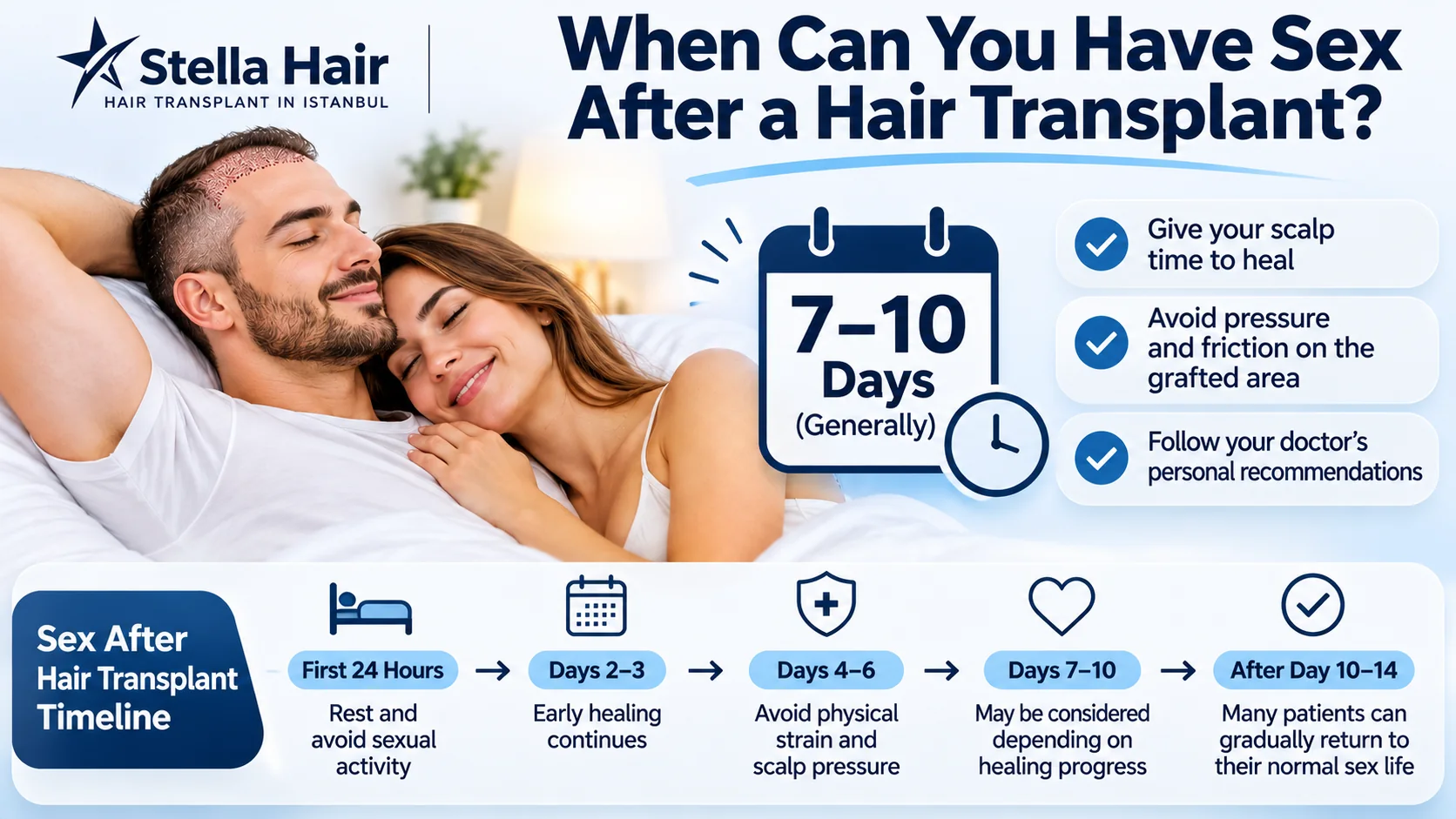
When Can You Have Sex After a Hair Transplant? Recovery Guide
Sex after a hair transplant is a common concern among patients recovering from hair restoration surgery. Many people want to know when they can safely return to their normal activities, including work, exercise, and intimacy. During sexual activity, physical movement, sweating, and accidental contact with the scalp may increase. These factors are particularly important during the first days after transplantation, when newly implanted follicles and the surrounding tissues are still healing. At Istanbul Stella Hair, we emphasize the importance of protecting the scalp during recovery while helping patients return comfortably to their everyday lives.
At Stella Hair, we recommend following individualized aftercare instructions following DHI, Sapphire FUE, and completely unshaven Long DHI hair transplantation. Although these procedures use different techniques, they all involve transferring follicles from a donor area into recipient sites that require time to heal. So, how long should you wait before having sex after a hair transplant? Is intercourse safe after seven days? Can you masturbate after surgery? Does sweating or ejaculation damage transplanted hair follicles? In this guide, we explain when sexual activity may be resumed, the possible risks during early recovery, and the precautions that can help protect your transplanted grafts.
When Can You Have Sex After a Hair Transplant?
Many hair transplant clinics recommend waiting approximately 7–10 days before resuming sexual intercourse. Some surgeons advise avoiding sexual activity for at least 10 days.
However, there is no universally established waiting period that applies to every patient.
During hair transplantation, follicles are extracted from the donor region and implanted into areas affected by hair loss.
The procedure creates numerous small surgical sites in the scalp.
Immediately after surgery, these sites begin healing, but the surrounding tissues require time to stabilize.
During sexual intercourse, physical exertion may increase, the heart rate may rise, and sweating may occur.
There is also a possibility of accidentally rubbing the transplanted area against a pillow, making contact with the scalp, or striking the head against a nearby surface.
For these reasons, temporary restrictions on sexual activity are primarily intended to reduce unnecessary physical stress and protect the healing recipient area.
The appropriate time to resume sexual activity should be determined according to individual healing progress and the treating medical team's recommendations.
How Many Days Should You Avoid Sex After a Hair Transplant?
The recommended waiting period may vary depending on the extent of the procedure, the condition of the scalp, and the patient's recovery.
In general, sexual activity is commonly restricted during the first week.
The period between days 7 and 10 is often when a gradual return may be considered, provided recovery is progressing normally.
Sexual Activity Timeline After Hair Transplantation
Recovery Period
General Recommendation
First 24 hours
Rest and avoid sexual activity.
Days 2–3
Early healing continues. Sexual intercourse is generally discouraged.
Days 4–6
Avoid unnecessary exertion, scalp friction, and pressure on the grafts.
Days 7–10
Resuming sexual activity may be considered for some patients, depending on healing.
Days 10–14
A gradual return to gentle sexual activity may be possible with medical approval.
After day 14
Many patients can return to normal activities if healing is uncomplicated.
This timeline is intended for general information rather than as a fixed medical rule.
Patients who undergo extensive transplantation, experience delayed wound healing, or develop postoperative complications may need to wait longer.
The safety of sexual activity depends on more than the number of days since surgery.
Protecting the transplanted area from mechanical trauma remains important throughout recovery.
Is Sex Harmful During the First 3 Days After a Hair Transplant?
The first three days after hair transplantation are part of the initial healing period.
During this time, redness, tenderness, small scabs, and temporary swelling may be present.
Recently implanted grafts are still becoming established within the surrounding tissues.
Avoiding unnecessary pressure on the scalp is especially important.
Potential concerns during sexual intercourse in the first three days include:
- Accidental rubbing of the head against bedding
- Unintentional contact with the transplanted area
- Sudden or uncontrolled movements
- Discomfort associated with physical exertion
- Bleeding or increased sensitivity around surgical sites
For these reasons, most conservative postoperative approaches recommend avoiding sexual intercourse during the first few days and prioritizing rest.
However, ordinary physical movement does not automatically cause transplanted grafts to become dislodged.
The potential risk depends on the force applied to the scalp, the stage of healing, and whether direct mechanical trauma occurs.
Can You Have Sex 7 Days After a Hair Transplant?
Some patients may be recovering well seven days after hair transplantation, but day seven is not universally considered a safe time to resume sexual intercourse.
The stability of transplanted grafts improves as the tissue surrounding them heals.
A clinical study published in 2006 examined how securely transplanted grafts become anchored during postoperative recovery.
The findings indicated that grafts become increasingly resistant to mechanical displacement over time, with substantially greater stability by approximately the ninth postoperative day under the conditions studied.
However, this research did not specifically evaluate sexual intercourse.
Therefore, it should not be interpreted as proof that every physical activity is safe on day seven or day nine.
Patients with persistent tenderness, bleeding, significant swelling, or delayed wound healing should avoid returning to sexual activity without medical guidance.
Is Sex Safe 10 Days After a Hair Transplant?
Approximately ten days after transplantation, many patients have made substantial progress through the initial healing period.
Scabbing may have decreased, and the scalp may feel less sensitive.
For this reason, many postoperative protocols consider days 7–10 a possible stage for assessing readiness to resume sexual activity.
However, reaching day ten does not mean the scalp can tolerate unlimited pressure or friction.
If the treating medical team approves a return to sexual intercourse, patients should take several precautions:
- Avoid direct contact with the transplanted area.
- Prevent the head from striking hard surfaces.
- Limit movements that require excessive physical exertion.
- Avoid prolonged activities that cause heavy sweating.
- Stop if pain, bleeding, or unusual discomfort occurs.
Individual recovery and medical approval remain more important than a specific date.
Can Sexual Intercourse Damage Transplanted Hair Follicles?
Sexual intercourse itself is not known to directly cause transplanted hair follicles to die or become permanently damaged.
The main concern is the possibility of physical stress or injury during the early recovery period.
During hair transplantation, follicular units are placed into prepared recipient sites in the scalp.
The surrounding tissue gradually heals and stabilizes these grafts.
In the first days after surgery, significant friction, direct pressure, or accidental trauma may potentially disturb the healing recipient area.
By contrast, sexual arousal without mechanical contact with the scalp has not been shown to dislodge transplanted grafts.
Therefore, postoperative recommendations focus primarily on protecting the healing scalp rather than treating sexual activity itself as inherently harmful to transplanted hair.
Is Sweating During Sex Harmful After a Hair Transplant?
Sweating is one of the concerns frequently associated with sexual activity after hair transplantation.
During intercourse, physical movement and body temperature may increase.
As a result, sweating can occur on the scalp.
Sweating does not automatically mean that transplanted follicles have been damaged or that grafts have become dislodged.
However, heavy sweating and prolonged exertion may cause discomfort or irritation in skin that is still healing.
For this reason, many medical teams advise temporarily limiting strenuous activities during early recovery.
It is also important to distinguish ordinary sweating from intense physical exertion.
Mild sweating in a warm room is not equivalent to engaging in prolonged, physically demanding activity.
If sweating occurs, the scalp should not be rubbed aggressively.
Patients should continue following their prescribed washing and aftercare routine.
When Can You Masturbate After a Hair Transplant?
There is no universally established waiting period specifically for masturbation after hair transplantation.
Masturbation can involve changes in heart rate, physical movement, and sweating.
However, the intensity of these responses varies between individuals.
When masturbation does not involve direct contact with the scalp, the risk of mechanical trauma to the transplanted area may be lower than during activities involving greater physical movement.
Nevertheless, many clinics recommend avoiding sexual activity during the first days after surgery as a precaution.
The commonly recommended 7–10-day waiting period for sexual intercourse may also be used as a conservative reference for masturbation.
However, this timeframe has not been established through strong clinical trials specifically examining masturbation after hair transplantation.
Patients experiencing pain, bleeding, significant swelling, or other complications should seek advice from their medical team before resuming sexual activity.
Can Ejaculation or Orgasm Damage Hair Transplant Grafts?
During orgasm, the body experiences temporary physiological changes.
These may include:
- Increased heart rate
- Faster breathing
- Temporary blood pressure changes
- Muscle contractions
These responses are normal parts of sexual physiology.
However, there is no strong clinical evidence demonstrating that ejaculation or orgasm alone causes transplanted follicles to die or reduces the success of a hair transplant.
The more relevant concerns during early recovery are excessive physical exertion and direct pressure on the transplanted area.
For this reason, recommendations about returning to sexual activity should consider the physical intensity of the activity rather than orgasm alone.
Ejaculation should not be confused with mechanical injury to the transplanted grafts.
Can Sex Increase Swelling After a Hair Transplant?
Temporary swelling around the forehead or eyes can occur after hair transplantation.
This may be related to fluid used during surgery and the body's response to tissue manipulation.
During strenuous physical activity, circulation and blood pressure can change temporarily.
As a result, many postoperative care protocols recommend limiting demanding physical activities during early recovery.
However, there is insufficient evidence to conclude that sexual intercourse always increases postoperative swelling.
Patients who continue to experience significant swelling should consult their medical team before resuming intercourse.
A return to physical activity should be planned according to the individual's condition rather than a fixed timetable.
Which Sexual Positions Should You Avoid After a Hair Transplant?
Once sexual activity has been approved by the treating medical team, protecting the transplanted area remains important.
The main concern is avoiding positions or movements that expose the scalp to unnecessary pressure, friction, or accidental injury.
There is no single sexual position that can be considered the safest choice for every hair transplant patient.
Instead, patients should follow these general principles:
- Avoid placing direct pressure on the transplanted area.
- Prevent the head from striking the bed frame or other hard surfaces.
- Avoid accidental contact between a partner's hands or body and the recipient area.
- Do not pull the hair or rub the scalp.
- Limit movements that require excessive physical exertion.
- Stop the activity if pain, bleeding, or significant discomfort occurs.
These precautions are particularly relevant during the early postoperative period.
As healing progresses, returning to ordinary activities typically becomes easier.
What Happens If You Have Sex Too Early After a Hair Transplant?
Some patients become concerned after having sexual intercourse before the recommended waiting period has ended.
Having sex earlier than recommended does not automatically mean that the hair transplant has failed or that transplanted grafts have been lost.
The important question is whether the recipient area experienced direct pressure, friction, or trauma during the activity.
If no bleeding, significant pain, or visible tissue injury occurred, graft damage should not be assumed solely because sexual activity took place.
However, patients should contact their medical team if they experience:
- New bleeding from the recipient area
- Severe or increasing scalp pain
- Visible tissue injury
- Sudden or worsening swelling
- Spreading redness
- Purulent discharge or fever
If a problem is suspected, avoid touching, rubbing, or removing scabs to check whether the grafts are still in place.
Persistent or worsening symptoms require medical assessment.
Are Sex and Exercise Associated With the Same Risks After Hair Transplantation?
Sexual activity and exercise can produce some similar physiological responses.
Both may increase movement, heart rate, and sweating.
However, not every sexual activity involves the same degree of physical exertion.
Similarly, different forms of exercise create different levels of physical stress.
A gentle walk is not equivalent to a heavy weightlifting session.
The physical intensity of sexual activity can also vary considerably.
Therefore, the recommended timeline for returning to exercise does not necessarily have to be identical to the timeline for resuming sexual intercourse.
In both situations, the primary objective is to prevent unnecessary pressure, friction, and excessive physical strain during the initial healing period.
Is the Waiting Period Different After DHI and Sapphire FUE?
DHI and Sapphire FUE hair transplantation differ in certain aspects of follicle implantation.
However, both procedures involve extracting hair follicles from a donor region and transferring them into the recipient area.
As a result, postoperative tissue healing is important after either technique.
There is no universal scientific rule stating that every DHI patient can resume sexual intercourse earlier or that Sapphire FUE always requires a longer waiting period.
The appropriate timeline depends on multiple factors, including:
- The extent of the transplantation
- The location of the recipient area
- Individual healing progress
- Scalp sensitivity
- The presence of postoperative complications
- The treating medical team's instructions
Patients should not assume that a particular implantation technique automatically eliminates postoperative activity restrictions.
Sex After Completely Unshaven Long DHI Hair Transplantation
The same general principles of postoperative protection apply after completely unshaven Long DHI transplantation.
At Istanbul Stella Hair, our Long DHI approach is designed to preserve the existing hair length in both the donor and recipient areas.
However, maintaining hair length does not mean that the scalp has avoided surgical treatment.
Hair follicles are still extracted and implanted.
Therefore, during early recovery:
- Avoid pressure on the transplanted area.
- Prevent pulling or tugging on the hair.
- Avoid friction and accidental impact.
- Follow the activity restrictions recommended by the healthcare team.
Whether the hair has been shaved does not, by itself, determine when sexual intercourse can safely resume.
For more information, explore our hair transplant services.
Precautions When Returning to Sexual Activity After a Hair Transplant
A few practical measures may help protect the healing scalp when returning to sexual activity.
1. Prioritize Rest During the First Days
Avoid physically demanding activities immediately after surgery.
Give the scalp sufficient time to begin healing.
2. Follow Your Medical Team's Recommended Timeline
Although many general guides mention waiting approximately 7–10 days, your individual postoperative instructions may differ.
3. Protect the Recipient Area
Avoid pressure, rubbing, hair pulling, and accidental trauma.
4. Limit Intense Physical Exertion
Avoid activities that involve excessive movement or heavy sweating during early recovery.
5. Maintain a Clean Environment
Keep pillowcases and bedding clean while the scalp is healing.
6. Stop if Concerning Symptoms Occur
Pain, bleeding, or unusual discomfort should not be ignored.
Stop the activity and seek medical advice when necessary.
7. Return to Normal Activities Gradually
A gradual return may be more comfortable than immediately resuming strenuous physical activity.
Frequently Asked Questions
How long should you avoid sex after a hair transplant?
Many clinics recommend avoiding sexual intercourse for approximately 7–10 days after transplantation. Some surgeons advise waiting at least 10 days. The appropriate period depends on individual healing progress and postoperative instructions.
Can I have sex 3 days after a hair transplant?
The first three days are part of the early healing period. Sexual intercourse is generally discouraged because of the potential for physical exertion, scalp friction, and accidental pressure on newly implanted grafts.
Can I have sex 5 days after a hair transplant?
On day five, the scalp may still be sensitive. Many conservative aftercare protocols recommend continuing to avoid sexual activity at this stage. Follow your treating medical team's instructions.
Is sex safe 7 days after a hair transplant?
Some patients may be recovering well after seven days. However, day seven is not universally considered safe for everyone. Medical approval and the condition of the transplanted area should guide the decision.
Can I have sex 10 days after a hair transplant?
Many patients may be ready to consider a gradual return around day ten if healing has progressed normally. Direct pressure, friction, and excessive physical activity should still be avoided.
Can I have sex 14 days after a hair transplant?
Many patients with uncomplicated recovery can return to ordinary activities within approximately two weeks. However, complications or persistent tenderness may require a longer recovery period.
Is masturbation harmful after a hair transplant?
There is no strong evidence that masturbation directly damages transplanted follicles. However, patients may be advised to avoid sexual activity during the early healing period to limit unnecessary exertion.
Can ejaculation damage transplanted hair follicles?
Ejaculation or orgasm alone has not been shown to cause graft loss. The main concerns during early recovery are mechanical pressure, friction, and excessive physical exertion.
Is sweating during sex dangerous after a hair transplant?
Sweating alone does not mean that transplanted grafts have been damaged. However, excessive sweating and physical exertion may irritate healing scalp tissue.
Can sex increase swelling after hair transplantation?
Physical exertion may affect circulation temporarily, but sexual intercourse has not been shown to increase swelling in every patient. Those with persistent postoperative swelling should consult their medical team.
Will transplanted hair fall out if I have sex too early?
Having sex earlier than recommended does not automatically cause transplanted hair loss. However, direct pressure, significant rubbing, or accidental trauma during the first days may create risks for healing grafts.
What should I do if my scalp bleeds during or after sex?
Stop the activity and contact your treating medical team. Severe or persistent bleeding requires urgent medical evaluation.
Can I resume sex earlier after DHI hair transplantation?
There is no universal rule that DHI patients can safely resume sexual activity earlier than patients undergoing other hair transplantation techniques. Recovery and medical recommendations should determine the timeline.
Conclusion: How Long Should You Wait Before Having Sex After a Hair Transplant?
When can you have sex after a hair transplant? Many clinics recommend waiting approximately 7–10 days, although some surgeons advise avoiding sexual activity for at least 10 days.
There is no universal recovery schedule that applies to every patient.
During the first days after transplantation, protecting the recipient area from pressure, friction, and accidental injury is particularly important.
Physical exertion and heavy sweating should also be considered when planning a return to sexual activity.
However, sexual intercourse, orgasm, or ejaculation alone should not automatically be considered causes of transplanted follicle damage.
The safest approach is to follow individualized postoperative instructions and return to sexual activity gradually once healing has progressed sufficiently.
At Istanbul Stella Hair, we emphasize careful recovery planning after DHI, Sapphire FUE, and completely unshaven Long DHI hair transplantation.
Protecting the scalp during early healing is an important part of the overall postoperative care process.
To learn more about our procedures and recovery guidance, visit our hair transplant services in Istanbul.
Scientific References
- American Society of Plastic Surgeons – Hair Transplant Recovery. General information about recovery and postoperative activity restrictions.
- Bernstein RM, Rassman WR. Graft Anchoring in Hair Transplantation. Dermatologic Surgery, 2006. Clinical research examining graft stability during postoperative healing.
- International Society of Hair Restoration Surgery (ISHRS). Professional information about hair restoration surgery and patient care.
Medical Disclaimer: This article is intended for general educational purposes only. The appropriate time to resume sexual activity after hair transplantation depends on individual healing progress, existing medical conditions, and the postoperative instructions provided by a qualified healthcare professional.
