Pimples After Hair Transplant: Causes, Treatment & Warning Signs
Why do pimples appear after a hair transplant? Learn about scalp folliculitis, ingrown hairs, recovery time, treatment and when to seek medical attention.
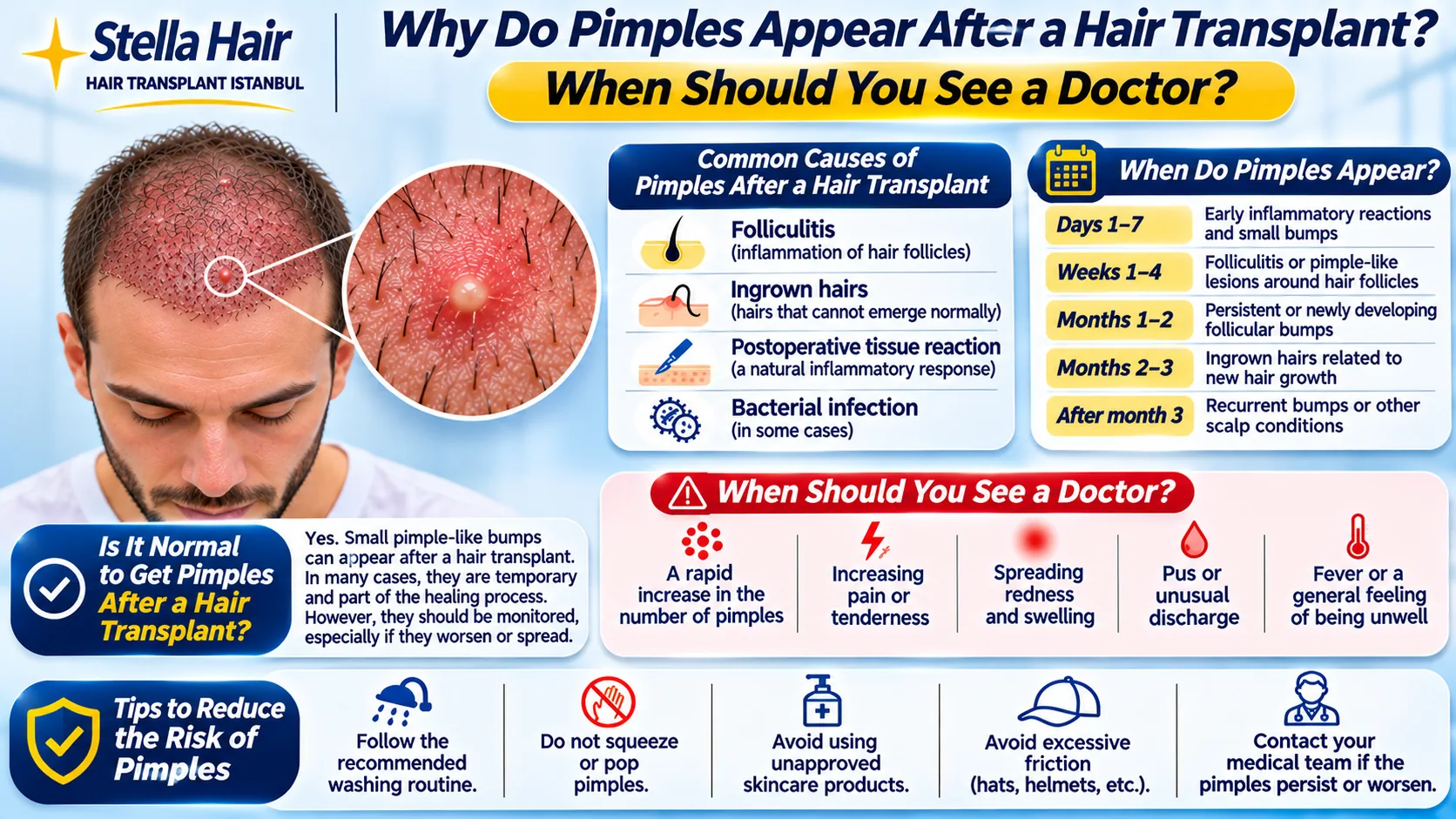
Pimples after a hair transplant are among the skin changes that some patients may experience during recovery. Small red bumps, whiteheads, or pimple-like lesions can develop in the transplanted area or in the donor region where hair follicles were extracted. While these bumps may be mild and temporary in some patients, others may experience tenderness, itching, redness, or pus-filled lesions. At Istanbul Stella Hair, we believe that understanding postoperative scalp changes is an important part of a safe and comfortable recovery. Not every pimple that appears after hair transplantation has the same cause, and not every case requires the same treatment.
At Istanbul Stella Hair, we emphasize the importance of monitoring scalp health throughout the healing process. Pimple-like bumps after hair transplantation may be associated with folliculitis, ingrown hairs, local inflammatory reactions, or bacterial infections. Some of these conditions can occur without a serious complication, while others may require medical attention. So, why do pimples develop after a hair transplant? Are whitehead pimples on the scalp normal? How long do they last? Should you pop them, and when should you contact a doctor? In this guide, we explain the possible causes of postoperative scalp pimples, their typical timing, and the warning signs that should not be ignored.
Is It Normal to Have Pimples After a Hair Transplant?
Small pimple-like bumps can appear after hair transplantation, and their presence does not automatically indicate infection or graft failure.
During hair transplantation, follicular units are extracted from the donor area and implanted into regions affected by hair loss.
The procedure creates many small surgical sites in the scalp.
As these areas heal, the body's natural inflammatory response may cause temporary redness, swelling, and small bumps around the follicles.
Some patients develop lesions that resemble acne.
These are sometimes associated with a condition called folliculitis.
Folliculitis refers to inflammation involving the hair follicles.
However, folliculitis is not always caused by a bacterial infection.
In some cases, a sterile inflammatory reaction develops without an infectious organism being responsible.
Therefore, not every pimple after a hair transplant requires antibiotics.
Nevertheless, painful, spreading, or persistent lesions should be evaluated by a qualified healthcare professional.
What Causes Pimples After a Hair Transplant?
There is no single cause of pimples after hair transplantation.
Several different conditions can produce similar-looking bumps on the scalp.
1. Folliculitis
Folliculitis is inflammation affecting the hair follicles.
After transplantation, it may appear as small red bumps or white- or yellow-tipped lesions around individual hairs.
Some cases are associated with bacterial infection, while others develop because of noninfectious inflammation.
These conditions may look similar from the outside.
For this reason, the appearance of a bump alone may not be enough to determine its cause.
2. Ingrown Hairs
As new hair begins growing after transplantation, some hair shafts may have difficulty emerging normally through the skin.
A hair may curl beneath the surface or irritate the surrounding tissue.
This can produce a small raised bump that resembles a pimple.
Ingrown hairs may occur more frequently in people with tightly curled or coarse hair.
They can also trigger inflammatory reactions without necessarily involving infection.
3. Postoperative Tissue Reactions
Hair transplantation involves creating small surgical wounds during graft extraction and implantation.
The body's healing response can sometimes cause localized inflammatory bumps.
Occasionally, retained keratin or small fragments of tissue may contribute to a foreign-body inflammatory reaction.
These lesions can resemble infected pimples even when no bacterial infection is present.
An appropriate medical assessment may be necessary to distinguish between the possible causes.
4. Bacterial Infection
Some postoperative pimples may be associated with bacterial infection.
Bacteria can infect hair follicles and produce redness, tenderness, and pus-filled bumps.
In certain cases, the surrounding skin may become warm, swollen, or increasingly painful.
However, an infection should not be diagnosed solely because a pimple contains white or yellow material.
A healthcare professional may need to examine the area and, when appropriate, perform additional tests.
When Do Pimples Appear After a Hair Transplant?
Pimples may appear during the first few weeks after hair transplantation, but some patients develop bumps several months later as new hair begins growing.
The timing depends on the underlying cause.
For example, a postoperative inflammatory reaction occurring within the first week is not necessarily the same as an ingrown hair appearing during the third month.
Pimples After Hair Transplant: General Timeline
Time After Surgery
Possible Changes
Days 1–7
Early inflammatory reactions and small raised bumps
Weeks 1–4
Folliculitis or pimple-like lesions around hair follicles
Months 1–2
Persistent or newly developing follicular bumps in some patients
Months 2–3
Ingrown hairs associated with emerging hair shafts
Month 3 onward
Recurrent bumps, ingrown hairs, or unrelated scalp conditions
This timeline is a general guide rather than a diagnostic tool.
Rapidly worsening pain, spreading redness, or purulent discharge during any recovery stage requires medical assessment.
Patients should not assume that a new lesion is harmless simply because it appears during a common recovery period.
How Long Do Pimples Last After a Hair Transplant?
The duration of postoperative scalp pimples depends on their cause.
Some mild follicular bumps may resolve within several days.
However, infections, ingrown hairs, or persistent inflammatory conditions may take longer to improve.
For this reason, there is no universal number of days after which every postoperative pimple should disappear.
A small bump that gradually becomes less noticeable is different from a lesion that continues growing, becomes increasingly painful, or begins producing discharge.
The progression of the symptoms is often more important than the number of days the pimple has been present.
Patients should contact their medical team if the bumps persist, multiply, or repeatedly return.
Why Do Whitehead Pimples Appear After a Hair Transplant?
White- or yellow-tipped bumps may develop around follicles following transplantation.
Some of these lesions are pustules, meaning small raised skin lesions containing inflammatory material.
However, a whitehead does not automatically indicate a bacterial infection.
Sterile folliculitis and other inflammatory conditions may produce a similar appearance.
This distinction matters because different causes may require different approaches.
Patients should avoid attempting to diagnose or treat the condition based only on the color of a pimple.
If numerous lesions appear or are accompanied by increasing pain, spreading redness, or unusual discharge, medical advice should be obtained.
Should You Pop Pimples After a Hair Transplant?
No. Patients should not squeeze, pop, puncture, or attempt to drain pimples at home after hair transplantation.
This is particularly important while the recipient area is still healing.
Applying pressure to the scalp may irritate the surrounding tissue.
Attempting to puncture a lesion with a needle or remove an ingrown hair with tweezers can create additional injury.
Possible consequences include:
- Unnecessary pressure on healing scalp tissue
- Irritation or damage to the surrounding skin
- Disruption of the skin barrier
- Increased risk of infection
- Worsening inflammation
- Delayed healing
In selected situations, a healthcare professional may recommend draining a lesion or performing another medical procedure.
However, these interventions should not be attempted at home.
How to Treat Pimples After a Hair Transplant
Treatment depends on why the pimples have developed.
Mild, localized bumps may improve with observation and appropriate scalp care.
Other conditions may require medical treatment.
Follow the Recommended Washing Routine
Maintaining appropriate scalp hygiene is important during recovery.
However, the scalp should be cleaned according to the postoperative instructions provided by the treating medical team.
During early healing, patients should avoid aggressive rubbing, scratching, or forcibly removing scabs.
Washing the scalp more frequently or using stronger cleansing products does not necessarily make pimples disappear faster.
Avoid Squeezing or Scratching
Patients should not attempt to remove pimples mechanically.
Scratching or pressing the recipient area can cause additional irritation.
If the bumps are uncomfortable or persistent, contacting the medical team is preferable to attempting self-treatment.
Avoid Unapproved Skincare Products
Products commonly used for facial acne are not automatically suitable for a healing scalp.
Ingredients such as salicylic acid, benzoyl peroxide, retinoids, and strong antiseptics may irritate skin that has not fully healed.
Patients should avoid applying acne creams, lotions, or medicated shampoos unless approved by their healthcare professional.
Seek Medical Treatment When Necessary
Certain cases of bacterial folliculitis may require topical or oral medications prescribed by a healthcare professional.
Noninfectious inflammatory reactions may require a different approach.
Antibiotics are not appropriate for every pimple after a hair transplant.
Unnecessary antibiotic use should be avoided, but suspected infections should also not be left untreated.
The correct treatment depends on an appropriate medical diagnosis.
When Are Pimples After a Hair Transplant Dangerous?
A small postoperative pimple does not necessarily indicate a serious complication.
However, some symptoms may suggest infection or another condition requiring medical care.
Patients should seek prompt medical assessment if they experience:
- Pimples that rapidly increase in number
- Increasing scalp pain or tenderness
- Redness spreading beyond the affected area
- Significant warmth or swelling
- Purulent or foul-smelling discharge
- Fever or chills
- Large, deep, or particularly painful lumps
- Symptoms that worsen after initially improving
Fever accompanied by rapidly spreading redness, severe pain, or a significant deterioration in general health requires urgent medical evaluation.
Patients with diabetes, immunosuppressive conditions, or medical problems affecting wound healing may need earlier assessment.
It is important not to dismiss unusual symptoms as an ordinary part of recovery.
Can Pimples Damage Transplanted Hair Follicles?
Mild and localized pimple-like lesions do not automatically mean that transplanted follicles have been damaged.
Some cases of folliculitis resolve without causing permanent problems.
However, severe, persistent, or recurrent inflammation may affect the tissue surrounding the follicles.
In certain situations, significant infection or deep inflammatory lesions can interfere with healing and potentially affect hair growth.
Therefore, patients should not assume that every postoperative scalp bump is harmless.
At the same time, developing a few pimples does not automatically mean that the transplantation has failed.
The underlying cause and severity should be assessed appropriately.
Why Do Pimples Develop in the Donor Area After FUE?
Pimple-like lesions can develop not only in the transplanted area but also in the donor region.
During FUE hair transplantation, individual follicular units are extracted from the back and sides of the scalp.
This creates small surgical sites that need time to heal.
Several factors may contribute to postoperative bumps in the donor area:
- Folliculitis
- Ingrown hairs
- Friction-related irritation
- Local inflammatory reactions
- Bacterial infection
For example, tight clothing collars or headwear may rub against the healing donor region and increase irritation.
However, not every bump in the donor area is necessarily caused by the transplantation itself.
Some patients may have pre-existing acne or folliculitis that continues after surgery.
Persistent or painful symptoms should be evaluated rather than attributed automatically to normal recovery.
Are Pimples and Scabs After a Hair Transplant the Same Thing?
No. Scabbing and pimple-like lesions are different postoperative changes.
Scabs develop as part of the normal healing process of small surgical wounds.
Pimples, on the other hand, may be associated with follicular inflammation, ingrown hairs, or other skin reactions.
Although both conditions can involve redness or mild sensitivity, their causes are different.
Patients should avoid forcibly removing scabs because this may injure the healing skin.
The appropriate washing and scab-removal process should follow the instructions provided by the medical team.
Can Pimples Develop After DHI or Sapphire FUE?
Yes. Pimple-like lesions may appear after both DHI and Sapphire FUE hair transplantation.
Both approaches involve surgical intervention in the scalp.
Follicles must be extracted from a donor region and placed into recipient sites.
Differences in implantation instruments do not completely eliminate the possibility of folliculitis, ingrown hairs, or infection.
There is no basis for claiming that DHI always causes more pimples or that Sapphire FUE guarantees their prevention.
Several factors may influence postoperative scalp reactions, including the extent of surgery, graft distribution, individual skin characteristics, and surgical conditions.
Can Pimples Appear After Completely Unshaven Long DHI?
Yes. Pimples and follicular inflammation may also occur after completely unshaven Long DHI transplantation.
At Istanbul Stella Hair, our Long DHI procedure is designed to preserve the existing hair length in both the donor and recipient areas.
However, keeping the hair unshaven does not mean that the scalp avoids surgical intervention.
Hair follicles are still extracted and implanted.
Consequently, postoperative inflammatory reactions, ingrown hairs, and folliculitis remain possible.
Patients with longer existing hair should take additional care during washing and grooming to avoid unnecessary friction against the healing recipient area.
The medical team's individualized aftercare instructions should be followed.
Can You Prevent Pimples After Hair Transplantation?
It is not always possible to prevent every postoperative pimple.
However, appropriate scalp care may help support healing and reduce avoidable irritation.
Important precautions include:
- Following the recommended washing and aftercare routine.
- Avoiding scratching or aggressively rubbing the scalp.
- Never squeezing or puncturing pimples.
- Avoiding dirty hats and unclean equipment.
- Preventing unnecessary friction during early recovery.
- Not applying unapproved skincare or medical products.
- Contacting the medical team if pain, redness, swelling, or discharge increases.
Patients who already have folliculitis, scalp acne, or another dermatological condition should inform their healthcare team before surgery.
An appropriate preoperative assessment can help identify issues that may require treatment or additional precautions.
Frequently Asked Questions
Is it normal to get pimples after a hair transplant?
Small pimple-like bumps can occur during recovery. They may be associated with folliculitis, ingrown hairs, or local inflammatory reactions. However, painful, rapidly spreading, or persistent lesions should be assessed by a healthcare professional.
When do pimples appear after a hair transplant?
Folliculitis may appear during the first few weeks after surgery. Ingrown hairs associated with new hair growth may develop several months later.
How long do pimples last after a hair transplant?
The duration depends on the underlying cause. Some mild bumps resolve within a few days, while infections or recurrent folliculitis may require longer treatment and monitoring.
Can I pop pimples after a hair transplant?
No. Squeezing or puncturing pimples may irritate healing tissue and increase the risk of infection. Patients should seek medical advice instead of attempting to drain lesions at home.
Why do whitehead pimples appear after hair transplantation?
White-tipped bumps may be associated with follicular inflammation or pustules. However, a whitehead does not always indicate bacterial infection.
Do I need antibiotics for pimples after a hair transplant?
Not necessarily. Some bacterial infections require antibiotics, but many pimple-like lesions have noninfectious causes. Medication should be prescribed only after appropriate medical assessment.
Can pimples damage transplanted grafts?
Mild localized bumps do not automatically indicate graft damage. However, severe or persistent inflammation and infection may interfere with healing and potentially affect transplanted follicles.
Are pimples normal three months after a hair transplant?
Some patients develop ingrown hairs or follicular bumps as new hair begins growing. However, not every pimple appearing during the third month is related to hair growth.
Why do pimples appear in the donor area?
Pimples in the donor area may be related to folliculitis, ingrown hairs, friction, inflammatory reactions, or infection. Persistent or painful lesions should be evaluated.
When should I see a doctor for pimples after a hair transplant?
Seek medical assessment if pimples rapidly multiply, become increasingly painful, produce unusual discharge, or are accompanied by spreading redness, swelling, or fever.
Conclusion: Not Every Pimple After a Hair Transplant Is an Infection
Why do pimples appear after a hair transplant? Several factors may be responsible, including folliculitis, ingrown hairs, local inflammatory reactions, and bacterial infections.
Small bumps can develop during the first weeks after surgery or later as new hairs begin emerging.
However, similar-looking lesions may have different causes and require different approaches.
Patients should avoid squeezing pimples, puncturing bumps, or applying unapproved products.
At Istanbul Stella Hair, we emphasize the importance of monitoring scalp health alongside the development of newly transplanted hair.
Increasing pain, spreading redness, significant swelling, fever, and purulent discharge are warning signs that require medical attention.
Understanding these differences helps patients recognize normal healing changes while avoiding unnecessary delays in seeking care.
For more information about hair transplantation methods and postoperative recovery, explore our hair transplant services.
Medical Disclaimer: This article is intended for general educational purposes only. The diagnosis and treatment of pimples, folliculitis, or other postoperative scalp conditions require individualized assessment by qualified healthcare professionals.
