Is a Hair Transplant Permanent? Results After 5–10 Years
Is a hair transplant permanent? Discover whether transplanted hair can fall out after 5, 10 or 20 years and what affects long-term hair transplant results.
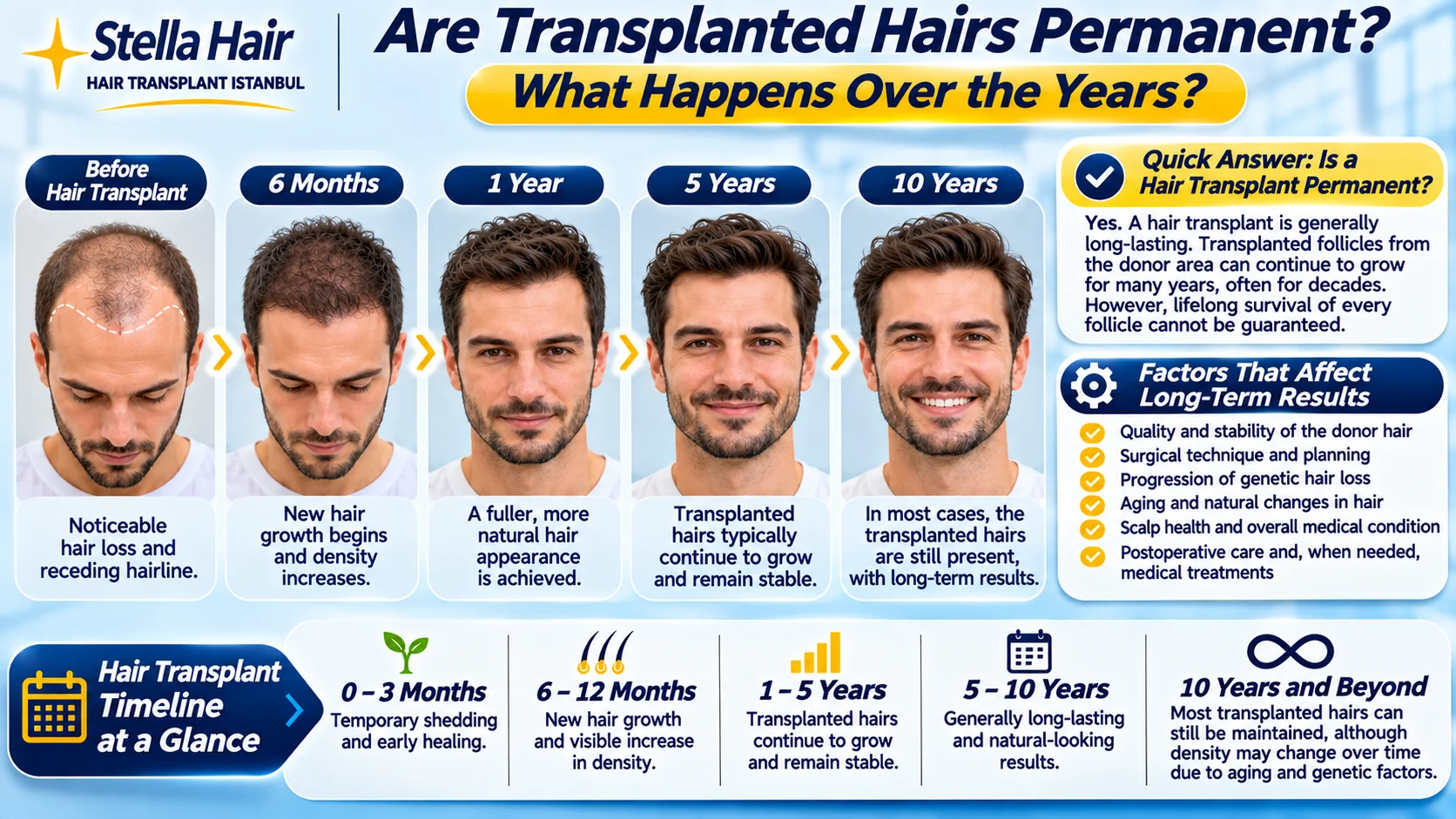
Are Transplanted Hairs Permanent? What Happens Over the Years?
Is a hair transplant permanent? This is one of the most important questions people ask before undergoing hair restoration surgery. Hair transplantation involves moving healthy follicles from a donor area, typically located at the back or sides of the scalp, to areas affected by hair loss. When suitable follicles are successfully transplanted, they may continue producing hair for many years. However, this does not mean that every transplanted hair is guaranteed to remain unchanged for a lifetime. At Istanbul Stella Hair, we believe that understanding long-term hair transplant results is just as important as evaluating the appearance achieved during the first year after surgery.
At Istanbul Stella Hair, we emphasize the importance of realistic expectations and long-term hair restoration planning. The survival of transplanted follicles and the continued loss of existing natural hair are two different processes. Aging, genetics, donor area characteristics, and certain medical conditions may also affect the appearance of transplanted hair over time. So, do transplanted hairs fall out after 5, 10, or 20 years? Does a hair transplant last forever? Can baldness return after surgery? In this guide, we explain hair transplant longevity, the factors that influence permanent results, and what patients can expect as they grow older.
Is a Hair Transplant Permanent?
Yes, hair transplantation is generally considered a long-term hair restoration procedure. However, permanent survival of every transplanted follicle cannot be guaranteed.
The primary reason hair transplantation can produce lasting results is that follicles are usually extracted from scalp regions that are relatively resistant to hereditary hair loss.
When these follicles are successfully relocated, they may retain important biological characteristics from their original donor area.
As a result, transplanted follicles can continue producing hair in their new location for many years.
However, individual follicles are not completely immune to aging, medical conditions, or changes in hair growth.
The appearance of transplanted hair may also change because surrounding natural hair continues to thin.
Therefore, hair transplantation should be understood as a potentially long-lasting restoration procedure rather than a guarantee that hair density will remain identical throughout life.
Why Can Transplanted Hair Last for Many Years?
Hair follicles used during transplantation are commonly extracted from the back and sides of the scalp.
In many individuals with androgenetic alopecia, these regions contain follicles that are less sensitive to the hormonal effects associated with hereditary hair loss.
A key concept behind this process is known as donor dominance.
Donor dominance describes the ability of transplanted hair follicles to retain certain characteristics associated with their original location.
For example, a follicle extracted from a suitable donor area at the back of the scalp may continue growing after being transplanted to the frontal hairline.
This biological characteristic helps explain why hair transplantation can provide long-lasting results.
However, not every follicle in the donor region has the same resistance to hair loss.
Some individuals may also develop progressive thinning in areas traditionally considered suitable for donation.
For this reason, careful donor area assessment is essential before transplantation.
The biological quality and long-term stability of donor follicles are important factors in hair transplant longevity.
What Does a Hair Transplant Look Like After 5 Years?
Many patients wonder whether their transplanted hair will look the same five years after surgery.
In individuals with successfully established and relatively resistant follicles, transplanted hair may continue growing normally after five years.
However, the overall appearance depends on more than the survival of transplanted hair.
For example, consider someone who undergoes transplantation to restore a receding frontal hairline.
Five years later, the transplanted hairline may remain relatively stable.
However, the natural hair behind that hairline may continue thinning because of progressive androgenetic alopecia.
This can create a visible difference between the transplanted area and the surrounding scalp.
Consequently, a change in appearance after five years does not necessarily mean that the transplanted follicles have failed.
The location and cause of any new hair loss should be evaluated separately.
Can Transplanted Hair Fall Out After 10 Years?
Yes, transplanted hair can become thinner over time, but many patients retain substantial transplanted hair growth ten years after surgery.
There is no universal rule stating that transplanted follicles stop growing after a particular number of years.
Instead, long-term appearance depends on several biological and individual factors.
One important factor is the progression of hereditary hair loss in non-transplanted areas.
Another is the natural aging process, which may affect hair thickness and density.
The original quality of the transplanted follicles also plays an important role.
For example, someone who undergoes transplantation at age 30 may have a different overall hairstyle at age 40.
This change may result from continued loss of native hair rather than the disappearance of transplanted follicles.
This is why appropriate hairline design should consider not only the immediate result but also the possibility of future hair loss.
Does a Hair Transplant Last 20 Years?
A hair transplant may continue producing visible results twenty years after surgery.
However, the exact outcome varies considerably between individuals.
As people age, hair follicles may undergo biological changes.
Some individuals experience gradual thinning of hair shafts, while others develop reduced density in previously stable areas.
These changes can affect both transplanted and non-transplanted hair.
The donor region itself may also experience thinning over time.
Consequently, it would be inaccurate to promise that hair transplanted twenty years earlier will always retain exactly the same thickness and density.
Nevertheless, these possibilities do not mean that hair transplantation is a temporary treatment that expires after a set period.
Successful transplanted follicles may remain functional for decades.
Hair Transplant Results Over Time
The following table summarizes possible changes during different periods after surgery.
Time After Surgery
Possible Changes
Months 1–3
Temporary shedding and early recovery
Months 6–12
New hair growth becomes more noticeable and density improves
Months 12–18
Hair maturation and thickening may continue
Years 3–5
Transplanted follicles may continue growing while natural hair loss progresses
Years 5–10
Aging and hereditary hair loss may change the overall appearance
Years 10–20
Many transplanted follicles may remain, although density can change over time
These periods are general references rather than guaranteed outcomes.
There is no reliable universal percentage describing exactly how much transplanted hair every patient will retain after five, ten, or twenty years.
Long-term results depend on individual characteristics and the quality of the surgical plan.
Why Can Transplanted Hair Become Thinner Over Time?
Although hair transplantation is designed to provide lasting results, several factors may affect transplanted follicles over the years.
1. Donor Hair Characteristics
The durability of transplanted hair depends partly on where the follicles were originally extracted.
Follicles selected from areas that are susceptible to progressive hair loss may also become thinner after transplantation.
This is why selecting an appropriate donor region is important.
2. Natural Aging
Aging can influence hair growth cycles, shaft diameter, and overall hair density.
Some individuals experience finer hair strands as they grow older.
These changes may affect the appearance of transplanted hair.
3. Scalp Conditions and Medical Disorders
Certain inflammatory scalp diseases, including conditions that cause scarring hair loss, may damage follicles.
Such conditions can affect both natural and transplanted hair.
Unexpected or unusual hair loss should therefore be evaluated by a dermatologist.
4. Poor Graft Survival
Not every implanted follicle necessarily establishes successful long-term growth.
Some grafts may fail to survive or produce adequate hair following the initial transplantation.
This is different from follicles that grow successfully for years and subsequently become thinner.
Distinguishing between early graft failure and later hair loss is important when assessing long-term results.
Is Transplanted Hair Shedding the Same as Shock Loss?
No. Postoperative shock loss and hair thinning several years after transplantation are different processes.
Shock loss usually refers to temporary shedding occurring during the early period after surgery.
Some transplanted hair shafts may shed within the first weeks.
However, this does not automatically mean that the underlying follicles have been lost.
Successfully established follicles may begin producing new visible hair during the following months.
By contrast, hair loss that develops five or ten years after surgery may be associated with ongoing androgenetic alopecia, aging, or another medical condition.
The timing and location of hair loss are therefore important.
Patients should not automatically assume that every episode of shedding indicates permanent graft failure.
Can Natural Hair Continue Falling Out After a Hair Transplant?
Yes. Hair transplantation does not automatically stop hereditary hair loss in follicles that were not transplanted.
This distinction is essential for understanding long-term results.
For example, a patient may undergo a successful frontal hairline transplantation.
The transplanted follicles may continue producing hair for many years.
However, the natural hair in the mid-scalp or crown may gradually thin.
This can create new areas of visible scalp behind the transplanted hairline.
Some patients may mistakenly interpret this change as a failure of the transplanted hair.
In reality, the newly visible thinning may primarily involve existing natural follicles.
For this reason, long-term hair restoration planning should consider the likely progression of the patient's underlying hair loss.
Is DHI More Permanent Than Sapphire FUE?
DHI and Sapphire FUE involve differences in implantation instruments and surgical workflow.
However, there is no established universal rule showing that DHI produces more permanent results than Sapphire FUE in every patient.
Both approaches generally involve transplanting suitable follicles from a donor area to regions affected by hair loss.
Long-term results depend on the characteristics of those follicles, surgical planning, graft handling, and individual biological factors.
Using a particular implantation instrument does not guarantee lifelong follicle survival.
Similarly, the use of sapphire-tipped instruments does not automatically mean that transplanted hair will last longer.
The appropriate technique should be selected according to individual surgical requirements rather than claims of guaranteed permanence.
Is Completely Unshaven Long DHI Permanent?
At Istanbul Stella Hair, we offer Long DHI hair transplantation as a completely unshaven procedure.
Our Long DHI approach is designed to preserve existing hair length in both the donor and recipient areas.
However, preserving hair length does not change the fundamental biological growth cycle of transplanted follicles.
The procedure still involves extracting suitable follicles from the donor region and placing them into the planned recipient area.
Therefore, long-term results depend on the same biological considerations involved in other hair transplantation approaches.
The completely unshaven nature of Long DHI does not guarantee that every transplanted follicle will remain unchanged throughout life.
Patients interested in preserving their existing hairstyle can explore our Long DHI treatment information to understand the procedure in more detail.
Can Baldness Return After a Hair Transplant?
Yes. Some patients may develop new areas of baldness several years after transplantation.
However, this does not happen to everyone.
Individuals with progressive hereditary hair loss may continue losing natural hair in areas that were not treated.
For example, a patient who receives a frontal hairline transplant may later experience thinning at the crown.
This can create a need to reassess the overall hair restoration plan.
The possibility of future hair loss is particularly important when transplantation is considered at a relatively young age.
An excessively low or aggressive hairline design may become difficult to maintain aesthetically if surrounding natural hair continues disappearing.
Long-term planning should balance immediate cosmetic improvement with the preservation of donor hair for possible future needs.
How Can You Maintain Hair Transplant Results?
Maintaining a natural-looking result involves more than caring for the newly transplanted follicles.
Preserving existing hair and identifying ongoing hair loss are also important.
Regular Dermatological Evaluation
Changes in hair density should be assessed when necessary.
If new or progressive thinning develops, identifying the cause may help determine suitable treatment options.
Managing Hereditary Hair Loss
In selected patients, medical treatments may help slow the progression of androgenetic alopecia.
Medications such as minoxidil and finasteride may be considered by qualified healthcare professionals when appropriate.
However, these treatments are not suitable for everyone.
Potential side effects, contraindications, and monitoring requirements should be discussed with a physician.
Patients should not start or discontinue prescription treatments without appropriate medical advice.
Maintaining General Health
Certain nutritional deficiencies, systemic illnesses, and scalp disorders can contribute to hair loss.
When significant thinning develops, investigating possible underlying causes is more appropriate than relying exclusively on cosmetic products.
Maintaining Realistic Expectations
Even successfully transplanted hair may change in appearance as a person ages.
The objective of long-term hair restoration is not to guarantee an identical hairstyle forever.
Instead, planning should consider natural aging, donor limitations, and future hair loss.
Will You Need a Second Hair Transplant?
Not everyone who undergoes a hair transplant will need another procedure.
Some individuals achieve a satisfactory result that remains aesthetically acceptable for many years.
However, a second transplantation may be considered in certain circumstances.
Possible reasons include:
- Continued loss of existing natural hair
- Development of new bald areas
- A desire for additional coverage
- Changes in the frontal hairline
- Revision of an earlier transplant result
The possibility of further transplantation depends heavily on the remaining donor area.
Hair transplantation does not create new follicles in the donor region.
Every extraction uses part of the available follicle supply.
Consequently, the first procedure should be planned with future donor preservation in mind.
Is Long-Term Follow-Up Necessary After Hair Transplantation?
Hair transplant assessment does not necessarily end after the first year.
For patients with progressive hereditary hair loss, longer-term monitoring may be valuable.
Photographs taken under similar lighting conditions and camera angles can help document changes over time.
For example, the frontal hairline, mid-scalp, and crown can be photographed periodically.
This can help distinguish changes in transplanted areas from thinning of surrounding natural hair.
However, photographs alone cannot establish the medical cause of hair loss.
Sudden shedding, patchy baldness, inflammation, or unexpected scalp symptoms require professional evaluation.
Frequently Asked Questions
Is a hair transplant permanent for life?
Hair transplantation is designed to provide long-lasting results. Successfully established follicles from suitable donor areas may grow for many years. However, lifelong survival of every graft cannot be guaranteed.
Can transplanted hair fall out after five years?
Transplanted follicles may continue producing hair after five years. Nevertheless, surrounding natural hair can become thinner, changing the overall appearance.
Does a hair transplant wear off after ten years?
No. A hair transplant does not have a fixed expiration date. However, aging and progressive hair loss may affect the way the scalp looks after ten years.
Can transplanted hair survive for twenty years?
Yes. Some transplanted follicles may remain productive for twenty years or longer. However, the original density and thickness are not guaranteed to remain unchanged.
Can you go bald again after a hair transplant?
Yes. Baldness may progress in areas containing natural, non-transplanted hair. Hair transplantation does not automatically prevent further genetic hair loss.
Why is transplanted hair often long-lasting?
Transplanted follicles are commonly obtained from donor regions that are relatively resistant to hereditary hair loss. They may retain these characteristics after being relocated.
Is DHI more permanent than FUE?
There is no guarantee that DHI produces more permanent results than other suitable implantation approaches. Long-term outcomes depend on donor follicle quality, surgical planning, and individual factors.
Can transplanted hair become thinner with age?
Yes. Aging, donor follicle characteristics, and certain scalp conditions may contribute to changes in hair thickness over time.
Does everyone need a second hair transplant?
No. A second procedure is not automatically necessary. It may be considered if natural hair loss continues or additional coverage is desired, provided suitable donor hair remains available.
How can I improve the longevity of my hair transplant?
Appropriate donor selection, careful surgical planning, postoperative care, and medical management of ongoing hair loss may support long-term results. However, no method guarantees that every graft will survive unchanged for life.
Conclusion: Transplanted Hair Can Last for Many Years
Is a hair transplant permanent? The most accurate answer is that successfully established follicles from suitable donor regions can continue producing hair for many years.
Hair transplantation is not a temporary procedure that automatically loses its effect after a predetermined period.
However, the survival of every transplanted follicle cannot be guaranteed for life.
Aging, hereditary hair loss, donor area characteristics, and certain medical conditions may influence long-term appearance.
At Istanbul Stella Hair, we believe that responsible hair restoration planning should consider not only the first-year result but also the changes that may occur over the following decades.
The objective is to preserve donor resources and develop a balanced treatment plan based on individual hair characteristics and realistic long-term expectations.
To learn more about transplantation techniques and treatment planning, explore our hair transplant services.
Medical Disclaimer: This article is intended for general educational purposes only. Hair transplant longevity, progression of hair loss, and treatment suitability should be evaluated individually by qualified healthcare professionals.
