How to Wash Your Hair for the First Time After an Unshaven Hair Transplant ?
Learn when and how to wash your hair after an unshaven hair transplant, which products to use, and how to protect your grafts and existing hair.
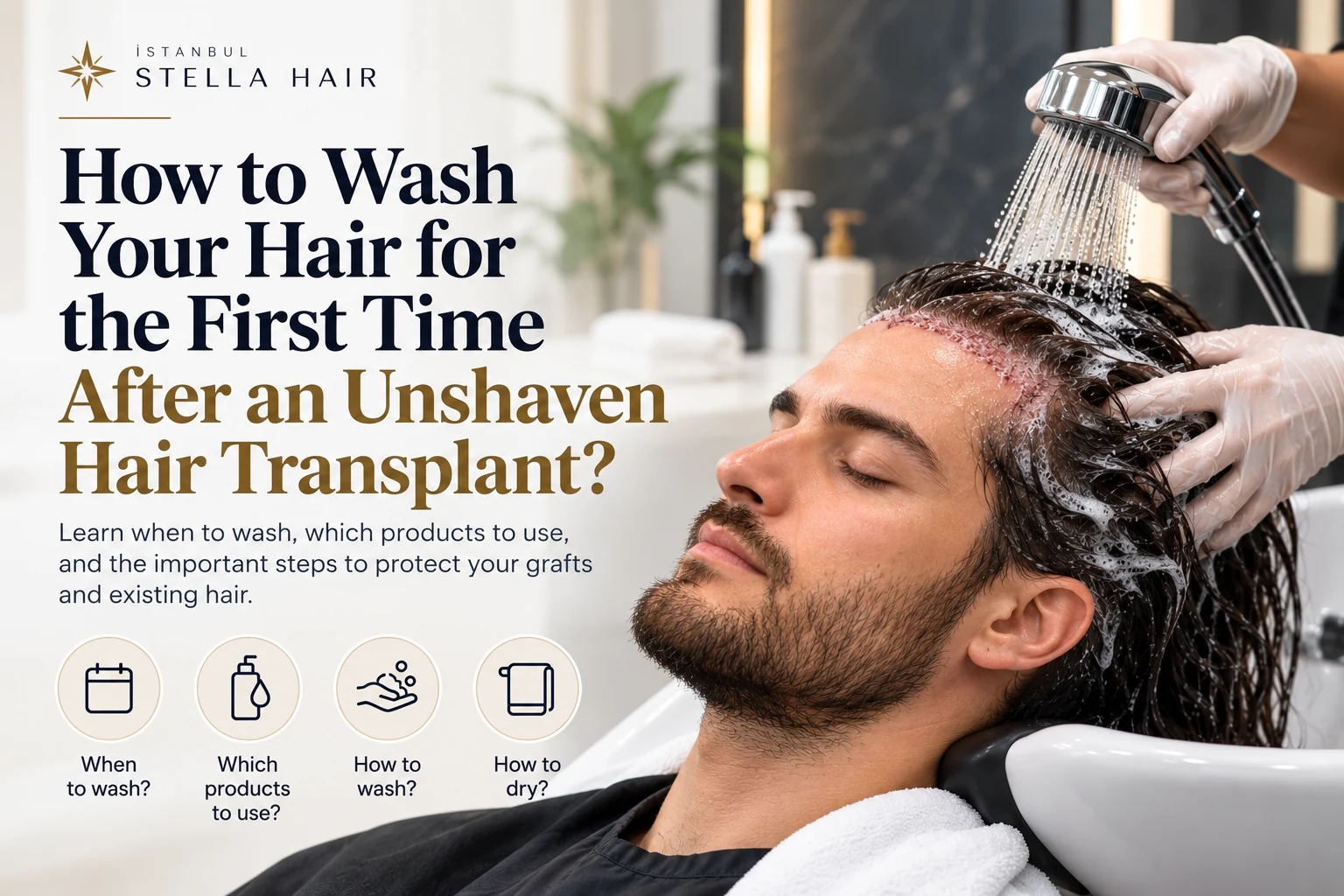
The first hair wash after an unshaven hair transplant should be performed at the time recommended by your medical team, using gentle techniques that protect newly implanted grafts from friction and excessive water pressure. At Istanbul Stella Hair, we explain how to wash your hair safely, which products to use, and how to protect your existing hair following an unshaven hair transplant procedure.
At Istanbul Stella Hair, one of the most common questions we receive after an unshaven hair transplant concerns washing the hair without disturbing the transplanted area. Although preserving the original hair length can offer cosmetic advantages during recovery, it also requires additional care when cleaning the scalp. In this guide, we explain when the first wash should take place, how to manage longer hair, which products may be recommended, and what precautions should be followed throughout the early recovery period.
When Can You Wash Your Hair After an Unshaven Hair Transplant?
The timing of the first wash after an unshaven hair transplant depends on the surgical technique, the condition of the scalp, and the aftercare instructions provided by the medical team.
Some postoperative protocols allow gentle washing after approximately 24 hours, while others recommend waiting longer.
There is no single washing schedule that applies to every patient.
The recommended timing may depend on several factors:
- The number and location of transplanted grafts
- The condition of the donor area
- The hair transplantation technique used
- Postoperative sensitivity and scab formation
- Individual healing characteristics
- Specific instructions provided after surgery
An important point to understand is that keeping your existing hair long does not necessarily mean that you can begin washing it earlier.
During the initial recovery period, newly implanted grafts should be protected from unnecessary pressure, pulling, and friction.
At Istanbul Stella Hair, we provide patients with individualized instructions explaining when to begin washing their hair and which products to use.
We recommend following these instructions rather than relying on general timelines found online.
Why Is the First Hair Wash Important After a Hair Transplant?
Following hair transplantation, the scalp may develop temporary redness, sensitivity, and small scabs around the implantation sites.
These changes can be part of the normal healing process.
The purpose of the first wash is to help clean the scalp appropriately while protecting the recently treated areas.
However, washing transplanted hair is different from washing your hair under normal circumstances.
During a regular shower, you may massage shampoo directly into the scalp and rinse your hair using a standard showerhead.
After hair transplantation, these techniques may be too aggressive during the early healing period.
Important precautions include:
- Avoiding excessive pressure on the recipient area
- Not rubbing the newly implanted grafts
- Avoiding scratching or picking at scabs
- Keeping strong water pressure away from the scalp
- Preventing pulling or tangling of longer hair
- Using only approved washing products
For patients undergoing unshaven hair transplantation, managing the surrounding long hair is an additional consideration.
Long hair may move across the recipient area during washing, potentially creating friction.
Therefore, careful handling of both the transplanted area and existing hair is essential.
How to Wash Your Hair for the First Time After an Unshaven Hair Transplant
The exact washing procedure should always follow the instructions provided by your surgical team.
The following steps outline general precautions that may be appropriate once your medical team has confirmed that washing can begin.
1. Prepare the Learn when and how to wash your hair after an unshaven hair transplant, which products to use, and how to protect your grafts and existing hair.Recommended Hair Care Products
Before washing your hair, gather the shampoo, foam, or postoperative care products recommended by your clinic.
Not every patient requires the same products.
Depending on the procedure and individual scalp condition, your medical team may recommend a specific shampoo or cleansing product.
Avoid experimenting with unfamiliar shampoos, oils, serums, or homemade treatments during the initial recovery period.
Products containing ingredients that irritate sensitive skin may cause additional discomfort.
At Istanbul Stella Hair, we explain which products are appropriate and how they should be applied as part of the postoperative care process.
2. Separate Longer Hair Without Pulling
Unlike conventional shaved hair transplantation, an unshaven hair transplant allows existing hair to retain its length.
This means transplanted areas may be surrounded or partially covered by longer hair strands.
When preparing for the first wash, avoid pulling the hair backward or separating it forcefully.
Instead, follow the method demonstrated by your medical team for managing the surrounding hair without applying pressure to the recipient area.
Longer hair should never be treated as permission to comb or pull the scalp aggressively during early recovery.
Combs and brushes should be kept away from the newly transplanted area until your medical team confirms that their use is appropriate.
3. Apply the Recommended Shampoo or Foam Gently
Your medical team may recommend a special shampoo or cleansing foam.
Follow the instructions regarding the amount to use, application method, and rinsing procedure.
During the early healing period, avoid rubbing shampoo directly into the transplanted area using vigorous circular movements.
The primary objective is to clean the scalp without placing unnecessary pressure on newly implanted follicles.
The donor and recipient areas may require different care techniques.
Therefore, do not assume that the same washing method should be applied to both areas.
If your aftercare plan includes different instructions for the donor region, follow them carefully.
4. Rinse With Lukewarm Water and Low Pressure
Water pressure is one of the most important considerations during the first hair wash.
Avoid directing a powerful shower stream onto newly implanted grafts.
Instead, use lukewarm water and the gentle rinsing method recommended by your medical team.
Very hot water may increase discomfort on a sensitive scalp.
When rinsing longer hair, avoid pulling tangled strands or forcing them apart.
The objective is to remove the cleansing product while minimizing unnecessary movement across the recipient area.
5. Dry Your Hair Without Rubbing the Scalp
One common mistake after hair transplantation is drying the hair by rubbing it vigorously with a towel.
Learn when and how to wash your hair after an unshaven hair transplant, which products to use, and how to protect your grafts and existing hair.This should be avoided during the initial healing period.
Towel friction may place unnecessary pressure on the recipient area.
Follow your medical team's instructions regarding whether and how the hair should be dried.
If gentle drying is permitted, avoid direct rubbing of the transplanted area.
You should also ask when it is safe to resume using a hair dryer.
During early recovery, strong airflow and high temperatures should not be directed onto the sensitive recipient area unless specifically approved by your medical team.
How Should You Wash Long Hair After an Unshaven Hair Transplant?
One of the defining characteristics of an unshaven hair transplant is that the patient's existing hair length is preserved.
At Istanbul Stella Hair, our unshaven hair transplantation approach focuses on performing the procedure while maintaining the length of the surrounding hair.
This makes postoperative hair management an important part of the recovery process.
Patients should understand the difference between two areas.
The recipient area: This is where new grafts have been implanted. During early recovery, it requires protection from unnecessary friction and pressure.
The surrounding existing hair: These are the longer hair strands that remain around the recipient area. They can move, become tangled, or come into contact with transplanted grafts during washing.
When transplantation is performed between existing hair strands, the distinction between these areas may be particularly important.
Avoid pulling longer hair tightly backward, tying it into a restrictive hairstyle, or brushing directly across the implantation sites.
Hair washing, brushing, and styling should be resumed according to the recovery instructions provided by the medical team.
The goal is to maintain scalp hygiene while protecting the transplanted area throughout the early healing process.
Is the First Hair Wash Different After Long DHI and Long Sapphire Hair Transplantation?
Unshaven hair transplantation refers to an approach in which existing hair length is preserved during the procedure.
Long DHI and Long Sapphire techniques differ mainly in the methods used to implant the hair grafts.
During Long DHI hair transplantation, grafts are implanted using a specialized implantation pen.
With Long Sapphire transplantation, sapphire-tipped instruments are used to prepare recipient channels before the grafts are placed.
Both approaches may be performed while preserving existing hair length, depending on the patient's suitability and the treatment plan.
However, this does not mean every patient will receive identical postoperative washing instructions.
Factors such as the extent of transplantation, the condition of the donor area, and individual healing characteristics may influence the recommended care routine.
At Istanbul Stella Hair, we consider the specific procedure when explaining how patients should wash and care for their hair.
Common Mistakes to Avoid During the First Hair Wash
Following the correct washing technique is important, but avoiding certain mistakes is equally essential.
Rubbing the Transplanted Area
Normal hair washing habits may involve vigorous scalp massage.
During early recovery, this can place unnecessary pressure on newly implanted grafts.
Avoid aggressive rubbing until your medical team confirms that normal washing techniques can be resumed.
Removing Scabs Forcefully
Small scabs may develop around transplanted follicles.
Do not attempt to remove them by scratching, picking, or applying excessive force.
Scab management should follow the specific instructions provided by your medical team.
Pulling or Tightly Tying Long Hair
Patients with longer hair may instinctively pull it backward to keep it away from the face.
However, tight hairstyles and forceful pulling can create unnecessary tension around the recipient area.
Avoid these practices until they are considered safe.
Using Strong Water Pressure
Directing a powerful shower stream onto the scalp may be inappropriate during the initial healing period.
Gentle rinsing techniques should be followed according to postoperative guidance.
Using Unapproved Hair Products
Different shampoos, hair oils, styling products, and scalp treatments may contain ingredients that irritate sensitive skin.
Avoid introducing new products without consulting your medical team.
Applying Excessive Heat
High-temperature hair dryers and strong airflow may cause discomfort and irritation during the early stages of recovery.
Ask your medical team when heated styling tools can be safely reintroduced.
How Should Scabs Be Managed After an Unshaven Hair Transplant?
Small scabs may appear around newly implanted grafts after hair transplantation.
Their presence during the early recovery period is common.
However, patients should not expect every scab to disappear immediately after the first wash.
Scab formation and shedding take time.
In an unshaven hair transplant, longer hair may partially conceal the recipient area, making scabs less visible.
This does not mean that scabs are absent or that the scalp has completely healed.
Avoid using a comb to remove scabs trapped between longer hair strands.
Similarly, do not pull the surrounding hair in an attempt to expose or remove crusted areas.
Follow the cleansing and scab-management instructions given by your surgical team.
If scabs persist longer than expected or are accompanied by significant pain, unusual discharge, or increasing redness, contact your medical provider for assessment.
Can You Wash Your Hair Normally After the First Wash?
No. Completing the first postoperative wash does not mean that you can immediately return to your normal hair washing routine.
During the early healing period, washing should remain gentle.
Published expert recommendations commonly describe a gradual transition from very gentle washing toward normal washing techniques over approximately the first two weeks.
However, the appropriate schedule can vary depending on the patient and procedure.
For individuals undergoing unshaven hair transplantation, the presence of longer hair makes careful management particularly important.
Before returning to your usual routine, ask your medical team about:
- When regular shampoo can be used
- When it is safe to comb or brush your hair
- When a hair dryer can be used
- When longer hair can be tied or styled
- When hair styling products can be reintroduced
- Whether any areas require additional protection
The condition of the scalp, the presence of scabs, and the progression of healing should guide these decisions.
When Should You Contact Your Clinic After the First Hair Wash?
Some redness, sensitivity, and scab formation may occur during the early recovery period.
However, not every postoperative symptom should automatically be considered normal.
Contact your medical team promptly if you experience:
- Pain that becomes progressively worse
- Increasing redness or swelling
- Fever
- Unusual or foul-smelling discharge
- Persistent or significant bleeding
- Unexpectedly severe scalp sensitivity
Severe or rapidly worsening symptoms may require urgent medical evaluation.
At Istanbul Stella Hair, we consider postoperative communication and follow-up an important part of the overall treatment experience.
Patients should feel comfortable reporting unexpected symptoms and asking questions about their recovery.
Frequently Asked Questions About the First Hair Wash After an Unshaven Hair Transplant
How many days after an unshaven hair transplant can I wash my hair?
The timing depends on your clinic's postoperative protocol and the details of your procedure. Some protocols allow gentle washing after approximately 24 hours, while others recommend waiting longer. Always follow the schedule provided by your medical team.
Can transplanted grafts fall out during the first hair wash?
Not every hair strand seen during washing indicates graft loss. However, newly implanted grafts should be protected from excessive pressure and friction. If you notice bleeding accompanied by tissue or suspect that a graft has been dislodged, contact your surgical team.
Can I use regular shampoo after an unshaven hair transplant?
During the initial recovery period, use only products approved by your medical team. The timing for returning to regular shampoo should be determined according to your postoperative care plan.
Can I brush my long hair during the first wash?
Avoid brushing or combing directly across the recipient area during early recovery. Even if your existing hair remains long, pulling or brushing near newly implanted grafts may create unnecessary friction. Ask your medical team when normal brushing can resume.
Will all scabs disappear after the first wash?
No. Some surface residue may be removed, but it is not necessary or advisable to force all scabs off during the first wash. Scabs should be managed according to the postoperative instructions provided by your clinic.
Can I use a hair dryer after the first wash?
Avoid directing hot, powerful airflow onto the recipient area during early recovery. Your medical team should advise when and how a hair dryer can be safely used.
Is the first wash after Long DHI different from other hair transplant procedures?
The main objective remains the protection of newly implanted grafts. However, washing schedules, approved products, and specific care instructions may vary according to the procedure and individual healing characteristics.
Does an unshaven hair transplant require more careful washing?
Preserving existing hair length introduces additional considerations because longer hair may overlap with or move across the recipient area. Gentle handling is important to avoid unnecessary pulling, tangling, and friction around the transplanted grafts.
Can I wash my hair myself after an unshaven hair transplant?
Whether you can perform the first wash independently depends on your clinic's protocol and your ability to follow the recommended technique. Some patients may be asked to attend a supervised first wash or receive detailed instructions before washing at home.
Always follow the guidance provided by your medical team.
Plan Your Unshaven Hair Transplant and Aftercare With Istanbul Stella Hair
An unshaven hair transplant involves more than preserving hair length during the operation.
The postoperative period is equally important, particularly when it comes to washing longer hair, protecting newly implanted grafts, and gradually returning to a normal hair care routine.
At Istanbul Stella Hair, we evaluate appropriate transplantation techniques before treatment and explain postoperative precautions to help patients understand each stage of recovery.
Our clinic in Beşiktaş, Istanbul, provides consultations for patients considering hair transplantation while maintaining their existing hair length.
If you would like to learn more about the available options, explore our unshaven hair transplantation service or review our Long DHI hair transplant procedure.
For personalized information about your suitability, treatment options, and postoperative care, contact Istanbul Stella Hair.
Medical Disclaimer: This article is provided for general educational purposes and does not replace individualized medical advice. Hair transplantation is a surgical procedure. The timing of the first wash, recommended care products, and return to normal hair care routines should always follow the instructions of the medical team responsible for your procedure.
