How Long Does a Hair Transplant Take? Duration & Stages
How long does a hair transplant take? Learn about surgery duration, DHI and Sapphire FUE procedures, graft counts, and the factors affecting operation time.
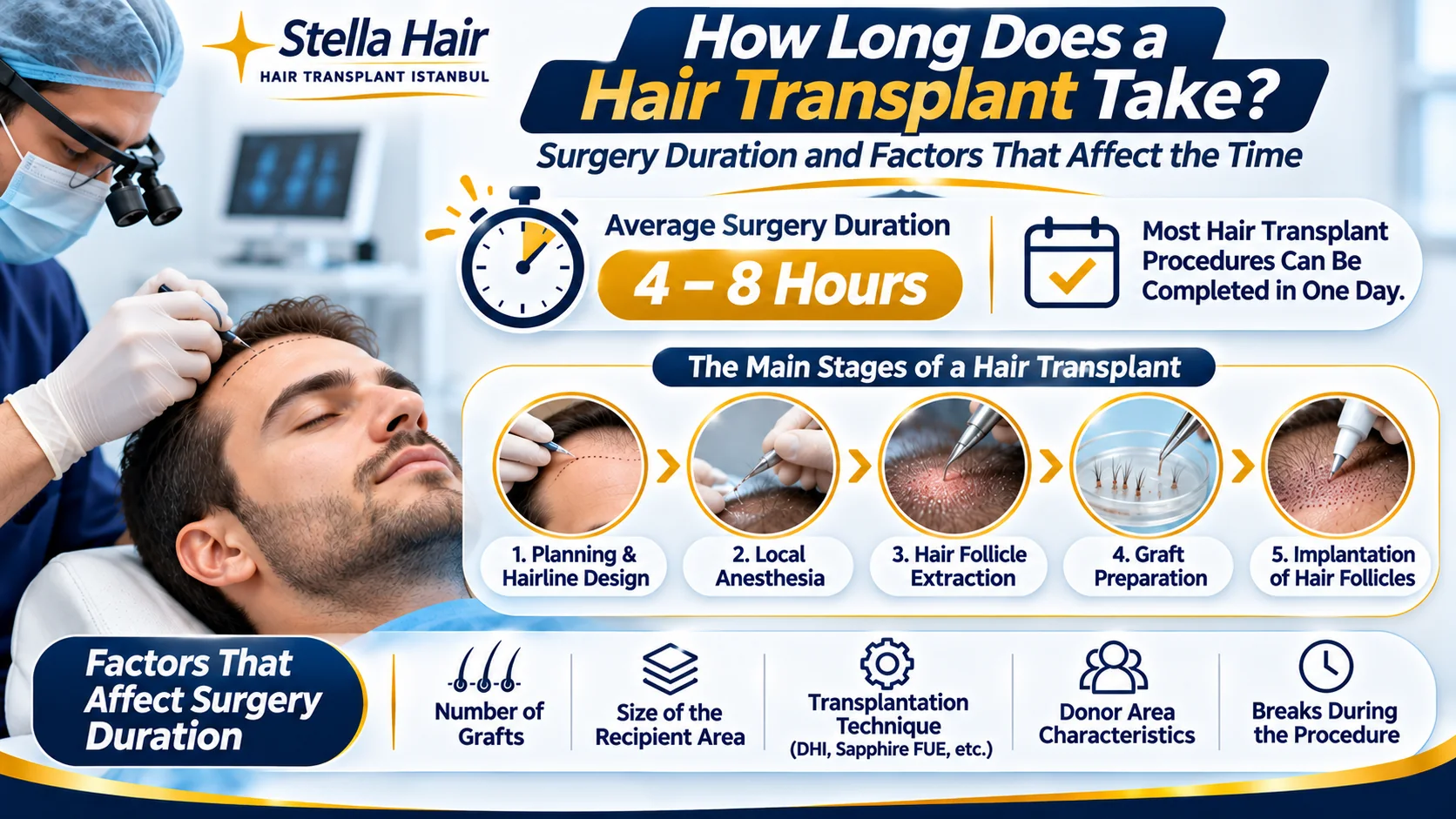
How long does a hair transplant take? This is one of the most frequently asked questions among people considering hair restoration surgery. Hair transplantation involves extracting healthy hair follicles from a donor area and implanting them into areas affected by hair loss. Although most hair transplant procedures can be completed within a single day, the exact duration varies depending on several factors. At Istanbul Stella Hair, we consider the number of grafts, the size of the recipient area, donor hair characteristics, and the selected transplantation technique when planning each procedure.
At Istanbul Stella Hair, we believe patients should understand every stage of their hair transplant journey before arriving for surgery. The procedure involves much more than placing hair follicles into the scalp. Hairline design, local anesthesia, follicle extraction, graft preparation, implantation, and postoperative checks all require time. So, how many hours does a hair transplant take? Does DHI take longer than Sapphire FUE? How long does a 3,000-graft hair transplant last, and can the entire operation be completed in one day? In this guide, we explain the typical duration of hair transplantation and the factors that influence operating time.
How Many Hours Does a Hair Transplant Usually Take?
A hair transplant procedure typically takes approximately 4 to 8 hours. However, smaller procedures may take less time, while extensive transplantation sessions can last longer than eight hours.
One of the most important factors affecting surgery duration is the number of grafts required.
A graft is a follicular unit that may contain one or more hair follicles.
Patients with limited hair loss may need fewer grafts, while those with larger areas of baldness may require a more extensive procedure.
As a general guide:
- Small hair transplant procedures may be completed within several hours.
- Medium-sized procedures often require a significant portion of the day.
- Extensive hair transplantation may take eight hours or longer.
- Certain complex cases may require more than one session or treatment day.
These are general estimates rather than guaranteed operating times.
The exact duration should be determined after evaluating the patient's donor area, hair loss pattern, and individual treatment requirements.
What Are the Main Stages of a Hair Transplant?
Hair transplantation is not a single-step procedure.
Several stages must be completed to extract, prepare, and implant hair follicles appropriately.
Understanding these stages helps explain why a hair transplant can take several hours.
1. Initial Assessment and Hairline Design
Before surgery begins, the donor area and recipient regions are evaluated.
The surgical team assesses the patient's existing hair density, hair loss pattern, and available donor follicles.
The desired hairline is then planned according to the patient's facial proportions, hair characteristics, and long-term hair restoration goals.
This stage may also include reviewing the patient's medical history, medications, and surgical suitability.
Hairline design requires careful attention because the distribution and direction of transplanted hair can influence how natural the final result appears.
The amount of time required for planning varies between patients.
2. Local Anesthesia
Hair transplantation is commonly performed under local anesthesia.
Local anesthesia temporarily reduces or blocks pain sensation in the areas where the procedure will take place.
Before administering anesthesia, the responsible healthcare professionals should assess relevant medical conditions, medication use, and known allergies.
In some cases, additional sedation may be considered when clinically appropriate.
Administering anesthesia and ensuring that it has taken effect are part of the overall procedure time.
3. Hair Follicle Extraction
Hair follicles are generally extracted from the back and sides of the scalp.
These areas are commonly used because their follicles may be more resistant to hereditary pattern hair loss.
In Follicular Unit Excision (FUE), individual follicular units are removed using specialized instruments.
The extraction process requires precision to minimize unnecessary damage to the surrounding tissues and preserve the donor area's appearance.
As the number of grafts increases, extraction may take longer.
However, graft count is not the only factor.
Hair follicle characteristics, scalp conditions, and donor density can also influence the duration of extraction.
4. Graft Preparation
After extraction, the grafts must be evaluated and prepared for implantation.
This process may involve examining follicular units, organizing them according to the surgical plan, and maintaining appropriate storage conditions.
Protecting the follicles from unnecessary physical damage and prolonged exposure to unsuitable conditions is important.
Depending on the surgical workflow, graft preparation may occur alongside other stages of the procedure.
The time required varies according to the number and characteristics of the extracted grafts.
5. Hair Follicle Implantation
During the implantation stage, the prepared hair follicles are placed into the planned recipient areas.
Different transplantation approaches use different instruments.
For example, DHI generally uses specialized implanter pens, while Sapphire FUE typically involves preparing recipient channels with sapphire-tipped instruments before graft placement.
In both approaches, the angle, direction, and distribution of implanted follicles require careful planning.
The duration depends on the number of grafts, the recipient area's size, and the surgical technique.
Once implantation is complete, postoperative checks are performed, and patients receive instructions for the recovery period.
What Factors Affect Hair Transplant Surgery Duration?
Several factors determine how long a hair transplant takes.
Although the selected technique matters, it is only one part of the overall surgical plan.
1. Number of Grafts
The number of grafts is one of the main factors influencing hair transplant duration.
Each follicular unit must be extracted, prepared, and implanted.
For example, a procedure involving 1,500 grafts will generally require less work than a procedure involving 4,000 grafts.
However, it is not possible to calculate an exact operating time based on graft count alone.
Two patients receiving the same number of grafts may require different operating times because of differences in hair characteristics, surgical complexity, and implantation requirements.
2. Size of the Recipient Area
Hair transplantation may involve the frontal hairline, temples, mid-scalp, crown, or several areas during the same session.
Larger recipient areas may require more extensive planning and graft distribution.
Implantation between existing hair strands can also require additional care to protect surrounding follicles.
The complexity of the recipient area may therefore influence surgery duration.
3. Hair Transplant Technique
DHI, Sapphire FUE, and completely unshaven hair transplantation involve different instruments and workflows.
These differences may affect the time required for extraction and implantation.
However, it would be inaccurate to claim that DHI always takes longer or that Sapphire FUE is consistently faster.
The duration depends on the surgical plan rather than the technique's name alone.
4. Donor Area Characteristics
Donor hair density, follicle structure, hair shaft thickness, and scalp characteristics can affect extraction.
Some follicular units may require greater care during removal.
The surgical team must also consider donor preservation rather than focusing exclusively on extraction speed.
5. Breaks During Surgery
Because hair transplantation can last several hours, appropriate breaks may be scheduled.
Patients may need to change position, rest, or receive additional medical checks.
The number and duration of breaks depend on the patient's comfort, medical condition, and surgical requirements.
As a result, the total time spent at the clinic may be longer than the active surgical time.
How Long Does a 2,000, 3,000, or 4,000-Graft Hair Transplant Take?
People researching hair restoration frequently search for operation times based on the number of grafts.
However, there is no universal formula that determines the exact number of hours required for a particular graft count.
The following table provides a general comparison.
Number of Grafts
General Duration Considerations
1,000–1,500 grafts
Smaller procedures may require relatively less operating time.
2,000 grafts
May involve several hours of extraction and implantation.
3,000 grafts
Often requires a substantial portion of the surgical day.
4,000 grafts
May require a longer and more extensive operating session.
More than 4,000 grafts
May require additional time or multiple sessions depending on donor capacity and surgical suitability.
These figures are not recommendations for how many grafts a patient should receive.
For example, the duration of a 3,000-graft hair transplant cannot be determined accurately without evaluating the patient's hair characteristics and selected technique.
It is also important to remember that a higher graft count does not automatically produce a better result.
Appropriate donor preservation and graft distribution are essential parts of surgical planning.
How Long Does a DHI Hair Transplant Take?
DHI, or Direct Hair Implantation, uses specialized implantation instruments to place extracted follicles into the recipient area.
Depending on the number of grafts and the complexity of the procedure, DHI transplantation may require several hours or occupy most of the surgical day.
Factors affecting DHI surgery duration include:
- The number of follicles requiring implantation
- The size of the recipient area
- Existing hair density
- The complexity of hairline design
- Donor follicle characteristics
- The implantation workflow
Using an implanter pen does not automatically make the procedure faster.
Careful follicle handling and appropriate placement remain important regardless of operating time.
How Long Does a Sapphire FUE Hair Transplant Take?
Sapphire FUE involves extracting follicular units and preparing recipient channels using sapphire-tipped instruments.
The extracted grafts are then implanted into the prepared channels.
Surgery duration depends on the number of grafts, the size of the recipient area, and the complexity of channel preparation and implantation.
The use of sapphire-tipped instruments does not guarantee that surgery will be completed within a particular number of hours.
Similarly, it does not automatically guarantee faster healing or superior results.
Surgical technique, donor preservation, and appropriate graft placement remain essential.
How Long Does a Completely Unshaven Long DHI Hair Transplant Take?
Patients who want to preserve their existing hairstyle often ask whether unshaven hair transplantation requires more time than conventional procedures.
At Istanbul Stella Hair, we offer Long DHI as a completely unshaven hair transplantation approach.
Our Long DHI procedure is designed to preserve the existing hair length in both the donor and recipient areas without shaving or cutting the hair.
Working around longer hair strands requires a different approach to follicle extraction and implantation.
This may influence the duration of the procedure.
However, completely unshaven Long DHI does not take a fixed number of additional hours in every patient.
The operating time depends on graft requirements, existing hair characteristics, donor area conditions, and individual surgical planning.
Patients interested in maintaining their existing hair length can explore our Long DHI treatment information to understand the procedure in greater detail.
Can a Hair Transplant Be Completed in One Day?
Yes. Many hair transplant procedures can be completed within a single day.
However, this does not mean that every patient will necessarily receive all required grafts during one session.
Patients with extensive hair loss or particular surgical requirements may need more than one session.
The decision should account for donor capacity, patient safety, and the overall treatment plan.
It is also important to distinguish between completing the surgery and completing the recovery process.
Although surgery may finish within one day, scalp healing takes longer.
Temporary redness, sensitivity, swelling, and scabbing may develop during the first days.
New hair growth takes several months, and the final appearance generally requires much longer to develop.
The duration of hair transplant surgery is not the same as the time required to achieve hair transplant results.
Are Patients Awake During Hair Transplant Surgery?
Hair transplantation is commonly performed under local anesthesia.
This means many patients remain awake throughout the procedure.
Local anesthesia reduces pain sensation in the treated scalp areas.
However, patients may still experience pressure, touch, or temporary discomfort associated with positioning.
Anesthetic injections can also cause brief discomfort.
In selected situations, healthcare professionals may consider additional sedation.
Patients should inform their medical team if they experience discomfort during the procedure.
For longer operations, maintaining patient comfort and monitoring medical safety are important considerations.
Does a Longer Hair Transplant Mean Better Results?
Not necessarily.
A longer operation does not automatically mean that more follicles will survive or that the final result will look more natural.
Similarly, a shorter procedure does not automatically indicate greater efficiency or better surgical quality.
Sometimes extraction or implantation takes longer because of the patient's follicle characteristics, scalp anatomy, or surgical requirements.
Additional breaks or medical checks may also increase the total duration.
The objective should not be to complete the procedure as quickly as possible.
The priority is to perform the transplantation safely, preserve suitable donor follicles, and follow an appropriate surgical plan.
Operating time alone is therefore not a reliable measure of hair transplant quality.
How Should You Prepare for Hair Transplant Surgery?
Patients should allow sufficient time for the procedure and avoid scheduling demanding activities immediately afterward.
Because surgery may last several hours, maintaining a flexible schedule is advisable.
International patients should also consider postoperative checks and recovery requirements when planning travel.
Before the operation, patients should disclose relevant medical conditions, prescribed medications, allergies, and previous reactions to anesthesia.
Instructions regarding food intake, medication use, and preparation should be followed carefully.
Prescribed medications should not be discontinued without medical advice.
At Istanbul Stella Hair, we emphasize the importance of understanding both the operation itself and the postoperative recovery process.
Frequently Asked Questions
How long does a hair transplant usually take?
A hair transplant commonly takes approximately 4–8 hours. However, the duration varies depending on graft count, surgical technique, recipient area size, and individual patient requirements.
How long does a 3,000-graft hair transplant take?
A 3,000-graft hair transplant often requires a significant portion of the day. The exact duration depends on donor characteristics, the selected implantation technique, and surgical planning.
Can 4,000 grafts be transplanted in one day?
In some suitable patients, a 4,000-graft procedure may be planned within a single day. However, donor capacity, patient safety, and the extent of surgery may require a different approach or multiple sessions.
Does DHI take longer than Sapphire FUE?
Not always. DHI and Sapphire FUE use different implantation instruments, but the total operating time depends on the number of grafts and individual surgical requirements.
Does an unshaven hair transplant take longer?
Completely unshaven procedures may require additional care when working around existing hair. This can increase operating time, although the difference varies between patients.
Are breaks allowed during a hair transplant?
Yes. Appropriate breaks may be scheduled depending on the duration of the operation, patient comfort, and medical requirements.
Can hair transplantation be completed in one day?
Many procedures can be completed in one day. However, healing and new hair growth take considerably longer, and some complex cases may require multiple sessions.
Does a longer operation guarantee better graft survival?
No. A longer procedure does not guarantee better graft survival or a more natural result. Outcomes depend on several medical, surgical, and individual factors.
Conclusion: Hair Transplant Duration Depends on Individual Needs
How long does a hair transplant take? In general, hair transplantation takes approximately four to eight hours, although the actual duration may be shorter or longer.
The number of grafts, recipient area size, donor characteristics, and chosen implantation technique all influence operating time.
DHI, Sapphire FUE, and completely unshaven Long DHI may require different surgical workflows.
However, a shorter or longer operation is not automatically an indication of success.
At Istanbul Stella Hair, we focus on appropriate donor area preservation, natural-looking hairline planning, and individualized treatment requirements when discussing hair restoration procedures.
To learn more about hair transplantation techniques and the treatment process, visit our hair transplant services.
Medical Disclaimer: This article is intended for general educational purposes only. The duration, technique, and suitability of hair transplant surgery must be determined through an individual assessment by qualified healthcare professionals.
