How Is the Hairline Designed for a Hair Transplant?
How is a natural hairline designed for a hair transplant? Learn how facial proportions, age, graft placement and hair direction shape your results.
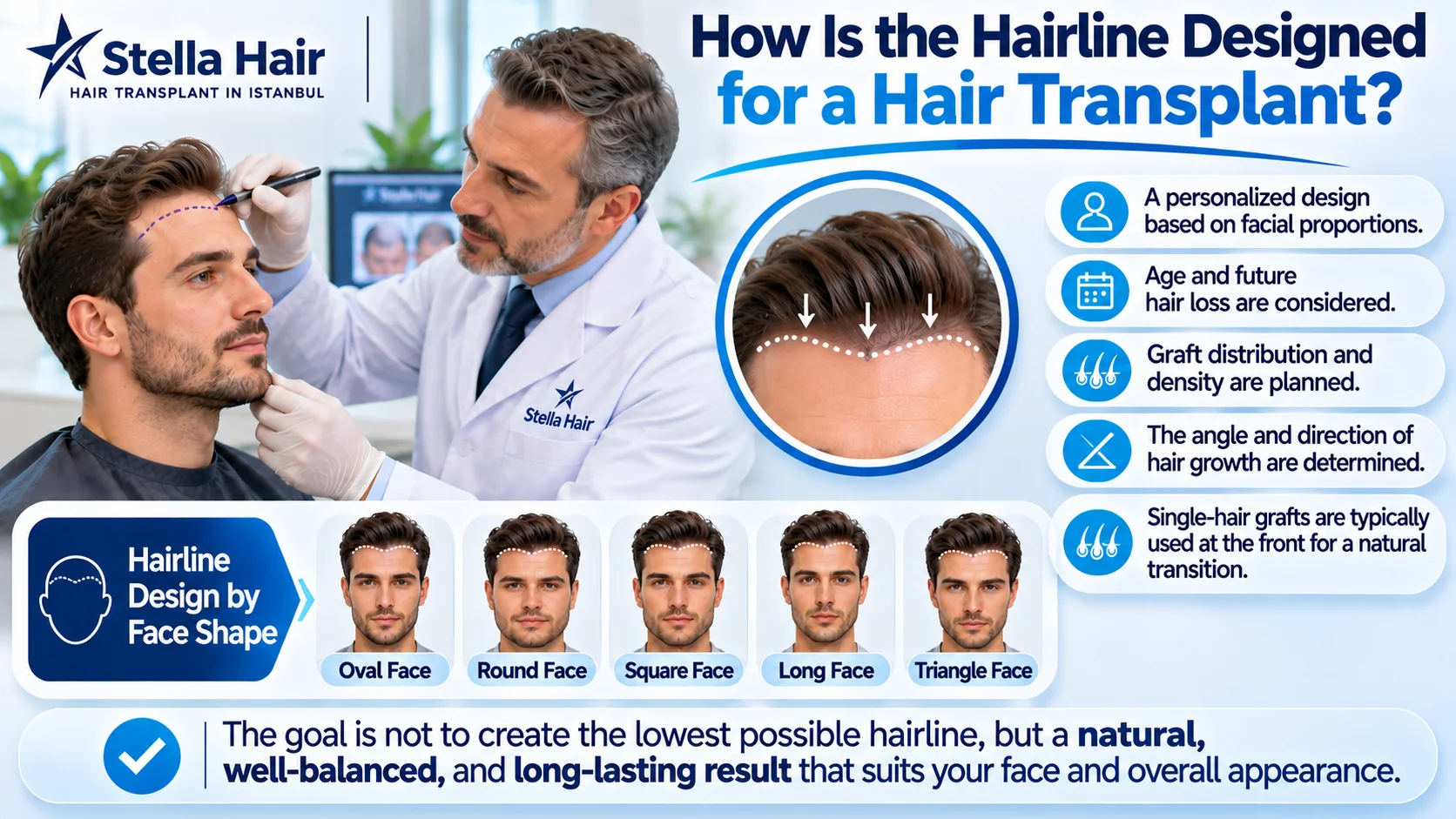
Hair transplant hairline design is one of the most important factors influencing how natural the final result will look. Most patients considering hair restoration want more than simply covering areas affected by hair loss. They want a natural-looking hairline that complements their facial features and remains aesthetically balanced over time. However, successful hairline design involves much more than drawing a straight line across the forehead or positioning the hairline as low as possible. Age, facial proportions, forehead height, existing hair density, future hair loss, and donor hair availability must all be considered. At Istanbul Stella Hair, we emphasize creating individualized hairline plans that take both current appearance and long-term hair loss patterns into account.
At Stella Hair, we consider personalized hairline planning an essential part of DHI, Sapphire FUE, and completely unshaven Long DHI hair transplantation. Two patients of the same age with similar patterns of hair loss may have very different facial structures, forehead shapes, and natural hair growth directions. Therefore, the same hairline design will not necessarily suit both individuals. So, how is a hairline designed for a hair transplant? How high should the frontal hairline be? Why can placing the hairline too low create an unnatural appearance? How are receding temples restored? In this guide, we explain the main principles of natural hairline design, graft distribution, hair direction, and preoperative planning.
What Is the Frontal Hairline in Hair Transplantation?
The frontal hairline is the boundary between the forehead and the hair-bearing scalp. Its position, shape, and density influence the overall appearance of the face.
The frontal hairline plays an important role in facial proportions.
When the hairline recedes, the forehead may appear larger or more prominent.
Restoring the frontal hairline can change how the upper part of the face is perceived.
However, moving the hairline excessively forward may create proportions that do not match the patient's facial anatomy.
Natural hairline design involves much more than determining where the first row of hair follicles should be placed.
Other important factors include:
- The overall shape of the hairline
- The transition between the forehead and the hair-bearing scalp
- Hair density immediately behind the frontal edge
- The number of hairs within each transplanted graft
- The angle and direction of hair growth
- The relationship between the frontal hairline and temple areas
These details contribute to creating a hairline that blends with the patient's existing hair.
How Is a Hairline Designed for a Hair Transplant?
A hair transplant hairline is designed by evaluating facial proportions, age, existing hair distribution, temple recession, donor capacity, and the possibility of future hair loss.
There is no single hairline shape that is appropriate for every patient.
The planning process generally involves several important considerations.
1. Facial Shape and Proportions
Facial anatomy is one of the primary factors influencing hairline placement.
The overall length and width of the face, forehead structure, and relationship between the eyebrows, nose, and chin may be considered.
For example, a patient with a long face may require a different hairline design from someone with a round face and a relatively wide forehead.
Some hairline planning techniques use facial reference points and proportional measurements.
However, these measurements should guide the assessment rather than determine the design automatically.
The goal is to create a balanced hairline that complements the individual's facial characteristics.
2. Patient Age
Age is particularly important when planning frontal hairline restoration.
Younger patients sometimes prefer a low hairline similar to the one they had during adolescence.
However, androgenetic alopecia, commonly known as pattern hair loss, may continue progressing over time.
A hairline positioned too low at a young age may become less natural as the surrounding hair continues to thin.
For this reason, hairline design should consider the possibility of future hair loss.
An age-appropriate, conservative approach may help preserve a more balanced appearance over the long term.
3. Existing Hairline Structure
Not every patient has the same pattern of frontal hair loss.
Some patients experience extensive recession across the entire frontal region.
Others retain much of their central hairline but develop noticeable recession at the temples.
The existing hairline can provide useful information about natural hair growth direction and density.
In some cases, complete reconstruction is unnecessary.
Instead, the surgical plan may focus on improving specific areas of thinning or restoring the transition between the frontal hairline and temples.
4. Donor Area Capacity
Hair transplantation generally involves extracting follicular units from the back and sides of the scalp.
These regions are commonly referred to as the donor area.
However, donor hair is a limited resource.
Moving the frontal hairline too far forward increases the size of the area requiring transplantation.
This may also increase the number of grafts needed.
Using too many grafts in the frontal region could reduce the donor reserve available for future hair restoration procedures.
Therefore, donor capacity should be considered alongside the desired hairline position.
5. Hair Thickness and Texture
Hair characteristics can significantly influence the appearance of the transplanted hairline.
Fine and coarse hair do not necessarily provide the same visual coverage at identical densities.
Hair texture also matters.
Straight, wavy, and curly hair may create different impressions of fullness.
The patient's natural hair color and contrast with the scalp can also affect the visual appearance of hair density.
For these reasons, two patients receiving the same number of grafts may achieve different visual results.
How High Should a Hair Transplant Hairline Be?
There is no universally ideal hairline height or fixed distance in centimeters that applies to every patient.
Some approaches to hairline planning use facial proportions or anatomical landmarks as reference points.
For example, practitioners may assess the relationship between the eyebrows, forehead, and upper facial region.
However, facial anatomy varies considerably.
The position of the eyebrows, forehead height, hairline shape, and overall face length are not identical in every individual.
Therefore, using a fixed measurement without considering the patient's anatomy may produce an unsuitable design.
A hairline that appears natural on one patient may look excessively low or high on another.
The objective is not to position the hairline as low as possible, but to establish a height that creates natural facial balance.
Should a Natural Hairline Be Straight or Irregular?
A natural frontal hairline usually does not resemble a perfectly straight line drawn with a ruler.
Small variations along the frontal edge help create a softer transition between the forehead and scalp.
In hair transplantation, placing grafts in an excessively straight arrangement may produce an artificial appearance.
This is sometimes described as a pluggy or unnatural hairline.
Natural hairline design generally considers two types of irregularity.
Macro-Irregularities
Macro-irregularities refer to variations in the overall shape of the hairline.
For example, the central frontal region may extend slightly farther forward than the temple areas.
The hairline may also contain subtle curves or changes in contour.
These characteristics can help the design resemble natural hair growth patterns.
Micro-Irregularities
Micro-irregularities are smaller variations along the leading edge of the hairline.
They help prevent transplanted hairs from appearing in a rigid, uniform row.
Appropriate spacing and positioning of individual follicular units can create a softer transition.
However, natural irregularity should not be confused with random graft placement.
A natural-looking hairline requires controlled, anatomically appropriate irregularities rather than an artificially perfect line.
Why Should the Hairline Not Be Placed Too Low?
A low hairline may initially appear attractive because it can make the forehead look smaller.
However, lowering the hairline excessively is not always the most appropriate long-term strategy.
This is especially important for patients with progressive male pattern hair loss.
If the transplanted frontal hairline remains in place while the natural hair behind it continues to recede, an unnatural separation may develop.
Additional transplantation may eventually be required to restore visual balance.
A lower hairline also increases the area that needs coverage.
This can require more grafts and place greater demands on the donor area.
Because donor hair is limited, using a large proportion of the available grafts to create an unnecessarily low frontal hairline may not be advisable.
An appropriate hairline should balance the patient's expectations with future hair restoration needs.
How Are Receding Temples Restored During a Hair Transplant?
Temple recession is a common characteristic of male pattern hair loss.
Some patients retain a relatively stable central hairline while the left and right temple areas gradually recede.
This can create an M-shaped hairline.
Temple restoration requires more than simply filling empty spaces with hair grafts.
The shape and direction of the surrounding hair must be considered.
A natural transition should be maintained between the frontal hairline and the lateral hair-bearing areas.
The design should also account for facial proportions and the possibility of further recession.
In some patients, preserving a degree of mature temple recession may produce a more natural appearance than attempting to restore an extremely low, juvenile hairline.
The goal is to achieve balanced temple transitions rather than eliminate every visible sign of recession.
Why Are Single-Hair Grafts Used in the Frontal Hairline?
Single-hair follicular units are generally preferred along the leading edge of the frontal hairline because they can create a softer, more natural transition.
A follicular unit may contain one or several hair shafts.
If larger follicular units containing multiple hairs are placed excessively close to the frontal edge, the hairline may appear too dense or abrupt.
Carefully selected single-hair grafts can help avoid this appearance.
Behind the leading edge, follicular units containing multiple hairs may be used to build additional density.
This creates a gradual transition from the softer frontal edge to the fuller hair-bearing area behind it.
Hairline Graft Placement
Area
General Planning Approach
Leading edge
Appropriate single-hair grafts for a soft transition
Immediately behind the hairline
Gradual increase in density
Frontal mid-scalp
Graft distribution based on available donor hair and coverage needs
Temple transitions
Natural placement with suitable angles and directions
These are general planning principles rather than a fixed surgical formula.
The final distribution depends on the patient's hair characteristics and individual treatment plan.
Why Do Hair Growth Angle and Direction Matter?
Natural hairline design is not determined by height and shape alone.
The angle and direction of transplanted hairs are equally important.
Natural hair does not grow in exactly the same direction across the entire scalp.
The frontal hairline, temples, sides, and crown may have different growth patterns.
These patterns should be considered when planning graft placement.
For example, transplanted hairs placed too upright in a region where surrounding hairs grow at a relatively low angle may create a noticeable mismatch.
Incorrect placement can also make styling more difficult after the transplanted hair grows.
Therefore, existing hair growth patterns should guide the orientation of transplanted follicles.
The objective is for newly transplanted hair to grow in harmony with the surrounding natural hair.
How Many Grafts Are Needed for Frontal Hairline Restoration?
The number of grafts required depends on the size of the affected area and the design being planned.
Restoring small temple recessions is different from reconstructing a frontal hairline that has receded extensively.
The required graft number may be influenced by:
- The current position of the hairline
- The width and depth of temple recession
- The thickness of individual hair shafts
- Existing hair density
- The desired coverage
- Donor area availability
- The size of the planned hairline transition zone
A photograph may help with preliminary assessment, but it may not provide enough information to determine the exact graft requirement.
A detailed examination is usually needed.
Additionally, using more grafts does not automatically produce a better or more natural result.
The way grafts are selected, distributed, and implanted is also important.
Is Hairline Design Different in Your 20s, 30s, and 40s?
Age can influence the most appropriate approach to frontal hairline design.
However, age alone does not determine the ideal hairline.
Hairline Design in Your 20s
Patients in their twenties may still be experiencing active or rapidly progressing hair loss.
This is particularly relevant in cases of androgenetic alopecia.
A very low hairline created at this stage may become less suitable if additional hair loss develops later.
Some younger patients may benefit from medical treatment and observation before considering transplantation.
The underlying cause and progression of hair loss should be evaluated.
Hairline Design in Your 30s
By their thirties, some patients may have developed a clearer pattern of hair loss.
However, hair loss can continue progressing.
Therefore, the hairline should still be designed with future changes in mind.
Existing hair density, donor capacity, and the potential need for future treatment remain important considerations.
Hairline Design in Your 40s and Beyond
For older patients, natural facial balance remains a priority.
The design should complement the patient's current facial features and hair density.
An extremely low or excessively dense hairline may appear unsuitable for some individuals.
There is no single hairline shape that should be applied to everyone within a particular age group.
A personalized, long-term approach is more appropriate.
Is Hairline Design Different for Men and Women?
Male and female hairlines may show certain common anatomical differences.
For example, men may naturally have more pronounced temporal recessions and sharper frontotemporal transitions.
Women may have a rounder or softer frontal hairline in some cases.
However, these are general observations rather than universal rules.
Not every man or woman has the same hairline shape.
In female patients, the underlying cause of hair loss is particularly important.
Diffuse hair thinning, frontal hairline recession, and certain scalp disorders require different evaluations.
Hair loss related to hormonal changes or medical conditions may also influence treatment planning.
Therefore, determining the diagnosis and assessing the patient's suitability for hair transplantation should come before designing a new hairline.
Can Patients Choose Their Own Hairline Design?
Patient preferences are an important part of the consultation process.
However, the final hairline should not be determined solely by the patient's desired position.
For example, someone may request the restoration of the exact hairline they had during adolescence.
That design may not always be appropriate given their current donor capacity, age, or expected future hair loss.
The consultation should therefore balance personal expectations with anatomical and medical considerations.
A proposed hairline may be marked on the forehead before surgery so the patient can review its position and shape.
This helps the patient understand the planned design and discuss concerns.
However, a preoperative drawing should not be interpreted as a guarantee of the final appearance after hair growth.
How Is Hairline Planning Performed Before Surgery?
The planning process usually involves several stages.
1. Assessing the Existing Hair Loss
The medical team evaluates the current position of the frontal hairline, temple recession, and hair density in other areas.
2. Evaluating Facial Proportions
Forehead height, facial structure, and the relationship between the existing hairline and facial features are examined.
3. Assessing Donor Capacity
The density and quality of available donor hair are evaluated.
4. Creating the Proposed Hairline
An initial design may be marked using the patient's anatomy and appropriate reference points.
5. Planning Graft Distribution
The distribution of single-hair and multiple-hair follicular units is considered to achieve a gradual, natural-looking transition.
6. Evaluating Hair Direction
Existing hair growth angles and directions are assessed to guide graft placement.
7. Reviewing the Design With the Patient
The proposed design is discussed in relation to the patient's expectations and long-term hair restoration needs.
These stages may vary depending on the patient's condition and the treatment technique being used.
The final surgical plan should be determined by appropriately qualified healthcare professionals.
How Is the Hairline Designed With DHI Hair Transplantation?
DHI is a hair transplantation technique that may involve specialized implantation pens for placing follicular units into the recipient area.
In DHI hair transplantation, the frontal hairline must still be carefully planned before implantation.
The height, shape, and density distribution of the hairline are important considerations.
The natural direction of existing hair should also guide graft placement.
Appropriate single-hair grafts may be selected for the leading edge, while additional density can be created farther behind the hairline.
However, using DHI does not automatically guarantee a natural-looking hairline.
Surgical planning, graft selection, technical execution, and individual hair characteristics all contribute to the final appearance.
Is Hairline Design Different With Sapphire FUE?
Sapphire FUE involves extracting follicular units using the FUE approach and may use sapphire-tipped instruments to prepare recipient channels.
However, the fundamental principles of natural hairline design remain similar to those used in other hair transplantation methods.
The patient's facial proportions, existing hair growth direction, donor capacity, and future hair loss should still be considered.
Using sapphire instruments does not automatically guarantee a more natural hairline or a higher graft survival rate.
The suitability of the technique and the quality of surgical planning are more important than the instrument name alone.
Can Completely Unshaven Long DHI Restore the Frontal Hairline?
Yes. Completely unshaven Long DHI may be considered for suitable patients who want to improve or restore their frontal hairline without shaving the existing hair.
At Istanbul Stella Hair, our Long DHI approach is designed to preserve the existing hair length in both donor and recipient areas.
However, keeping the hair unshaven does not reduce the importance of careful hairline planning.
New follicular units still need to be placed in suitable positions and directions.
This is particularly relevant when transplantation is performed among existing hairs.
The surgeon must consider the natural direction and distribution of surrounding hair.
Patient age, donor capacity, facial proportions, and possible future hair loss remain essential factors.
Unshaven transplantation is not a substitute for personalized hairline design.
Learn more about our procedures through our hair transplant services in Istanbul.
Can an Unnatural Hairline From a Previous Transplant Be Corrected?
Some patients seek corrective treatment after an earlier hair transplant produced an unnatural frontal hairline.
Potential concerns include:
- A hairline positioned too low
- An excessively straight frontal edge
- Multiple-hair grafts placed prominently along the leading edge
- Unnatural hair growth angles
- Poor transitions between the frontal hairline and temples
- Uneven density distribution
Corrective hair transplantation may be possible in selected cases.
For example, additional appropriate grafts may sometimes be used to create a softer transition along the hairline.
However, hairline correction can be technically challenging.
The existing graft positions, condition of the scalp, remaining donor capacity, and overall hair loss pattern must be evaluated.
Some patients may require alternative corrective surgical approaches.
Therefore, careful planning during the initial procedure is particularly valuable.
What Should You Ask Before Choosing a Hairline Design?
Patients considering frontal hairline restoration may find it useful to discuss the following questions during their consultation:
- Is the proposed hairline suitable for my facial proportions?
- Does the design take my age and potential future hair loss into account?
- How will my temple recession be addressed?
- Will appropriate single-hair grafts be used along the frontal edge?
- How will the angle and direction of transplanted hair be determined?
- Will enough donor hair remain available for future needs?
- Could the proposed design still look natural if further hair loss occurs?
- Can I review the planned hairline before surgery?
Clear communication about these issues helps patients better understand the proposed treatment.
Frequently Asked Questions
How is a hairline designed for a hair transplant?
A hairline is designed by evaluating facial proportions, age, forehead structure, existing hair density, donor capacity, and the possibility of future hair loss. The goal is to create a natural, balanced appearance.
What is the ideal hairline height for a transplant?
There is no universal ideal height. Hairline placement should be based on the patient's facial anatomy and individual characteristics rather than a fixed measurement.
Can a hair transplant hairline be too low?
Yes. An excessively low hairline may create unnatural facial proportions, require more grafts, and become difficult to maintain aesthetically if additional hair loss develops.
Should a natural hairline be straight?
A natural hairline generally contains subtle irregularities. An excessively straight or uniformly dense frontal edge may appear artificial.
Why are single-hair grafts used at the front?
Single-hair follicular units help create a softer transition between the forehead and the denser hair behind the frontal edge.
Can I choose exactly where my new hairline will be?
Your preferences are important, but the final design should also reflect your anatomy, donor capacity, and long-term hair loss risks.
Should temple recession be completely restored?
Not necessarily. Some degree of mature temple recession may produce a more natural appearance. The appropriate design depends on the patient's facial features and hair loss pattern.
Can a 25-year-old get a hairline transplant?
Some younger adults may be suitable candidates. However, active or progressive hair loss requires careful evaluation, and medical treatment or monitoring may be preferable in certain cases.
Should the hairline be higher after age 40?
Age alone does not determine hairline height. The design should complement the patient's facial structure, existing hair, and long-term treatment needs.
How many grafts are required for a hairline transplant?
The number depends on the size of the affected area, existing hair density, hair characteristics, donor capacity, and desired coverage.
Will a transplanted hairline look natural?
A natural appearance can be achieved in suitable patients with careful planning and appropriate surgical technique. However, results vary and cannot be guaranteed.
How long does it take for the new hairline to become visible?
New hair growth may begin to become noticeable around the third or fourth month. The appearance generally develops over subsequent months, and results are often assessed more fully around 12 months.
Does DHI create a more natural hairline?
DHI is one technique used for hair transplantation. Natural-looking results depend on hairline design, graft selection, hair direction, and surgical execution rather than the technique name alone.
Can an unshaven hair transplant restore a receding hairline?
Completely unshaven Long DHI may be an option for suitable patients. However, the patient's existing hair, donor capacity, and hair loss pattern must be evaluated.
Can a badly designed hairline be corrected?
Some unnatural hairlines can be improved through corrective procedures. However, treatment options depend on existing grafts, scalp condition, and remaining donor hair.
What Matters Most When Designing a Natural Hairline?
The most important goal of hair transplant hairline design is not simply to cover a receding forehead, but to create a balanced appearance that works with the patient's facial features and existing hair.
Hairline height, temple transitions, graft distribution, and hair growth direction all contribute to the final appearance.
A hairline that is excessively low, unnaturally straight, or too dense along the leading edge may not be suitable for every patient.
Future hair loss is another essential consideration, particularly for younger individuals.
Because donor hair is limited, the available grafts should be planned carefully with both current and potential future needs in mind.
At Istanbul Stella Hair, we emphasize personalized planning for patients considering DHI, Sapphire FUE, and completely unshaven Long DHI hair transplantation.
Our approach focuses on evaluating facial proportions, natural hair characteristics, donor capacity, and possible future changes before developing an individualized hairline plan.
To explore our procedures and learn more about hair restoration options, visit our hair transplant services in Istanbul.
Scientific and Medical References
- Hair Transplant Practice Guidelines. Journal of Cutaneous and Aesthetic Surgery, 2021. Guidance on patient evaluation, donor assessment, and hair transplantation planning.
- Hairline Design and Frontal Hairline Restoration. Facial Plastic Surgery Clinics of North America, 2013. Principles of frontal hairline design and restoration.
- Recipient Area. Journal of Cutaneous and Aesthetic Surgery, 2018. Considerations for recipient area preparation, graft placement, and hairline design.
- Revision of the Unfavorable Result in Hair Transplantation. Facial Plastic Surgery, 2008. Approaches to correcting unsatisfactory hair transplantation results.
- International Society of Hair Restoration Surgery (ISHRS). Professional resources on hair restoration surgery and patient care.
Medical Disclaimer: This article is provided for general educational purposes only. Hairline design and hair transplant suitability depend on individual anatomy, the underlying cause of hair loss, donor availability, and medical considerations. Treatment planning should be carried out by appropriately qualified healthcare professionals.
