Hair Transplant Scabs: When Do They Fall Off?
When do scabs fall off after a hair transplant? Learn how long scabbing lasts, how to care for your scalp, and when to contact your clinic.
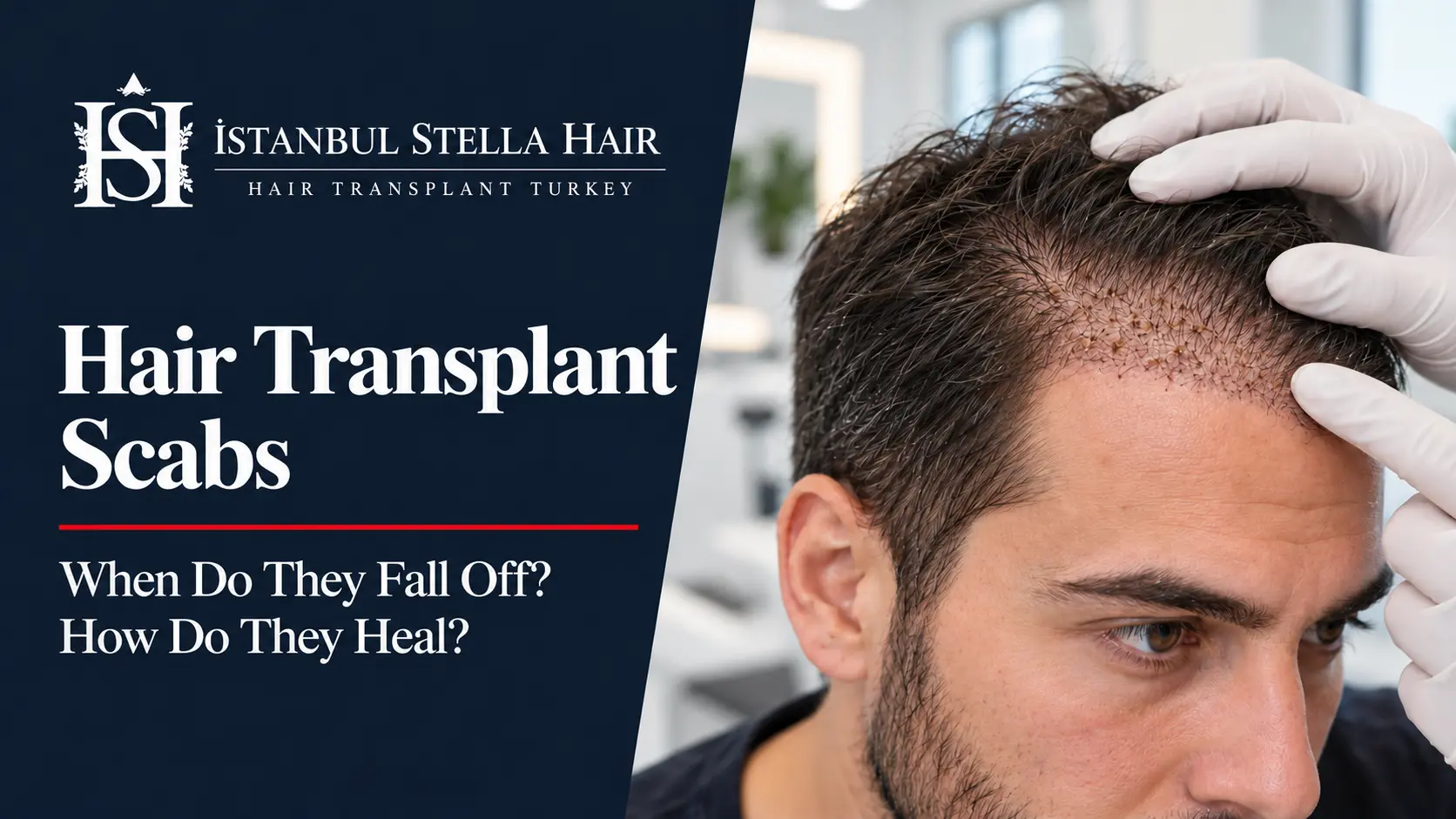
Small scabs that form on the scalp after a hair transplant are among the most visible signs of the early healing process. During the first few days following surgery, patients may notice redness, sensitivity, and tiny crusts surrounding the transplanted follicles. At Istanbul Stella Hair, we explain what patients can expect during recovery, including when hair transplant scabs normally fall off and how to care for the scalp without disturbing the newly implanted grafts.
At Istanbul Stella Hair, we offer DHI, Sapphire FUE, Long DHI, and completely unshaven hair transplantation options. Regardless of the technique, the scalp needs time to heal after surgery. The appearance, number, and duration of scabs can vary from patient to patient. We provide individual aftercare guidance to help our patients protect their transplanted follicles while allowing the scalp to recover naturally.
Why Do Scabs Form After a Hair Transplant?
During a hair transplant, follicular units are extracted from the donor area and implanted into the recipient area.
The procedure creates very small openings in the scalp. Small amounts of blood and tissue fluid may collect around these openings.
As these fluids dry, tiny crusts or scabs develop around the implanted follicles.
This is part of the body's natural wound-healing response.
Common changes during the early recovery period include:
- Small scabs surrounding transplanted follicles
- Mild redness in the recipient area
- Temporary scalp sensitivity
- Small healing spots in the donor area
- Occasional itching as the scalp recovers
These changes are often expected when they remain mild and gradually improve.
However, the appearance of scabs alone cannot determine whether a hair transplant has been successful.
Scabbing is primarily associated with the healing of the scalp's surface.
How Long Do Hair Transplant Scabs Last?
Hair transplant scabs typically fall off within 5 to 14 days after surgery.
Some patients notice that their scabs begin loosening toward the end of the first week. Others may continue to have visible crusting until the second week.
Several factors can influence how quickly scabs disappear:
- The size of the transplanted area
- The number of grafts implanted
- Individual healing characteristics
- The thickness and number of scabs
- The postoperative care routine
- Skin condition and overall health
For this reason, not every patient follows exactly the same healing schedule.
The main consideration is whether the amount of scabbing gradually decreases and the scalp continues healing without concerning symptoms.
Hair Transplant Scabbing Timeline: The First 15 Days
Recovery Period
What You May Notice
Days 1–3
Small scabs become visible around the transplanted follicles.
Days 4–6
The scabs begin drying, and some may loosen naturally.
Days 7–10
Many patients notice a significant reduction in visible scabbing.
Days 10–14
Most scabs have usually fallen off as healing progresses.
Day 15 onward
Remaining scabs or persistent sensitivity may require advice from the medical team.
This timeline is a general guide rather than a fixed schedule.
Your clinic's specific aftercare instructions should always take priority.
How Do Hair Transplant Scabs Fall Off?
Hair transplant scabs gradually loosen as the skin heals.
Appropriate postoperative care helps the scalp recover and allows surface crusts to separate naturally.
There is usually no reason to remove every scab at once.
During the first few days, picking, scratching, or aggressively rubbing the recipient area can damage healing tissue.
The safest approach is to follow the washing and care schedule provided by the medical team responsible for your procedure.
1. Use the Recommended Aftercare Products
After hair transplantation, patients may receive a specially selected shampoo, foam, or other scalp-care products.
These products support appropriate cleansing and help manage residue during healing.
However, application methods differ depending on the product and the patient's condition.
At Istanbul Stella Hair, we explain how and when to use the recommended products as part of our postoperative guidance.
Patients should avoid introducing new oils, lotions, shampoos, or cosmetic treatments without first consulting their medical team.
2. Avoid Picking or Pulling Off Scabs
Visible scabs can be frustrating, particularly around the frontal hairline.
Some patients may want to remove them quickly to improve their appearance.
However, pulling off scabs before they are ready can irritate the scalp and interfere with healing.
We recommend allowing the scabs to loosen naturally.
If your medical team advises a particular scab-removal technique later in recovery, follow its instructions carefully.
3. Protect the Scalp From Friction
Rubbing the recipient area with a towel, scratching the scalp, or using a comb directly over the scabs may cause unnecessary irritation.
The transplanted area requires particular care during the early healing period.
Avoid applying pressure or massaging the scalp unless your medical team has specifically advised that it is safe.
4. Monitor the Healing Process
You do not need to lift individual scabs to check the skin underneath.
Instead, observe whether the amount of crusting gradually decreases.
Taking photographs under similar lighting conditions can help you monitor changes over several days.
This approach can also make it easier to discuss your recovery with your clinic if you have concerns.
Can You Remove Hair Transplant Scabs on Day 10?
One of the most frequently searched questions is whether scabs should be removed exactly ten days after a hair transplant.
Some clinics include a specific scab-removal stage around the tenth postoperative day.
However, this does not mean that every patient should perform the same procedure on the same day.
The appropriate timing depends on scalp healing, graft stability, and the surgical technique used.
We do not recommend copying aggressive rubbing or massage techniques shown in online videos.
If a particular cleaning method is necessary, the treating medical team should explain when and how to perform it.
Day 10 is not a universal deadline for removing all scabs.
For some patients, remaining crusts may still be part of the normal healing process.
Is It Dangerous to Pick Scabs After a Hair Transplant?
Picking scabs too early can cause bleeding, irritation, and damage to healing skin.
Newly transplanted grafts are particularly vulnerable to unnecessary mechanical pressure during the early postoperative period.
Potential problems associated with forcibly removing scabs include:
- Bleeding in the recipient area
- Increased scalp sensitivity
- Irritation of healing tissue
- Delayed recovery
- Unnecessary trauma around the grafts
- Damage to the skin that may increase infection risk
For these reasons, we encourage patients to focus on proper healing rather than trying to make scabs disappear as quickly as possible.
If crusting persists longer than expected, contact the clinic instead of attempting aggressive removal.
Is It Normal for Hair to Fall Out With the Scabs?
Some patients notice small hair strands attached to scabs as they fall off.
This can cause concern that transplanted follicles are being lost.
However, a hair shaft and a hair follicle are not the same structure.
Seeing a hair strand attached to a scab does not automatically mean that the entire graft has been removed.
It is also important to understand that hair transplantation involves different recovery stages.
Scab shedding and shock loss are two separate processes.
Scab shedding refers to the removal of surface crusts as the skin heals.
Shock loss refers to temporary shedding of hair shafts during the weeks following transplantation.
A transplanted follicle may remain beneath the scalp even when its visible hair shaft falls out.
If scab removal is accompanied by significant bleeding or suspected tissue loss, contact your medical team for assessment.
How Long Do Scabs Last in the Donor Area?
Scabbing may occur in both the recipient and donor areas.
The donor area is usually located at the back or sides of the scalp, where hair follicles are harvested.
With FUE techniques, small healing spots can develop around the extraction sites.
These may form tiny crusts during the first few days.
Donor-area scabs also commonly improve during the first one to two weeks.
However, the healing pattern can differ depending on the extraction method and the extent of the procedure.
Avoid unnecessary friction and follow the recommended cleaning instructions.
The number of visible scabs alone does not indicate whether the correct number of grafts was extracted.
Is Scabbing Different After an Unshaven Hair Transplant?
Completely unshaven hair transplantation allows patients to preserve their existing hair length during the procedure.
However, maintaining hair length does not prevent scabs from forming.
With approaches such as Long DHI and Long Sapphire, the transplanted areas still require a normal healing period.
In some cases, existing long hair may partially conceal the scabs.
Patients may therefore notice fewer visible crusts even though healing is taking place underneath the hair.
Sometimes the crusts may appear attached to nearby hair strands.
It is important not to pull these strands apart or use a comb aggressively around the transplanted area.
At Istanbul Stella Hair, our unshaven hair transplantation options focus on preserving existing hair length while carefully planning graft placement and postoperative care.
We also explain how patients can manage their longer hair without placing unnecessary pressure on the recipient area.
For more information about our treatment options, explore our hair transplantation services.
Is It Normal to Experience Itching During Scab Healing?
Mild itching can occur as the scalp heals and the scabs begin drying.
However, scratching the recipient area with your fingernails should be avoided.
Repeated rubbing may irritate the skin and disturb the healing surface.
If you experience dryness or tightness, use only the care products recommended by your medical team.
Persistent or severe itching, particularly when accompanied by spreading redness or a rash, should be evaluated.
When Should You Be Concerned About Hair Transplant Scabs?
Temporary scabbing is usually part of the expected recovery process.
Nevertheless, not every scalp change should be considered normal.
Contact your treating medical team if you notice:
- Increasing or severe pain
- Redness spreading beyond the treated area
- Yellow or green discharge
- An unpleasant odor
- Fever
- Persistent or significant bleeding
- Severe swelling or pain beneath the scabs
- Scabbing that worsens instead of improving
- Significant crusting that remains after the second week
These symptoms may require an examination to rule out infection or another healing complication.
Severe or rapidly worsening symptoms should receive prompt medical attention.
Frequently Asked Questions About Hair Transplant Scabs
When do hair transplant scabs start falling off?
Some scabs begin loosening toward the end of the first week. Most typically fall off within approximately 5 to 14 days after surgery, although individual recovery times vary.
Is it normal to still have scabs 10 days after a hair transplant?
Yes. Some patients still have visible scabs on day 10. This does not automatically indicate a problem. Avoid picking them and continue following your clinic's instructions.
What if hair transplant scabs remain after 15 days?
If significant scabbing remains after the second week, contact your treating clinic. The medical team can assess whether the area is healing normally and whether any changes to your aftercare routine are necessary.
Can falling scabs damage transplanted follicles?
Scabs separating naturally are generally part of normal healing. However, pulling or scraping them off too early may injure the skin and disturb the recipient area.
Is it normal for hair to fall out with the scabs?
Hair strands may occasionally appear attached to falling scabs. This does not necessarily indicate graft loss. However, bleeding or suspected tissue damage should be assessed by the medical team.
How can I make hair transplant scabs fall off faster?
Follow the prescribed aftercare routine. Do not use aggressive massage, scratch the scalp, or apply unapproved products in an attempt to accelerate scab removal.
Will my transplanted hair start growing immediately after the scabs fall off?
No. Scab removal and hair growth are different stages of recovery. After the scabs disappear, transplanted hair shafts may still undergo temporary shedding. New hair growth generally develops gradually over the following months.
Plan Your Hair Transplant Recovery With Istanbul Stella Hair
Scabbing after hair transplantation is a common part of the scalp's early healing process.
Most scabs gradually loosen and fall off during the first two weeks.
The most important consideration is protecting the recipient area rather than attempting to remove the crusts quickly.
At Istanbul Stella Hair, we provide information about the recovery process before surgery and explain postoperative care according to each patient's needs.
Whether you are considering DHI, Sapphire FUE, Long DHI, or completely unshaven hair transplantation, understanding the healing stages can help you approach the procedure with realistic expectations.
You can also read our hair transplant patient guide for further information about preparation, washing, and recovery.
To discuss your hair transplantation options and aftercare questions, contact Istanbul Stella Hair.
This article is intended for general informational purposes. Always follow the specific postoperative instructions provided by the medical team responsible for your procedure.
