Flying After a Hair Transplant: When Is It Safe?
Can you fly after a hair transplant? Learn when to travel, whether cabin pressure affects grafts, and how to plan your return flight after surgery.
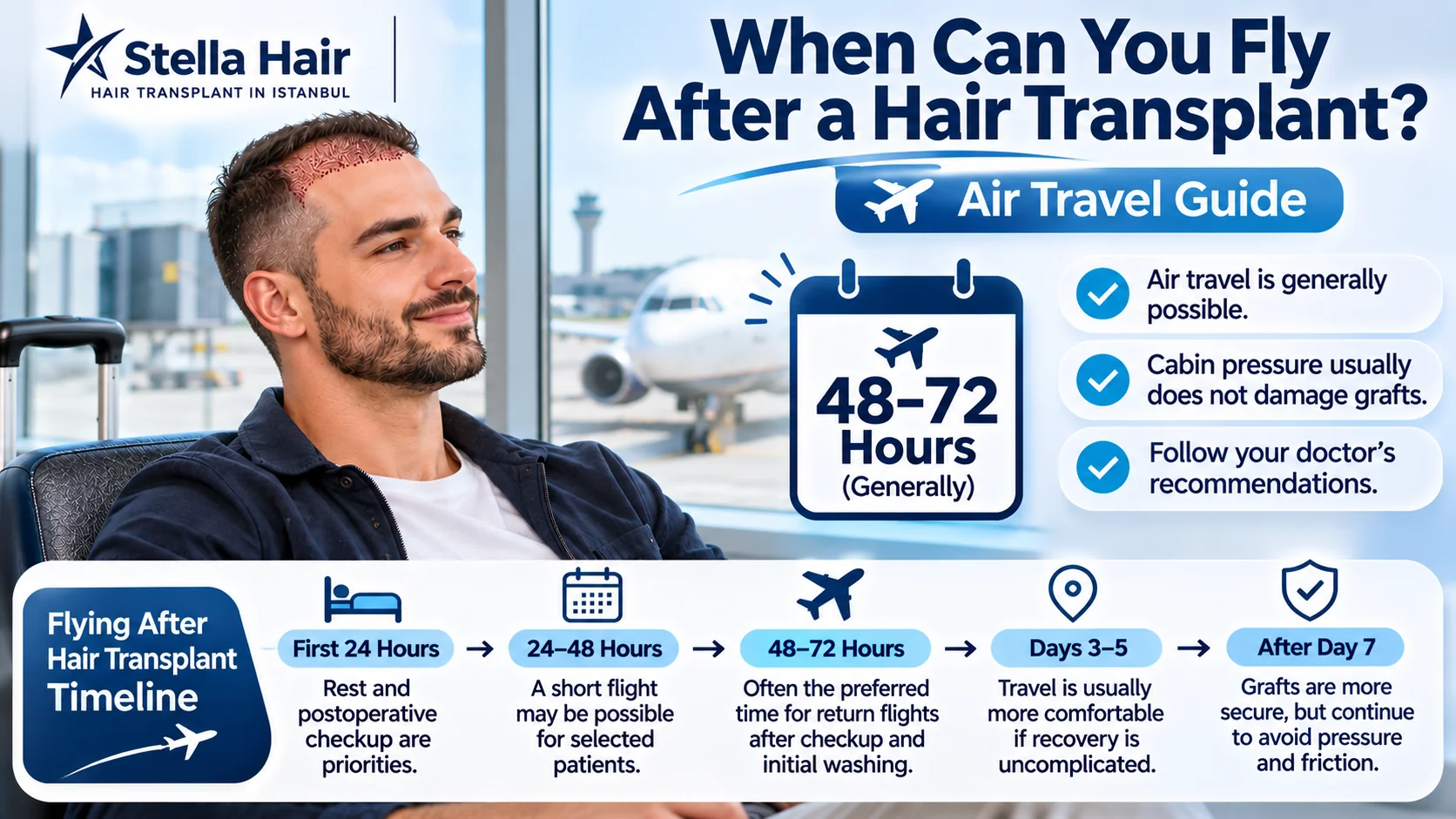
When Can You Fly After a Hair Transplant? Air Travel Guide
Flying after a hair transplant is one of the most common concerns among patients traveling to Istanbul for hair restoration surgery. International patients frequently want to know when they can return home, whether airplane cabin pressure can damage newly transplanted hair follicles, and what precautions they should take during long flights. Air travel is generally possible after hair transplantation, but the appropriate timing depends on the patient's recovery, medical condition, and postoperative care requirements. At Istanbul Stella Hair, we emphasize the importance of planning not only the surgical procedure but also a comfortable and well-organized journey home.
At Stella Hair, we recommend that patients undergoing DHI, Sapphire FUE, or completely unshaven Long DHI hair transplantation coordinate their return flights with their postoperative checkups and aftercare schedule. Although hair transplantation is commonly performed under local anesthesia, the procedure creates small surgical sites in the scalp that need time to heal. So, how soon can you fly after a hair transplant? Is it safe to fly 24 or 48 hours after surgery? Can cabin pressure affect transplanted grafts? Are long-haul flights associated with additional risks? This guide explains the recommended considerations for flying after hair transplantation, including recovery timelines, airport precautions, and travel planning for international patients.
Can You Fly After a Hair Transplant?
Yes. Air travel is generally possible after hair transplantation, provided the patient is medically fit to fly and the treating healthcare team has approved the travel plan.
Hair transplantation is a surgical procedure in which follicular units are extracted from a donor area and implanted into areas experiencing hair loss.
Most procedures are performed under local anesthesia, and many patients do not require an extended hospital stay.
However, small surgical wounds remain in the donor and recipient areas after transplantation.
These areas require time to heal.
During the first days after surgery, newly implanted grafts should be protected from direct pressure, rubbing, and accidental trauma.
When considering a flight, the main concerns are not limited to the transplanted hair follicles.
The patient's general medical condition, postoperative symptoms, medications, flight duration, and ability to complete the recommended aftercare routine should also be considered.
For these reasons, the decision to fly should not be based solely on the number of hours that have passed since surgery.
How Soon Can You Fly After a Hair Transplant?
Some patients with uncomplicated recovery may be able to fly within 24–48 hours after hair transplantation. However, many international hair transplant travel schedules allow approximately 48–72 hours for postoperative assessment and the initial washing appointment before departure.
These timeframes describe commonly used travel arrangements rather than universally established medical safety thresholds.
There is no single waiting period that has been proven appropriate for every hair transplant patient.
The recommended departure date depends on several factors:
- The extent of the hair transplant procedure
- The patient's general health
- The type of anesthesia and medications used
- The condition of the donor and recipient areas
- Whether postoperative bleeding or swelling is present
- The duration of the flight
- The availability of follow-up care after returning home
A short domestic flight and an eight-hour international journey do not necessarily involve the same considerations.
Flying After a Hair Transplant: Recovery Timeline
Time After Surgery
General Travel Considerations
First 24 hours
Rest and early postoperative assessment should take priority. Same-day travel is generally not preferred.
24–48 hours
A short flight may be possible for selected patients with medical approval.
48–72 hours
Return flights are frequently scheduled during this period after the recommended checkup and initial washing appointment.
Days 3–5
Travel planning may become more comfortable as uncomplicated recovery progresses.
Days 5–7
Early healing continues; protecting the recipient area from pressure and friction remains important.
Days 7–10
Graft anchoring generally becomes more secure, although individual recovery varies.
Days 10–14
Initial healing has progressed substantially for many patients, but personal medical considerations still apply.
Important: This timeline is a general planning reference, not a medical clearance schedule. Patients should obtain individualized advice before flying, particularly when planning long-haul travel.
Can You Fly 24 Hours After a Hair Transplant?
Flying approximately 24 hours after hair transplantation may be possible for some patients.
However, traveling the day after surgery is not always the most practical option.
During the first 24 hours, the scalp may still be tender, and some patients experience mild bleeding, swelling, or discomfort.
Certain medications administered during the procedure may also affect the patient's condition afterward.
In addition, the first postoperative checkup or washing appointment may not yet have taken place.
Before considering a flight the following day, patients should ensure that:
- Their postoperative medical assessment has been completed.
- There are no concerning signs of bleeding or complications.
- Any effects of anesthesia or sedative medication have been appropriately assessed.
- Their prescribed medications are suitable for travel.
- They understand how to protect the transplanted area during the journey.
- Their medical team has confirmed that traveling is appropriate.
Flying after 24 hours does not automatically cause graft damage.
However, rushing to the airport immediately after surgery may make postoperative monitoring and aftercare more difficult.
Can You Fly 48 Hours After a Hair Transplant?
Approximately 48 hours after a hair transplant, the early healing process is underway.
Depending on the clinic's postoperative protocol, patients may have completed their first checkup or initial washing appointment.
For this reason, some international patients plan their return flights around the second postoperative day.
However, the scalp may still be sensitive.
Patients should avoid accidental contact between the recipient area and airplane seats, luggage compartments, or other hard surfaces.
If the postoperative assessment shows uncomplicated healing, travel may be considered.
Nevertheless, the passage of 48 hours alone does not guarantee that every patient is fit to fly.
Individual health, symptoms, and flight duration remain important.
Is It Safe to Fly 3 Days After a Hair Transplant?
The third postoperative day is a commonly selected departure date in some international hair transplant travel arrangements.
By this stage, patients may have completed their first postoperative checkup and received instructions for washing and caring for their scalp at home.
However, swelling may become more noticeable around the second or third day after surgery.
Some patients develop swelling around the forehead or eyes.
Although this may be part of the expected postoperative course, it can make a long journey less comfortable.
Patients experiencing rapidly worsening swelling, severe pain, persistent bleeding, or unusual symptoms should obtain medical assessment before traveling.
A flight scheduled for day three should not take priority over the patient's recovery needs.
Does Airplane Cabin Pressure Affect Transplanted Hair Follicles?
There is no strong clinical evidence demonstrating that normal airplane cabin pressure changes directly dislodge newly transplanted hair grafts.
During transplantation, follicular units are placed into small recipient sites within the scalp.
The surrounding tissue gradually heals, allowing the grafts to become more securely anchored.
Changes in airplane cabin pressure are not equivalent to physically pulling, rubbing, or striking the transplanted area.
Therefore, the principal concern during air travel is generally not that cabin pressure will directly push hair follicles out of the scalp.
Instead, greater attention should be given to postoperative complications, accidental mechanical trauma, and the patient's overall fitness to fly.
However, direct clinical studies specifically investigating cabin pressure after hair transplantation are limited.
For this reason, it would also be inappropriate to claim that air travel is completely risk-free for every patient.
Can Flying Damage Newly Transplanted Hair Grafts?
Flying itself does not automatically damage transplanted grafts.
However, certain situations during airport travel or on the airplane may expose the healing scalp to unnecessary pressure or friction.
Clinical research on graft anchoring indicates that newly transplanted follicular units become increasingly resistant to mechanical displacement as healing progresses.
A study published in Dermatologic Surgery in 2006 found that grafts became more securely anchored during the postoperative period, with considerably greater resistance to displacement by approximately day nine under the conditions studied.
This does not mean that physical trauma becomes harmless after day nine.
Situations to Avoid While Flying
Patients should take care to avoid:
- Rubbing the transplanted area against the airplane headrest
- Accidentally striking the head against overhead luggage compartments
- Hitting the scalp while moving through narrow airplane aisles
- Wearing tight hats or headwear that press against the recipient area
- Scratching or rubbing the scalp during the flight
- Placing unnecessary pressure on the donor or recipient areas while sleeping
Particular attention should be paid when boarding, storing luggage, or resting during the journey.
Are Long-Haul Flights Risky After a Hair Transplant?
Long-haul flights may require additional medical consideration compared with short journeys.
One important issue is prolonged immobility.
Sitting for several hours without moving can increase the risk of venous thromboembolism, including deep vein thrombosis (DVT), in susceptible individuals.
The US Centers for Disease Control and Prevention (CDC) identifies long-distance travel, particularly journeys lasting more than four hours, as a situation associated with increased blood clot risk.
Recent surgery is also recognized as a potential risk factor.
However, hair transplantation is commonly performed under local anesthesia and differs considerably from major surgery.
Therefore, the risks associated with major operations should not automatically be assumed to apply at the same level to every hair transplant patient.
Nevertheless, patients with additional risk factors may require individualized assessment.
Such factors may include a previous blood clot, significant mobility limitations, certain medical conditions, or other established thrombotic risks.
Precautions During Long Flights
For patients medically cleared to travel, general recommendations may include:
- Avoid remaining completely motionless for long periods.
- Walk along the aisle periodically when it is safe and permitted.
- Move your ankles and calf muscles while seated.
- Maintain appropriate hydration.
- Follow prescribed medication instructions.
- Discuss personal blood clot risks with a healthcare professional before traveling.
Do not start aspirin, anticoagulants, or other blood-thinning medication solely to prevent travel-related blood clots without medical advice.
Patients already taking these medications should not stop or adjust them independently.
Can Flying Increase Swelling After a Hair Transplant?
Some patients experience temporary swelling around the forehead, eyes, or scalp after hair transplantation.
This may be associated with fluids used during surgery and the body's inflammatory response.
Swelling can become more noticeable during the first few postoperative days.
Long periods of sitting or travel-related fatigue may increase discomfort.
However, there is insufficient evidence to conclude that cabin pressure directly increases postoperative scalp swelling in every hair transplant patient.
It is important to distinguish between expected temporary swelling and symptoms that may indicate a complication.
Mild postoperative swelling can occur during normal recovery.
By contrast, rapidly worsening swelling, severe pain, fever, spreading redness, or unusual discharge requires medical attention.
Patients experiencing these symptoms should consult their healthcare team before boarding an airplane.
Can You Wear a Hat on a Plane After a Hair Transplant?
Some patients prefer wearing a hat during their journey home.
However, not all types of headwear are appropriate immediately after transplantation.
Tight-fitting caps or rigid headwear may place pressure on the recipient area.
During early recovery, this can create unnecessary friction against healing tissue.
Whether a hat can be worn depends on the location of the transplanted area and the stage of recovery.
Some patients may be permitted to wear specially designed loose headwear, while others may be advised to keep the scalp uncovered.
A hat should only be worn when the treating medical team has confirmed that it is suitable.
Wearing a hat is not a medical requirement for flying after hair transplantation.
What Should You Be Careful About at the Airport After a Hair Transplant?
Airports can be crowded environments involving queues, security checks, luggage handling, and movement through narrow spaces.
During the first days after surgery, patients should take precautions to avoid accidental contact with the transplanted area.
During Airport Security Checks
Avoid unnecessary contact with the scalp.
If you are wearing approved postoperative headwear, follow security personnel's instructions.
If relevant, explain your recent procedure and provide medical documentation when requested.
While Boarding the Aircraft
Be careful when walking through narrow airplane entrances and aisles.
Avoid hitting your head against doors, overhead storage areas, or other hard surfaces.
When Handling Hand Luggage
Lifting heavy luggage into overhead compartments may involve unnecessary exertion.
Patients recovering from transplantation may find it more comfortable to request assistance rather than reaching above their heads with heavy bags.
During the Flight
Avoid pressing the recipient area against the headrest.
If a neck pillow is used, it should support the head without creating excessive pressure on the donor or recipient areas.
Can You Sleep on an Airplane After a Hair Transplant?
Yes. Sleeping during a flight is not inherently harmful after hair transplantation.
However, the sleeping position matters during early recovery.
Patients should avoid allowing the transplanted area to rub against the seat, window, or other surfaces.
A suitable neck pillow may help maintain a more stable head position if recommended by the medical team.
The pillow should not press against the recently operated areas.
Patients traveling on long-haul flights should also consider the importance of moving periodically rather than remaining immobile throughout the journey.
A comfortable sleeping arrangement should take account of both scalp protection and general travel health.
Should You Wash Your Hair Before Flying Home?
The initial hair washing schedule varies between hair transplant clinics and postoperative protocols.
Some medical teams perform or recommend the first wash approximately 24–48 hours after surgery.
Other patients may receive different instructions depending on the procedure and their recovery.
For international patients, it can be useful to complete the recommended postoperative checkup and initial washing appointment before departure.
Before traveling home, patients should understand:
- When their first hair wash should take place
- Which shampoo or aftercare products they should use
- How to clean the recipient and donor areas
- Whether any topical products or sprays are prescribed
- How often each product should be used
- How to contact the clinic after returning home
Patients should not apply random cosmetic products or spray the scalp during the flight without following their medical team's instructions.
If a prescribed product must be carried on board, its packaging and quantity should comply with the airline's hand-luggage and liquid restrictions.
How Should International Patients Plan Their Return Flight From Istanbul?
Istanbul is a major destination for international patients seeking hair transplantation.
For patients traveling from another country, the timing of the surgery and return flight should be planned together.
A travel itinerary should allow sufficient time for the initial consultation, operation, postoperative assessment, and recommended washing appointment.
Flight tickets should not be selected solely on the basis of price or convenience if the schedule would interfere with necessary medical care.
Example Hair Transplant Travel Schedule in Istanbul
Day
Suggested Schedule
Day 1
Arrival in Istanbul and medical consultation
Day 2
Hair transplant procedure
Day 3
Postoperative checkup and aftercare instructions
Day 4
Return flight if the recommended first wash has been completed and the medical team approves travel
This schedule is illustrative.
It does not mean that every patient can or should depart on the fourth day.
Some patients may be cleared to travel earlier, while others may benefit from remaining in Istanbul longer.
The most appropriate schedule depends on the surgical plan, follow-up requirements, and individual medical circumstances.
Patients traveling long distances should discuss their flight duration with their medical team before surgery.
Is Flying Different After DHI and Sapphire FUE?
DHI and Sapphire FUE use different approaches during certain stages of hair follicle implantation.
However, both procedures involve extracting follicular units from a donor area and implanting them into recipient sites.
As a result, the scalp requires postoperative healing after either procedure.
There is no universally established medical rule stating that DHI patients can always fly earlier or that Sapphire FUE patients must remain at the destination for a longer period.
The following factors are more relevant when determining flight readiness:
- The extent of surgery
- The location and size of the transplanted area
- Postoperative bleeding or swelling
- Individual healing progress
- Existing medical conditions
- Prescribed medications
- Flight duration
Patients should not assume that the type of transplantation alone determines whether they are fit to fly.
Can You Fly After Completely Unshaven Long DHI Hair Transplantation?
Yes. Air travel may also be possible after completely unshaven Long DHI hair transplantation, subject to an appropriate postoperative assessment.
At Istanbul Stella Hair, our Long DHI approach is designed to preserve the existing hair length in both the donor and recipient areas.
However, maintaining hair length does not mean that the scalp has avoided surgical intervention.
Hair follicles are still extracted and implanted.
Consequently, early postoperative protection remains important.
Having longer existing hair does not guarantee that the recently transplanted area is protected against physical pressure or accidental trauma.
Patients should avoid pulling the hair, brushing aggressively, or allowing the recipient area to rub against airplane seats and other surfaces.
The appropriate timing of a return flight should be based on individual healing and medical advice, just as with other transplantation techniques.
For more information about available procedures, explore our hair transplant services in Istanbul.
When Should You Postpone Your Flight After a Hair Transplant?
In some circumstances, a planned flight should be postponed until the patient has received medical assessment.
Contact your healthcare team if you experience:
- Persistent or significant postoperative bleeding
- Severe or increasing scalp pain
- Rapidly spreading redness
- Purulent or unusual discharge
- Fever or chills
- Rapidly worsening swelling
- Significant medication side effects
- Fainting, severe dizziness, or deterioration in general health
Additional warning signs are particularly important before long-distance travel.
Unexplained swelling, pain, or warmth in one leg may require assessment for a possible blood clot.
Sudden shortness of breath, chest pain, or fainting requires emergency medical attention.
Patients experiencing these symptoms should not board a flight.
Medical safety should always take priority over travel arrangements.
Checklist Before Flying Home After a Hair Transplant
Before leaving Istanbul or another treatment destination, patients should review the following checklist:
- Has the recommended postoperative checkup been completed?
- Has the treating medical team confirmed that you are fit to travel?
- Has the initial hair wash been completed or appropriately scheduled?
- Do you have your prescribed medications and aftercare products?
- Do you understand how to protect the transplanted area during the journey?
- Have you considered the risk of accidental head contact at the airport?
- Have any personal blood clot risk factors been assessed for a long flight?
- Have you received clear washing and aftercare instructions?
- Do you have the clinic's contact details?
- Do you know where to seek medical care if a complication develops after returning home?
Preparing these details in advance can help make the journey more comfortable and reduce uncertainty during the first days of recovery.
Frequently Asked Questions
Can you fly after a hair transplant?
Yes. Flying after hair transplantation is generally possible if recovery is uncomplicated and the treating healthcare team has confirmed that travel is appropriate.
How many days after a hair transplant can you fly?
Some patients may be able to fly within 24–48 hours. Many international treatment schedules allow approximately 48–72 hours for postoperative checkups and initial washing before departure. There is no universally safe waiting period.
Can I fly 24 hours after a hair transplant?
A short flight may be possible for selected patients. However, the first day is an important period for rest, postoperative observation, and medical assessment. Travel should be approved by the treating team.
Can I fly 2 days after a hair transplant?
Some patients can travel approximately 48 hours after surgery if their recovery is uncomplicated. Completion of postoperative assessment and clear aftercare instructions are important.
Is it safe to fly 3 days after a hair transplant?
Flying around day three may be appropriate for some patients. However, swelling, discomfort, medication effects, flight duration, and individual medical risks must be considered.
Does airplane cabin pressure damage hair transplant grafts?
There is no strong clinical evidence showing that normal cabin pressure changes directly dislodge transplanted grafts. During early healing, direct mechanical pressure, rubbing, and accidental trauma are more immediate concerns.
Are long-haul flights dangerous after hair transplantation?
Long flights can involve prolonged immobility, which is associated with increased blood clot risk in susceptible people. Patients with additional risk factors should receive individualized medical advice.
Can I wear a hat on an airplane after a hair transplant?
A hat should only be worn if approved by the treating healthcare team. Tight headwear may place unnecessary pressure or friction on healing tissue.
Can I sleep during a flight after hair transplantation?
Yes. However, during early recovery, avoid resting the transplanted area against airplane seats or other hard surfaces. A suitable neck pillow may help if recommended by your medical team.
Can flying increase swelling after a hair transplant?
There is insufficient evidence that cabin pressure increases postoperative swelling in every patient. However, existing swelling may make the journey uncomfortable, and worsening symptoms require assessment.
Should I have my first hair wash before flying?
Completing the clinic's recommended first checkup and washing appointment before departure can be helpful. However, the appropriate timing depends on the individual aftercare protocol.
How long should I stay in Istanbul after a hair transplant?
Many international patients plan a stay of several days to accommodate surgery, postoperative assessment, and initial washing. Some patients may need longer follow-up. The schedule should be agreed upon with the treating team.
Can I fly earlier after DHI transplantation?
There is no universal evidence that DHI automatically permits earlier air travel than other hair transplantation methods. The patient's medical condition and healing progress determine flight readiness.
Is flying different after an unshaven hair transplant?
Completely unshaven Long DHI patients still need to protect the healing scalp. Preserving existing hair length does not eliminate postoperative travel precautions.
What should I do if I develop severe symptoms before my flight?
Contact your medical team immediately. Significant bleeding, severe pain, fever, or rapidly worsening swelling requires assessment. Chest pain, sudden breathing difficulties, or fainting requires emergency care.
Conclusion: When Is It Safe to Fly After a Hair Transplant?
When can you fly after a hair transplant? There is no single number of hours or days that can be considered safe for every patient.
Some individuals with uncomplicated recovery may be able to travel within 24–48 hours.
For many international patients, return flights are scheduled approximately 48–72 hours after surgery, allowing time for postoperative assessment and the initial washing appointment.
However, the ideal departure date depends on the patient's recovery, medical history, medications, and flight duration.
During travel, the transplanted area should be protected from direct pressure, friction, and accidental injury.
Patients undertaking long flights should also consider the effects of prolonged immobility and any personal blood clot risk factors.
At Istanbul Stella Hair, we emphasize the importance of coordinating postoperative care with return travel plans for international patients undergoing DHI, Sapphire FUE, or completely unshaven Long DHI transplantation.
Planning the journey carefully helps patients follow their recovery instructions while returning home with greater confidence.
To learn more about our procedures and treatment options, explore our hair transplant services in Istanbul.
Scientific and Medical References
- American Society of Plastic Surgeons – Hair Transplant Recovery. General postoperative recovery guidance.
- CDC – Understanding Your Risk for Blood Clots with Travel. Information about travel-associated blood clot risks.
- CDC Yellow Book – Deep Vein Thrombosis and Pulmonary Embolism. Medical considerations for long-distance travel.
- Bernstein RM, Rassman WR – Graft Anchoring in Hair Transplantation. Dermatologic Surgery, 2006. Research examining graft stability during postoperative healing.
Medical Disclaimer: This article is intended for general educational purposes only. The travel timeframes discussed are not universal medical clearance recommendations. Fitness to fly after hair transplantation should be determined by a qualified healthcare professional based on individual recovery, medical history, and travel circumstances.
