Does Donor Hair Grow Back After a Hair Transplant?
Does donor hair grow back after a hair transplant? Learn what happens to extracted follicles, how the donor area heals, and the risk of permanent thinning.
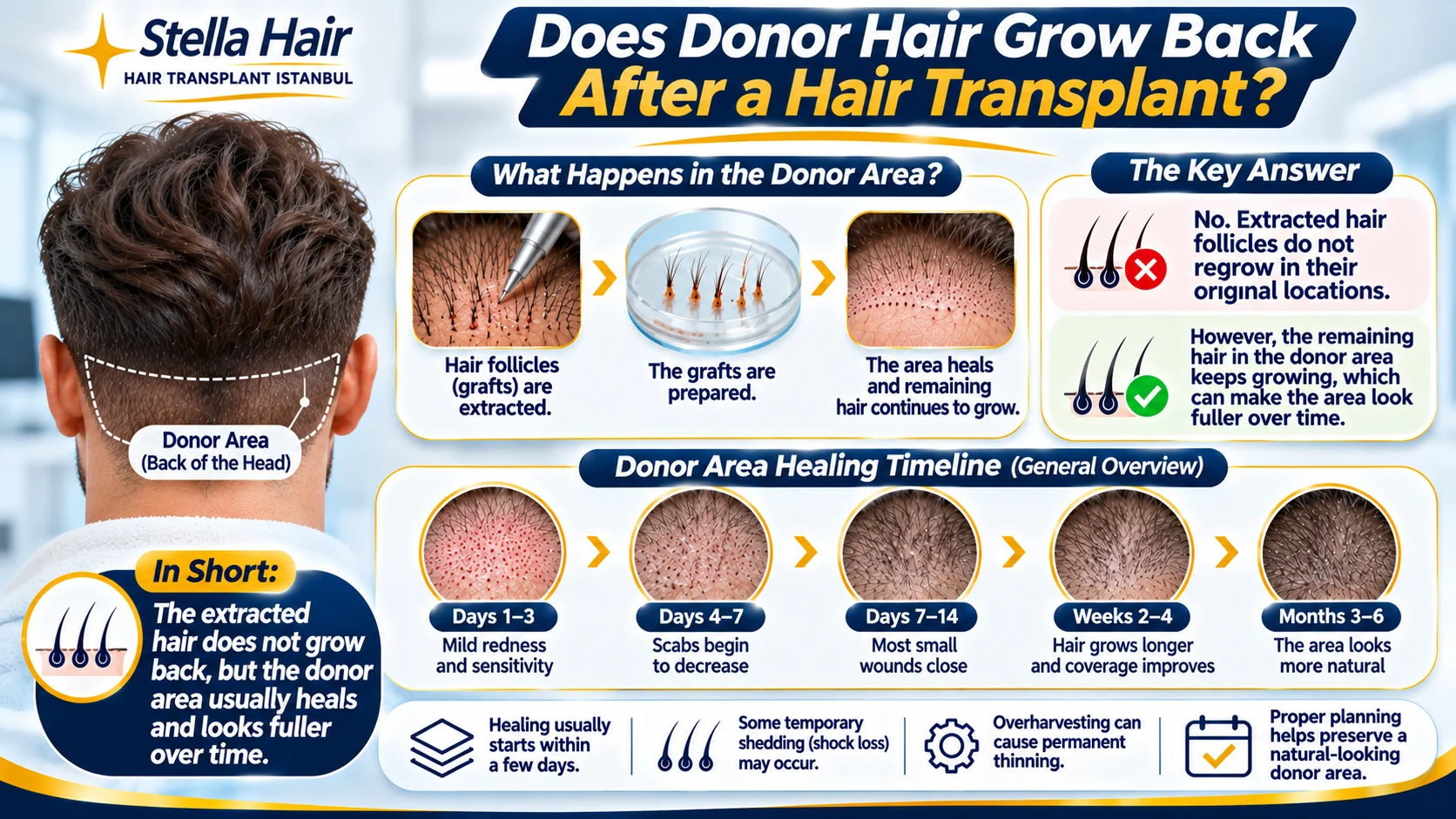
One of the most common concerns among people considering hair transplantation is whether hair removed from the donor area will grow back. Since hair follicles are typically extracted from the back and sides of the scalp, patients often wonder whether these areas will become thinner or develop permanent gaps after surgery. At Istanbul Stella Hair, we believe that protecting the donor area is just as important as achieving natural-looking coverage in the recipient area. Understanding how donor hair behaves after transplantation is an essential part of planning a successful hair restoration procedure.
At Istanbul Stella Hair, we emphasize the importance of evaluating donor hair capacity before performing a hair transplant. Hair transplantation does not create new hair follicles; instead, it relocates existing follicles from one part of the scalp to another. This means there is an important difference between extracted follicles growing back and the remaining donor hair continuing to grow. So, does donor hair grow back after a hair transplant? Why can the back of the head appear thinner after surgery? How long does the donor area take to heal, and can it return to its original appearance? In this guide, we explain what happens to the donor area following FUE and other hair transplantation procedures.
Does Hair Grow Back in the Donor Area After a Hair Transplant?
No. Hair follicles that have been completely extracted and transplanted do not normally regenerate in their original locations.
During hair transplantation, the surgeon does not simply cut the visible hair shafts. Entire follicular units are removed from the donor area and transferred to the recipient area.
Because the follicles responsible for producing those hairs have been relocated, the original extraction sites generally cannot produce the same hairs again.
However, this does not mean that every patient will develop visibly thin or patchy donor hair.
Only a portion of the available follicular units is extracted during an appropriately planned procedure.
The remaining follicles continue their normal growth cycles and produce hair.
As these surrounding hairs grow longer, they may cover the small spaces left behind by extraction.
This can make the donor area appear fuller as healing progresses.
The important distinction is:
Hair growing longer in the donor area does not mean that the extracted follicles have regenerated.
What Is the Donor Area in Hair Transplantation?
The donor area is the part of the scalp from which hair follicles are extracted for transplantation.
The most commonly used donor regions are located at the back and sides of the head.
In many patients, follicles in these areas are relatively resistant to the hormonal effects associated with hereditary pattern hair loss.
However, this does not mean that all donor hairs are permanently resistant to thinning.
Some individuals experience progressive hair loss even in regions traditionally considered suitable for donation.
For this reason, donor area assessment should include:
- Existing follicular density
- Hair shaft thickness
- Hair characteristics and growth patterns
- The size and distribution of the donor region
- Previous hair transplant procedures
- Potential future hair loss
- The number of grafts that can be safely extracted
Donor hair is a limited biological resource.
The number of grafts that can be extracted safely varies considerably between patients.
Why Does Donor Hair Appear to Grow Back After FUE?
After FUE hair transplantation, many patients notice that the back of their head gradually looks fuller.
This can create the impression that the extracted follicles have grown back.
However, the improvement is usually explained by the continued growth of follicles that were not removed.
For example, consider a donor area containing thousands of follicular units.
During surgery, only selected units are extracted.
The surrounding follicles remain in place and continue producing hair.
When the remaining hair is short, the extraction sites may be more visible.
As that hair grows longer, it can cover the small gaps between the remaining follicles.
Consequently, the donor region may look significantly denser several weeks or months after transplantation.
This improvement in appearance does not indicate that the number of follicles has returned to its original level.
How Does the Donor Area Heal After FUE Hair Transplantation?
FUE stands for Follicular Unit Excision.
During this procedure, individual follicular units are removed using specialized surgical instruments.
Each extraction creates a small wound in the donor area.
Following surgery, patients may experience temporary redness, sensitivity, and small scabs around the extraction sites.
As healing progresses, these small wounds close, and the surrounding hair continues growing.
However, extraction sites can leave small scars.
FUE does not usually create the long linear scar associated with strip harvesting, but it is not a completely scar-free procedure.
The visibility of these scars depends on several factors, including the number of extracted grafts, the surgical technique, skin characteristics, and the length of the surrounding hair.
If too many follicles are removed from a limited area, both scarring and reduced density may become more noticeable.
At Istanbul Stella Hair, we consider the preservation of donor hair an essential part of long-term hair restoration planning.
How Long Does the Donor Area Take to Recover?
The small wounds created during FUE extraction generally begin healing within the first few days.
However, the appearance of the donor region may continue changing for several weeks or months.
Donor Area Recovery Timeline
Time After Surgery
Typical Changes
Days 1–3
Mild redness, sensitivity, and visible extraction points
Days 4–7
Scabbing begins to decrease as superficial healing progresses
Days 7–14
Many small wounds close and scabs gradually disappear
Weeks 2–4
Remaining hair grows longer, improving coverage
Months 1–3
The donor area's appearance becomes more settled; temporary shedding may still be present
Months 3–6
Hair affected by temporary shock loss may show further recovery
These are general estimates rather than guaranteed recovery milestones.
Some patients may experience prolonged redness, sensitivity, or changes in scalp appearance.
It is also important to understand that healing of the extraction sites does not mean that the removed follicles have regenerated.
Is Donor Area Thinning Normal After a Hair Transplant?
A reduction in donor hair density can occur after transplantation because some follicular units have been permanently relocated.
However, how noticeable this reduction becomes depends on several factors.
These include:
- Original donor hair density
- Number of extracted grafts
- Distribution of extraction sites
- Hair shaft thickness
- Hair length
- Contrast between hair and scalp color
- Previous hair transplantation procedures
For example, a patient with naturally thick hair and high donor density may retain good visual coverage after a carefully distributed extraction.
By contrast, someone with fine hair and limited donor density may experience more visible thinning after the same number of grafts is removed.
Therefore, a particular graft count does not produce identical donor area results in every patient.
Careful extraction planning is essential.
What Happens if Too Many Grafts Are Removed?
Removing an excessive number of follicular units from the donor region is known as donor area overharvesting.
This is one of the important risks associated with poorly planned hair transplantation.
When too many grafts are extracted, the remaining hair may not provide sufficient coverage.
Overharvesting can lead to:
- Permanent thinning at the back of the head
- Increased scalp visibility
- Uneven or patchy donor hair density
- More noticeable extraction scars
- Reduced donor capacity for future procedures
Extracting too many follicles from a concentrated area may create an irregular appearance.
This is why the objective of hair transplantation should not simply be to harvest the highest possible number of grafts.
The available donor hair must be distributed carefully between current restoration needs and potential future requirements.
Is Donor Area Shock Loss Permanent?
Not always.
Some patients experience temporary shedding of existing donor hair following surgery.
This phenomenon is commonly called shock loss.
It may develop because of the temporary effects of surgical trauma on follicles that remain in the scalp.
Shock loss is different from the permanent reduction in follicle numbers caused by extraction.
With temporary shock loss, the affected follicles remain in place and may resume producing visible hair during the following months.
However, recovery is not guaranteed in every situation.
If the affected follicles were already significantly miniaturized or sustained permanent damage, the previous density may not fully return.
This is why persistent donor area thinning should be assessed individually rather than automatically attributed to temporary shedding.
Can the Donor Area Return to Its Original Density?
The donor area may recover a natural-looking appearance after transplantation.
However, it should not be expected to return biologically to the same number of follicles it contained before surgery.
Once follicular units have been completely removed, those units are no longer present in the original donor location.
The remaining hair may grow longer and provide better coverage.
Temporary shock loss may also improve over time.
These changes can make the donor region appear much fuller than it did immediately after surgery.
Nevertheless, the total follicular density has been reduced by the extraction process.
In cases involving excessive harvesting, the reduction may remain visibly noticeable.
A natural-looking donor area depends primarily on appropriate surgical planning and the preservation of sufficient remaining hair.
Will 3,000 or 4,000 Grafts Make the Donor Area Bald?
Not necessarily.
The impact of extracting 3,000 or 4,000 grafts varies according to the individual's donor capacity.
One patient may have enough donor density to accommodate a relatively large extraction while maintaining acceptable coverage.
Another patient may experience noticeable thinning after significantly fewer grafts.
Factors that influence the outcome include:
- Total donor follicle count
- Density per square centimeter
- Thickness and characteristics of the hair
- Size of the safe donor area
- Distribution of extracted grafts
- Future hair restoration requirements
This is why an identical graft count cannot be considered safe or appropriate for everyone.
A patient should not assume that a larger number of grafts automatically produces a better hair transplant.
Preserving donor capacity is especially important when future hair loss or additional transplantation may need to be considered.
Is Hair Extracted From the Donor Area During Unshaven Long DHI?
Yes.
Completely unshaven hair transplantation still involves extracting follicular units from a donor region.
The term unshaven refers to preserving the existing hair length rather than avoiding follicle extraction.
At Istanbul Stella Hair, we offer Long DHI as a completely unshaven hair transplantation procedure.
Our Long DHI approach focuses on preserving the existing hair length in both the donor and recipient areas.
However, the fact that the hair is not shaved does not mean that donor follicles remain in their original positions.
Selected follicles are still extracted and transferred to the recipient area.
As a result, donor hair capacity and extraction planning remain important considerations.
Preserving hair length and preserving the original number of donor follicles are two different things.
Patients interested in this approach can explore our Long DHI hair transplantation service for further information.
Can the Same Donor Area Be Used for a Second Hair Transplant?
In some patients, the same donor region may be used for an additional hair transplantation procedure.
However, eligibility depends on how much suitable donor hair remains after the first operation.
The initial transplantation permanently uses part of the available donor follicle supply.
Before planning another procedure, several factors should be evaluated:
- Remaining donor hair density
- Distribution of previous extraction sites
- Existing scars
- Quality of the remaining follicles
- Progression of natural hair loss
- Potential future transplantation needs
If donor capacity is insufficient, further extraction may produce unacceptable thinning.
This is why protecting the donor area during the first procedure can be important for future hair restoration options.
How Can You Protect the Donor Area After Hair Transplantation?
Postoperative care is an important part of donor area recovery.
Patients should follow the instructions provided by the healthcare professionals responsible for their procedure.
General precautions may include:
- Cleaning the donor area according to the recommended aftercare plan.
- Avoiding scratching or forcibly removing scabs.
- Protecting the scalp from unnecessary friction and pressure.
- Avoiding unapproved products during early healing.
- Attending scheduled follow-up appointments.
- Seeking medical advice if unusual symptoms develop.
Increasing pain, spreading redness, fever, or purulent discharge should be assessed promptly.
However, protecting the donor region begins before postoperative care.
The most important preventive measure is selecting an appropriate number of grafts and distributing extraction sites carefully during surgical planning.
Good aftercare cannot recreate follicles that have been permanently removed.
Frequently Asked Questions
Does hair grow back in the donor area after FUE?
Hair follicles that have been completely extracted do not normally grow back in their original locations. However, the remaining follicles continue producing hair, which can improve the donor area's appearance over time.
How long does donor area hair take to grow?
Hair that remains in the donor area continues its natural growth cycle. As it becomes longer, coverage can improve. If temporary shock loss occurs, visible recovery may take several months.
Do new follicles grow where grafts were extracted?
Normally, no. Hair transplantation relocates existing follicular units rather than creating new ones in the donor area.
Is donor area thinning permanent?
The reduction in follicle density caused by graft extraction is permanent. However, the appearance of thinning may improve as the remaining hair grows longer. Temporary shock loss may also recover.
Does FUE leave scars on the donor area?
Yes. FUE can leave small scars at extraction sites. These are often less noticeable when surrounding hair provides adequate coverage, but FUE is not entirely scar-free.
Will extracting 4,000 grafts damage the donor area?
The result depends on the patient's original donor density, hair characteristics, and extraction distribution. A graft count that may be appropriate for one patient could cause excessive thinning in another.
Can unshaven hair transplantation damage the donor area?
Unshaven transplantation still requires follicle extraction. Therefore, it can reduce donor density and create small surgical wounds. Preserving hair length does not eliminate these effects.
Does the donor area completely recover after a hair transplant?
The scalp can heal and return to a natural-looking appearance, but the original follicle count does not normally return because the extracted follicles have been relocated.
Conclusion: Extracted Donor Hair Follicles Do Not Normally Regrow
Does donor hair grow back after a hair transplant? The most important point is that completely extracted follicular units do not normally regenerate in their original locations.
Hair transplantation moves existing follicles from the donor area to the recipient area.
The remaining donor follicles continue growing hair, which may help the region appear fuller as recovery progresses.
However, the original follicular density is reduced by the extraction process.
At Istanbul Stella Hair, we emphasize donor area preservation as an essential part of responsible hair transplantation planning.
The objective should not be to extract as many grafts as possible but to create a balanced surgical plan that considers available donor hair, natural-looking coverage, and long-term restoration needs.
For more information about hair transplantation procedures, visit our hair transplant services.
Medical Disclaimer: This article is intended for general educational purposes only. Donor area assessment, graft extraction planning, and postoperative recovery should be evaluated individually by qualified healthcare professionals.
