DHI vs Sapphire FUE: Which Hair Transplant Is Better?
DHI vs Sapphire FUE: Discover the differences in implantation techniques, hair density, recovery time, benefits and suitability to help compare both methods.
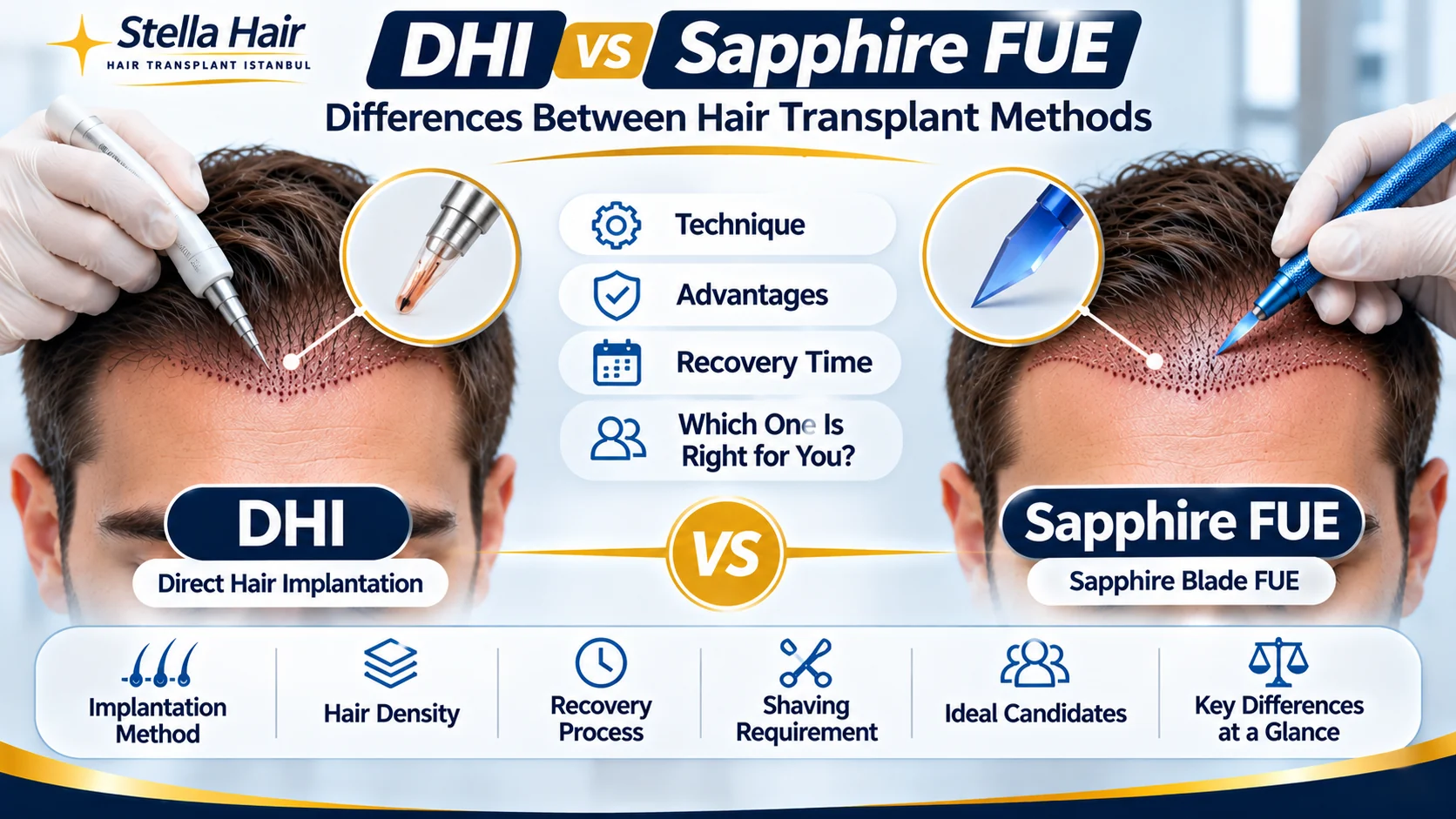
DHI vs Sapphire FUE: Which Hair Transplant Is Better?
Choosing the right hair transplantation technique is one of the most important decisions for individuals considering hair restoration. Among the available methods, DHI vs Sapphire FUE is a frequently discussed comparison. Both techniques involve transferring healthy hair follicles from a donor area to regions experiencing thinning or hair loss. However, the instruments used during implantation and the surgical workflow differ. At Istanbul Stella Hair, we believe understanding these differences is essential before making an informed decision about hair transplantation.
At Istanbul Stella Hair, we approach hair restoration planning by considering each patient's hair loss pattern, donor area density, existing hair characteristics, and long-term expectations. Rather than assuming that one technique is universally better, we focus on selecting an appropriate approach based on individual needs. So, what is the difference between DHI and Sapphire FUE? Which technique provides better hair density? Is recovery faster with one method? Can either procedure be performed without shaving? In this guide, we compare DHI and Sapphire FUE to help patients understand the characteristics of both techniques.
What Is the Main Difference Between DHI and Sapphire FUE?
The primary difference between DHI and Sapphire FUE lies in how the recipient sites are created and how hair follicles are implanted.
To understand this distinction, it is helpful to separate hair transplantation into two main stages.
The first stage involves extracting hair follicles from the donor area, typically located at the back or sides of the scalp.
Follicular Unit Excision, commonly known as FUE, is widely used for this purpose.
The second stage involves implanting the extracted follicles into areas affected by hair loss.
This is where DHI and Sapphire FUE generally differ.
- DHI: Hair follicles are implanted using a specialized implantation pen.
- Sapphire FUE: Recipient channels are prepared using sapphire-tipped blades before follicles are placed into them.
Therefore, DHI and Sapphire FUE should not be understood as two completely different follicle extraction techniques.
Both procedures may involve extracting grafts through FUE.
The difference mainly concerns the tools and techniques used during the implantation process.
What Is DHI Hair Transplantation?
DHI stands for Direct Hair Implantation.
It refers to an implantation approach in which extracted hair follicles are placed into the recipient area using a specialized implantation instrument, often called a DHI or implanter pen.
After the follicles are extracted from the donor area, they are prepared and loaded into the implantation instruments.
The practitioner then places the follicles into the planned recipient sites.
Depending on the instrument and surgical approach, recipient site creation and graft placement may occur together or involve previously prepared sites.
Key Characteristics of DHI
DHI transplantation is associated with several technical features:
- Implantation using a specialized pen-shaped instrument.
- Planning the angle and direction of implanted hair.
- The possibility of implantation between existing hair strands.
- Careful preparation and handling of extracted grafts.
- Implantation density determined by the available donor capacity and scalp characteristics.
The use of an implantation pen does not automatically guarantee better graft survival or greater hair density.
Surgical planning, follicle handling, practitioner experience, and postoperative care remain important factors.
DHI may be considered for patients with different hair loss patterns, but suitability must be assessed individually.
What Is Sapphire FUE Hair Transplantation?
Sapphire FUE is a hair transplantation approach in which follicles are commonly extracted using FUE and recipient channels are prepared using sapphire-tipped instruments.
In this technique, small openings are created in the recipient area before the extracted follicles are implanted.
The location, direction, depth, and distribution of these channels are planned according to the patient's hair characteristics and the intended result.
After the channels have been prepared, the extracted grafts are carefully placed into them.
Key Characteristics of Sapphire FUE
The procedure generally involves:
- Extracting individual follicular units from the donor area.
- Preparing recipient channels using sapphire-tipped blades.
- Planning the angle and direction of hair growth.
- Implanting the extracted follicles into the prepared channels.
- Distributing grafts according to donor capacity and recipient area requirements.
The sapphire-tipped blade is one of the defining instruments of this approach.
However, using sapphire instruments does not automatically guarantee faster healing, higher density, or better graft survival in every patient.
The final result depends on several clinical and individual factors.
DHI vs Sapphire FUE: Comparison Table
The following table summarizes the main differences between the two approaches.
Feature
DHI
Sapphire FUE
Follicle extraction
Commonly FUE
FUE
Implantation instrument
Specialized implanter pen
Grafts placed into channels prepared with sapphire-tipped blades
Recipient site preparation
May be combined with implantation
Generally performed before implantation
Hairline planning
Yes
Yes
Implantation between existing hairs
Possible in suitable patients
Possible in suitable patients
Shaving requirements
Depends on the procedure
Depends on the procedure
Recovery
Varies individually
Varies individually
New hair growth
Generally begins within several months
Generally begins within several months
Final density
Depends on donor capacity and surgical planning
Depends on donor capacity and surgical planning
Neither technique can be considered universally superior for every patient.
DHI vs Sapphire FUE: Which Is Better?
The answer depends on the patient's individual hair restoration requirements.
A person experiencing extensive baldness may have different treatment priorities from someone with mild thinning between existing hair strands.
Similarly, a patient seeking frontal hairline restoration may require a different surgical plan from someone undergoing transplantation in the crown area.
Several factors should be assessed before choosing a technique:
- The degree and pattern of hair loss.
- Available donor hair density.
- The size of the recipient area.
- Existing hair characteristics.
- Desired hairline design.
- Medical history and surgical suitability.
- Long-term hair loss expectations.
At Istanbul Stella Hair, we believe that treatment planning should be based on the characteristics of the patient rather than the popularity of a particular technique.
Both DHI and Sapphire FUE may be considered when clinically appropriate.
Does DHI Provide Better Hair Density Than Sapphire FUE?
Hair density is one of the most common concerns among individuals comparing these techniques.
Some promotional descriptions suggest that DHI always provides denser results than FUE.
However, there is no reliable basis for claiming that DHI guarantees greater hair density in every patient.
The achievable density depends on several factors.
Donor Hair Availability
Every patient has a limited number of suitable donor follicles.
Attempting to extract too many grafts may cause undesirable thinning in the donor area.
Hair Shaft Thickness
Thicker hair strands may provide greater visual coverage than finer hair strands, even when similar numbers of grafts are implanted.
Recipient Area Size
The number of follicles required depends partly on the size of the area being treated.
Larger areas may require grafts to be distributed differently to achieve a balanced result.
Hair Growth Direction
The natural appearance of a hair transplant depends not only on density but also on the direction and angle of implanted follicles.
For this reason, achieving natural-looking coverage involves more than maximizing graft numbers.
An appropriate surgical plan should balance aesthetic goals with donor area preservation and future hair loss.
Can DHI and Sapphire FUE Be Performed Without Shaving?
Shaving requirements are another important consideration for patients comparing hair transplantation techniques.
Not every standard DHI or Sapphire FUE procedure is completely unshaven.
In conventional approaches, some degree of trimming or shaving may be involved in preparing the donor or recipient area.
The amount of preparation depends on the technique and the specific surgical plan.
However, specialized procedures are available for individuals who want to preserve their existing hair length.
Completely Unshaven Long DHI at Istanbul Stella Hair
At Istanbul Stella Hair, we offer Long DHI hair transplantation as a completely unshaven procedure.
Our Long DHI approach is designed to preserve the existing hair length in both the donor and recipient areas.
Unlike conventional procedures involving hair trimming, this approach focuses on performing transplantation without cutting or shaving the patient's existing hair.
This distinction is particularly relevant for individuals who wish to maintain their current hairstyle.
Long DHI should therefore be distinguished from standard DHI procedures that may involve different hair preparation requirements.
The suitability of hair transplantation and the achievable outcome must still be assessed individually.
DHI vs Sapphire FUE: Which Has a Faster Recovery?
Recovery is an important concern for patients planning time away from work or other daily activities.
Both techniques involve extracting follicles and creating small surgical sites in the scalp.
Consequently, patients may experience similar postoperative symptoms.
Common temporary changes include:
- Redness around the donor and recipient areas.
- Mild scalp sensitivity.
- Small scabs around implanted follicles.
- Temporary forehead swelling.
- Mild postoperative edema.
- Tenderness in the donor region.
Some marketing claims suggest that Sapphire FUE always heals faster or that DHI consistently causes less trauma.
However, these outcomes cannot be guaranteed solely based on the implantation instrument.
Recovery depends on the extent of surgery, the patient's health, tissue response, surgical technique, and postoperative care.
Patients should follow the instructions provided by their treating healthcare professionals.
Scratching the scalp, forcibly removing scabs, or using unapproved products during early recovery may interfere with normal healing.
Does Hair Grow Faster With DHI or Sapphire FUE?
Both DHI and Sapphire FUE involve transplanted follicles that follow natural biological hair growth cycles.
For this reason, neither approach guarantees faster hair growth in every patient.
Temporary shedding of transplanted hair shafts may occur during the first weeks after surgery.
New hair often begins becoming visible around the third or fourth month.
During the following months, hair density and coverage may gradually improve.
Typical Hair Transplant Growth Timeline
Period
Expected Development
First month
Initial healing and temporary shedding
Months 2–3
Limited visible growth; early hairs may begin appearing
Months 3–4
New hair becomes increasingly noticeable
Months 5–6
Gradual improvements in coverage and density
Months 7–9
Further hair growth and thickening
Months 10–12
Results become substantially more established
Months 12–18
Additional maturation may occur in some patients
Individual recovery and hair growth rates vary.
Some patients may experience substantial visible improvement earlier than others.
The crown area may also require more time to achieve its mature appearance.
Do DHI and Sapphire FUE Have Different Risks?
Both approaches involve surgical procedures and therefore share several potential risks.
These may include:
- Infection.
- Bleeding.
- Delayed wound healing.
- Temporary swelling and discomfort.
- Unwanted thinning of the donor area.
- Poor graft growth.
- Unsatisfactory cosmetic results.
- Scarring or irregular hair distribution.
Using an implantation pen does not eliminate every surgical risk.
Likewise, a sapphire-tipped instrument does not automatically prevent complications.
The qualifications of the treating healthcare professionals, appropriate patient selection, and careful surgical planning remain essential.
Patients should receive clear information about the potential risks and limitations of their planned procedure.
What Should You Consider Before Choosing a Hair Transplant Technique?
Choosing between DHI and Sapphire FUE involves more than comparing the instruments used.
Patients should understand the full surgical process and the limitations of the available donor hair.
During a consultation, useful questions include:
- What is causing my hair loss?
- Is my donor area suitable for transplantation?
- How many grafts are expected to be needed?
- How will my hairline be designed?
- Will any part of my hair need to be trimmed?
- Which healthcare professionals will perform the procedure?
- What postoperative care will be required?
- What happens if my natural hair loss continues in the future?
At Istanbul Stella Hair, we emphasize evaluating these considerations when discussing hair restoration options.
The objective is not simply to choose a popular technique but to identify a suitable surgical approach based on individual needs.
Frequently Asked Questions
Is DHI better than Sapphire FUE?
Neither technique is universally better. DHI uses an implantation pen, while Sapphire FUE generally involves creating recipient channels with sapphire-tipped instruments before graft placement. Suitability depends on individual patient characteristics and surgical planning.
Is DHI the same as FUE?
Not exactly. FUE describes the extraction of individual follicular units from the donor area. DHI generally refers to a technique for implanting those follicles using a specialized pen. Both approaches may be used during the same procedure.
Does Sapphire FUE heal faster?
Sapphire FUE does not guarantee faster recovery for every patient. Healing depends on factors including the surgical approach, extent of treatment, general health, and postoperative care.
Does DHI provide greater hair density?
DHI does not automatically produce greater density. The final appearance depends on donor availability, follicle characteristics, recipient area size, and implantation planning.
Can DHI be performed without shaving?
Yes, specialized unshaven approaches are available. At Istanbul Stella Hair, our Long DHI service is designed as a completely unshaven hair transplantation procedure that preserves existing hair length.
Does hair grow faster after DHI than Sapphire FUE?
There is no guarantee that either technique produces faster growth. Transplanted follicles follow biological growth cycles, and visible growth generally develops over several months.
Which technique is more suitable for extensive hair loss?
The appropriate method depends on donor capacity, recipient area size, expected coverage, and other medical factors. Extensive hair loss does not automatically require one technique over the other.
Which technique provides more natural-looking results?
Both approaches can be used to create natural-looking results when appropriately planned and performed. Hairline design, follicle direction, hair characteristics, and surgical execution are important factors.
Conclusion: Should You Choose DHI or Sapphire FUE?
DHI vs Sapphire FUE is an important comparison for individuals researching hair restoration, but the techniques should not be evaluated solely according to their names.
DHI generally involves implanting follicles using a specialized pen-shaped instrument.
Sapphire FUE generally involves preparing recipient channels with sapphire-tipped instruments before placing the extracted follicles.
Both approaches may be suitable for different patients, and neither guarantees superior density, faster recovery, or better results in every case.
At Istanbul Stella Hair, we focus on individual hair loss characteristics, donor area preservation, natural hairline planning, and realistic long-term expectations.
Patients interested in preserving their existing hair length can also learn about our completely unshaven Long DHI approach.
Ultimately, the choice of technique should follow an appropriate medical assessment by qualified healthcare professionals.
Medical Disclaimer: This article is intended for general educational purposes only. It does not replace professional medical advice, diagnosis, or an individual assessment of surgical suitability.
